
Choosing the right bearing puller for automotive repairs depends heavily on physical clearance. While a 3-jaw bearing puller is the safer, self-centering default for open spaces, a 2-jaw puller is the indispensable problem-solver for restricted clearances. In the Philippines, where tropical humidity and road salt can heavily seize undercarriage parts, selecting the correct puller prevents costly damage to delicate shafts, pulleys, and bearing races.
How 2-Jaw and 3-Jaw Pullers Distribute Force
A mechanical bearing puller relies on a central forcing screw threaded through a yoke, linked to adjustable gripping jaws. As you turn the screw against a shaft, the jaws pull the bearing outward. The efficiency and safety of this process depend on how many jaws grip the component.
A 3-jaw puller positions its legs at equal 120-degree intervals. This triangular configuration provides a balanced, self-centering grip that keeps the forcing screw aligned with the shaft axis. In contrast, a 2-jaw puller positions its legs directly opposite each other at 180 degrees. While highly adaptable, it lacks inherent self-centering stability, requiring manual monitoring during rotation.
Products mentioned in this guide
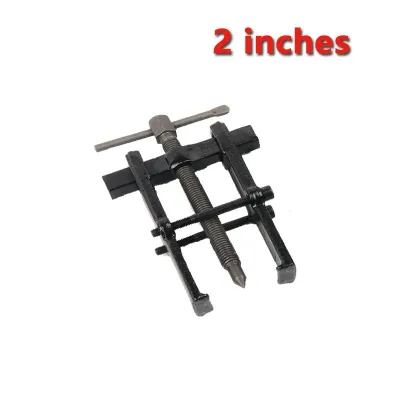
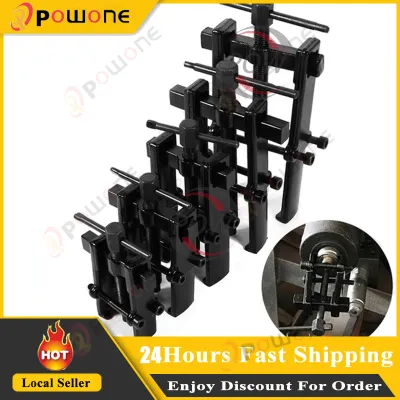
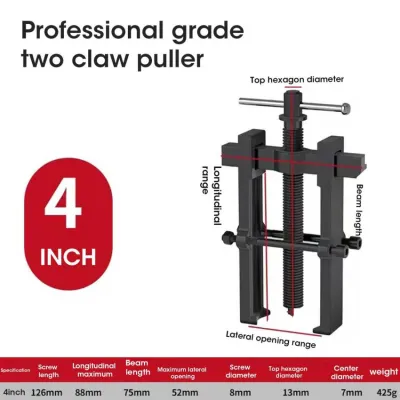
Prices are valid at publication and may change. Please refer to the product page for the latest price.
When pulling a tightly pressed component, any slight misalignment causes the forcing screw to tilt. A tilted screw exerts lateral force, which can bend the shaft, damage threads, or cause the jaws to slip off violently. By distributing the load across three points, the 3-jaw design minimizes tilting, keeping the pulling force perfectly parallel to the shaft.
When to Rely on a 2-Jaw Bearing Puller
Modern vehicle engine bays are incredibly dense, leaving very little room for tool placement. In these tight-clearance areas, a 2-jaw bearing puller is often the only tool that can physically fit.

Ideal scenarios include extracting alternator pulleys, steering column components, or tightly spaced gears where adjacent brackets or engine walls block access. For example, replacing a worn air conditioning compressor clutch or a water pump pulley in a compact car often leaves no room for a third jaw against the frame rails. A 2-jaw puller requires only a narrow, linear corridor of access across the diameter of the part.
Additionally, 2-jaw pullers excel when working with non-circular, asymmetrical, or slotted components. Parts like steering knuckles, suspension arms, or custom brackets may feature flat sides or specific slots designed for two-point pulling. Forcing a 3-jaw tool onto an asymmetrical part is dangerous, as the third jaw will not seat correctly, leading to an unstable setup.
To maximize stability when using a 2-jaw puller on a round component, ensure the jaws are positioned exactly 180 degrees apart and parallel to the forcing screw. Adjust the crossbar so the arms remain parallel, and use a centering adapter on the shaft tip to prevent the forcing screw from wandering.
The Risk of Uneven Stress and Tilting
Using a 2-jaw puller on a standard cylindrical bearing carries inherent risks. Because the force is concentrated on only two opposing points, the outer or inner bearing race is subjected to intense, localized stress. This uneven stress concentration can easily cause a hardened, brittle steel bearing race to crack or warp. Furthermore, if the bearing binds slightly on the shaft, the 2-jaw puller is highly prone to tilting. Once the tool tilts, the forcing screw can score or gall the precision-machined surface of the shaft, turning a simple bearing replacement into an expensive component repair.
Why a 3-Jaw Puller is the Default for Most Bearings
For standard cylindrical bearings, harmonic balancers, and heavy-duty pulleys, the 3-jaw bearing puller is the industry-standard default. When dealing with high-torque press fits, such as a wheel hub bearing or a crankshaft pulley, the force required to break the initial seizure can be immense.
The defining advantage of the 3-jaw design is its self-centering capability. As you tighten the forcing screw, the three jaws naturally pull inward with equal pressure, centering the screw tip on the shaft’s dimple. This automatic alignment prevents the forcing screw from sliding off the center point.
For delicate, precision-machined, or cast-iron automotive components, using a 3-jaw puller significantly reduces the risk of catastrophic part failure. Cast iron and aluminum can crack easily under uneven tension. By spreading the extraction load across three points rather than two, the 3-jaw configuration lowers the peak stress applied to any single area, ensuring a smooth, straight, and damage-free extraction.
Checking Radial Clearance Before Use
Before choosing a 3-jaw puller, you must verify that there is adequate radial clearance around the entire circumference of the target component. The bulk of three thick steel jaws requires a clear 360-degree workspace. If an alternator bracket, chassis member, or fluid line blocks even one of the three access paths, the tool cannot be seated safely. In such cases, do not try to angle or force a 3-jaw tool onto the part. You must instead switch to a slim-profile 2-jaw puller or utilize a specialized low-clearance bearing separator set to safely grip the back of the bearing.
Critical Sizing Specs: Reach, Spread, and Tonnage
Selecting the correct bearing puller involves matching the tool’s physical dimensions and mechanical capacity to the job at hand. Using an undersized tool can lead to tool breakage or severe vehicle damage. Investing in a high-quality puller set (typically ranging from ₱1,500 to ₱5,000 in local Philippine automotive supply shops) can save you from costly dealership repair bills.
- Reach (Depth) and Spread (Width): Reach is the maximum working distance from the tip of the forcing screw to the hook of the jaws, while spread is the maximum outer diameter the jaws can grip. Measure the target component before selecting a tool. The tool's rated spread must comfortably exceed the outer diameter of the bearing, and its reach must be long enough to extend past the end of the shaft.
- Tonnage and Capacity: Pulling force requirements vary drastically. A small water pump pulley or alternator bearing might require only 1 to 2 tons of force, whereas a seized front wheel hub or steering knuckle on an SUV can easily demand 5 to 10 tons of force to break free. Always check the tool manufacturer's rated capacity (typically listed in tons) and ensure it exceeds the estimated force needed. Using a light-duty DIY puller on a heavy-duty suspension component can strip the forcing screw threads or snap the jaw pins.
- Internal vs. External Pulling: Standard 2-jaw and 3-jaw pullers are designed primarily for external pulling, where the jaws hook around the outside edge of a part. If you are dealing with a pilot bearing seated inside a blind hole, standard jaws cannot grip it. For these tasks, you must use a specialized internal blind-hole puller set featuring expanding collets and a slide hammer.
Safety Rules to Prevent Part Damage and Injury
Extracting pressed-on automotive components involves handling significant mechanical forces, which can turn dangerous in an instant if a tool slips or a part fails. High-tension operations store massive amounts of kinetic energy. If a hardened steel bearing race shatters under pressure, or if a jaw slips off a pulley, metal fragments can fly off at high velocities, posing a severe risk of injury.
To maintain a safe working environment, always follow these fundamental safety protocols:
- Implement Protective Barriers: Always wrap a heavy shop towel, canvas shroud, or specialized safety cage around the puller assembly once it is tensioned. If the bearing shatters or the tool slips, the wrap will safely contain the flying debris.
- Wear Personal Protective Equipment: Never operate a bearing puller without wearing impact-rated safety glasses and heavy work gloves.
- Verify Vehicle Documentation: Before attempting to remove any major component, consult your vehicle's specific factory service manual. Verify the recommended extraction procedures, check if specialized adapters are required to protect sensitive shafts, and note any specific torque limits. If you are working on safety-critical suspension or braking assemblies and feel uncomfortable with the extraction process, seek qualified professional installation.
- Know When to Stop: If you apply significant torque to the forcing screw and the component does not budge, do not force it. Applying excessive torque can strip the tool's threads or warp the vehicle shaft. Never strike the end of the forcing screw with a heavy hammer unless the tool manufacturer's instructions explicitly permit it, as this can destroy the screw threads and damage the underlying bearings. If a part is heavily seized due to rust or tropical humidity, consider applying a high-quality penetrating oil according to its label instructions and letting it soak before attempting extraction again.
Frequently Asked Questions (FAQ)
Can I use a 2-jaw puller on a round bearing if I don't have a 3-jaw tool?
Yes, it is physically possible to use a 2-jaw puller on a round bearing, but you must proceed with extreme caution. Because a 2-jaw tool lacks the self-centering stability of a 3-jaw model, the risk of the tool tilting or slipping is significantly higher. To minimize these risks, ensure the jaws are aligned exactly 180 degrees apart and perfectly parallel to the forcing screw. Apply torque very slowly, and stop immediately if you notice the tool beginning to tilt, bind, or slip. If the bearing is tightly seized, it is always safer to wait and source a proper 3-jaw tool.
Do I need a different puller for internal vs. external bearings?
Yes, the design of the puller must match the mounting configuration of the bearing. Standard 2-jaw and 3-jaw pullers are external tools designed to grip the outer edges of a component. If the bearing is pressed into a recess or a blind hole—meaning the outer edge is completely recessed and inaccessible—you cannot use a standard external puller. Instead, you must use an internal blind-hole bearing puller set, which utilizes expanding collets that insert into the inner bore of the bearing and lock against the inner race, often paired with a slide hammer for extraction.

Community discussion
Share your experience or ask a question. Comments are reviewed before publication.