
Navigating the busy streets of Manila or driving along unlit provincial roads in the Philippines requires reliable tools to protect yourself from liability and capture unexpected road incidents. The 70mai S410 is designed to address these challenges, but understanding its technical specifications is crucial to knowing how it performs in real-world local conditions. From high-resolution recording that captures license plates in stop-and-go traffic to heat-resistant components that survive the intense tropical sun, each specification plays a specific role. Evaluating these features against the unique demands of local roads helps you determine if this dashcam fits your daily driving needs.
A dashcam is only as useful as the evidence it provides during an insurance claim or a traffic dispute. On local roads, where traffic rules are often contested and road conditions vary wildly, having clear, uninterrupted footage can save you from costly legal battles. By examining the core technical parameters of the 70mai S410, you can make an informed decision on whether its capabilities align with your daily commute and safety requirements.
Resolution and License Plate Readability in Heavy Traffic
When driving through congested areas like EDSA or C5, having a dashcam with clear resolution is essential for documenting minor fender-benders and identifying license plates. When reviewing the 70mai S410, you should check the official video resolution and frame rate listed in the product manual. A higher resolution, such as 2K or 3K, increases pixel density, which allows you to zoom in on digital footage to read distant license plates or vehicle decals. However, resolution alone does not guarantee a clear image when vehicles are moving. Frame rate and shutter speed are equally critical; a standard 30 frames per second (fps) is generally sufficient for slow-moving traffic, but fast-moving vehicles may require higher frame rates to minimize motion blur.
Products mentioned in this guide
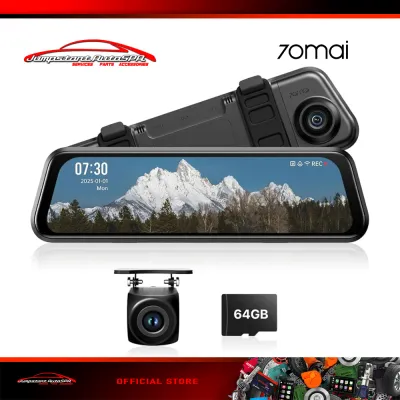
![[2026 New] 70mai S410 Mirror Dash Cam Set | Front and Rear | Touch Screen | Reverse Assistance | 2.5K](https://img.lazcdn.com/g/p/2e284b4d189b36c82fbbd60295f00100.jpg_400x400q80.jpg_.webp)
Prices are valid at publication and may change. Please refer to the product page for the latest price.
Another factor to consider is how high-resolution recording impacts your storage. Capturing video at maximum resolution generates larger files, which quickly consumes space on your microSD card. If you frequently embark on long drives across provinces, you must balance the desire for maximum clarity with the physical limits of your storage card. To manage this, look for video compression settings in the companion mobile app, which can help optimize file sizes without severely degrading the visual details needed for insurance claims.
Night Vision Capabilities for Poorly Lit Streets
Many roads in the Philippines, especially secondary streets and provincial highways, suffer from poor illumination or a complete lack of streetlights. To assess how the 70mai S410 handles these dark environments, you must look closely at its hardware specifications, specifically the sensor type and the lens aperture. The aperture is represented by an F-stop value, such as F1.8 or F2.0; a lower number indicates a larger opening that allows more light to reach the sensor. A larger aperture is vital for capturing clear footage when your only light sources are your own headlights and distant storefronts.

In addition to physical aperture size, check if the device features Wide Dynamic Range (WDR) or High Dynamic Range (HDR) technology. These software and hardware integrations help the camera balance extreme lighting contrasts, such as the glare from oncoming high-beam headlights or sudden transitions when entering and exiting dark underpasses. Keep in mind that actual night clarity is also heavily influenced by external factors. A dirty windshield or dashboard reflections can severely degrade night footage, so keeping your glass clean is just as important as having advanced low-light sensors.
Field of View for Navigating Chaotic Intersections
Navigating chaotic intersections, where motorcycles, tricycles, and pedestrians frequently merge from unexpected angles, requires a wide field of view (FOV). The stated FOV of a dashcam determines how much of the road ahead and to the sides is captured in the frame. When evaluating the 70mai S410, verify whether the manufacturer measures the FOV diagonally or horizontally, as diagonal measurements often sound wider but cover less horizontal road space. A wider angle helps document sudden cut-offs from adjacent lanes, which is common in tight city traffic.
However, a wider field of view comes with a trade-off known as the “fish-eye” effect. Extremely wide angles can distort the edges of the video, making distant objects appear smaller and harder to identify, which can compromise your ability to read license plates. To get the best results, position the dashcam high on your windshield, preferably behind the rearview mirror. This placement ensures that the camera captures the hood of your vehicle as a reference point while minimizing blind spots immediately in front of your bumper.
Heat Tolerance and Storage Specs for Tropical Conditions
The tropical climate of the Philippines presents a significant challenge for windshield-mounted electronics. Cabin temperatures can rise rapidly when a car is parked under direct sunlight, easily exceeding normal operating limits. When choosing a dashcam like the 70mai S410, it is crucial to check the manufacturer’s specified operating and storage temperature ranges. Devices that utilize a supercapacitor instead of a traditional lithium-ion battery are generally much better suited for hot climates, as supercapacitors do not degrade or swell under extreme heat, significantly reducing safety risks.
If you plan to use parking surveillance features to monitor your vehicle while it is parked in open lots, you will need to install a compatible hardwire kit. This kit connects the dashcam directly to your car’s fuse box, enabling continuous recording even when the engine is off. Ensure the hardwire kit includes a low-voltage protection feature, which automatically cuts power to the dashcam if your car battery drops below a certain threshold, preventing you from being stranded with a dead battery. Additionally, continuous loop recording requires a high-endurance microSD card. Standard memory cards can quickly fail under the constant write cycles and high heat, so verifying the maximum supported capacity and using a card rated for continuous surveillance is essential to prevent file corruption. Regular formatting via the mobile app will also help maintain storage health.
Frequently Asked Questions (FAQ)
Does the 70mai S410 require a specific type of memory card?
Yes, the dashcam requires a high-endurance microSD card designed specifically for continuous loop recording. Standard memory cards often fail prematurely under the constant write cycles and high operating temperatures inside a vehicle. You should check the official product manual to verify the maximum supported storage capacity and the recommended speed class, which is typically Class 10, U3, or V30. To ensure stable performance and prevent recording errors, always format the new memory card directly within the dashcam’s settings or its companion mobile app before using it for the first time.
Can the dashcam withstand direct sunlight on the windshield?
Windshield-mounted devices are subjected to intense heat and ultraviolet radiation, especially when parked outdoors in tropical climates. To determine if the dashcam can withstand these conditions, verify whether the model uses a supercapacitor or a lithium battery, as supercapacitors offer superior thermal resistance and safety. Always check the manufacturer’s specified operating temperature limits in the user manual. To protect the device from excessive heat buildup, mount it directly behind the rearview mirror where the windshield’s black ceramic dots or sun visor can provide partial shade.

Community discussion
Share your experience or ask a question. Comments are reviewed before publication.