
If your vehicle lacks built-in Bluetooth connectivity, modernizing your dashboard audio does not require installing an expensive aftermarket head unit. Two highly accessible devices can bridge the gap: a Bluetooth auxiliary (AUX) receiver and an FM transmitter car charger. Both options allow you to stream music and make hands-free calls from your smartphone, but they use entirely different signal paths to deliver audio to your car speakers.
Choosing the right device depends on your vehicle’s physical ports and your personal priorities. A Bluetooth AUX receiver is the superior choice for drivers who demand high-fidelity, static-free audio and have a functioning 3.5mm auxiliary port in their vehicle. Conversely, an FM transmitter car charger is the ideal all-in-one solution if your car lacks an AUX port, as it provides universal compatibility through your car’s radio waves while simultaneously offering high-speed charging ports for your mobile devices.
Understanding the Basics: How Each Technology Works
To make an informed decision, it is essential to understand how these two devices handle the wireless signal from your smartphone. While both rely on Bluetooth to connect to your phone, they diverge completely when transferring that audio signal to your vehicle’s factory sound system.
Products mentioned in this guide
Prices are valid at publication and may change. Please refer to the product page for the latest price.
A Bluetooth AUX receiver acts as a direct bridge. It receives digital audio packets from your phone via Bluetooth, converts them into an analog electrical signal using an internal digital-to-analog converter (DAC), and sends that signal directly into your car’s stereo system through a physical 3.5mm auxiliary cable. Because the connection from the receiver to the head unit is entirely wired, the signal remains shielded from external wireless interference.
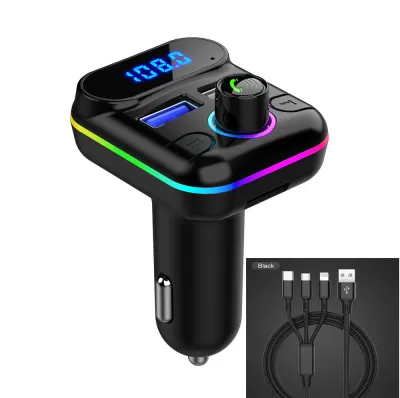
An FM transmitter car charger operates on a more complex wireless path. It plugs directly into your vehicle’s 12V cigarette lighter socket, draws power, and pairs with your phone via Bluetooth. Instead of using a wire to connect to your stereo, it converts the audio signal into a low-power FM radio broadcast. You must tune your car’s FM radio to a matching, unused frequency to hear the audio. The signal travels through the air, is picked up by your car’s external antenna, and is processed just like a local radio station.
Audio Quality: Direct AUX Connection vs. FM Broadcast
For most drivers, sound quality is the primary differentiator when comparing these two technologies. The physical medium used to transport the audio signal from the adapter to your car’s speakers plays a massive role in the final listening experience.

Bluetooth AUX receivers preserve audio fidelity by avoiding over-the-air radio transmission. Because the analog signal travels through a shielded copper cable directly into the auxiliary input, there is no compression beyond the standard Bluetooth codec. This direct path delivers a full dynamic range, resulting in deep, punchy bass, clear mid-tones, and crisp high frequencies. There is no background hiss, static, or electrical hum, making it the preferred choice for music enthusiasts who appreciate clear instrument separation.
FM transmitters face significant inherent audio limitations due to the nature of FM broadcasting. To transmit audio over radio frequencies, the signal must be modulated and compressed, which naturally caps the frequency response and limits the dynamic range. This compression often results in a flatter sound profile, where subtle details in your music are lost, and the bass response can feel muddy or hollow.
Furthermore, FM transmitters are highly susceptible to radio frequency interference. In densely populated urban areas, such as Metro Manila, the FM radio spectrum is incredibly crowded with commercial broadcast stations. Finding a completely empty frequency can be a challenge. As you drive past high-rise buildings, power lines, or other vehicles using similar transmitters, you will likely encounter static, signal drift, and cross-talk from competing radio signals.
Volume levels also differ significantly between the two setups. FM transmitters often broadcast at a lower line-level output than standard radio stations or CD players. To compensate, you must turn up your car stereo’s volume knob much higher than usual. This amplification of the car’s native audio system can introduce a noticeable background hiss, especially during quiet segments of a song or podcast. An AUX receiver, on the other hand, matches standard line-level inputs, allowing you to use your car’s volume controls naturally without introducing artificial noise.
Charging Capabilities and Car Charger Convenience
Beyond pure audio performance, daily usability and power management are critical factors to consider. This is where the physical design of an integrated car charger provides a distinct practical advantage.
An FM transmitter car charger is designed from the ground up as a multi-functional power hub. Because it plugs directly into your vehicle’s 12V accessory socket, it has direct access to the car’s electrical system. Manufacturers utilize this physical space to build robust charging ports directly into the body of the transmitter. Many models feature multiple USB-A and USB-C ports that support fast-charging protocols like Power Delivery (PD) or Quick Charge (QC), allowing you to keep your smartphone, dashcam, or tablet powered up without needing extra adapters.
In contrast, a Bluetooth AUX receiver does not charge your phone. In fact, the receiver itself requires a constant external power source to function. This means you must run a USB power cable from the receiver to a separate USB port in your car or to a dedicated car charger plugged into your 12V socket. If your vehicle’s built-in USB ports are older, they may only output a meager 0.5 amperes, which is barely enough to power the receiver and will not charge a modern smartphone efficiently. Running multiple cables for power and audio can quickly lead to an untidy, cluttered dashboard.
Physical controls also impact convenience. Many FM transmitters feature large, tactile buttons, physical rotary dials for volume adjustment, and integrated LED displays that show the current radio frequency or vehicle battery voltage. They also feature built-in microphones positioned on the unit itself, making hands-free calling straightforward. AUX receivers are typically much smaller and more minimalist, often lacking physical track-skipping buttons or incorporating tiny microphones that may struggle to pick up your voice clearly if the AUX port is located deep inside a glove box or center console.
When choosing any 12V accessory, safety should be your top priority. Always check the rated wattage output of any car charger ports to ensure they match your smartphone’s fast-charging specifications. Avoid uncertified, ultra-cheap 12V adapters, as they often lack proper internal fuses and voltage regulation. In tropical climates with high ambient temperatures, low-quality electronics left in a hot car can overheat, potentially damaging your vehicle’s electrical system or your phone’s battery. Look for reputable brands with safety certifications such as CE, FCC, and RoHS.
Vehicle Compatibility: What Does Your Car Support?
Before purchasing either device, you must diagnose your vehicle’s physical layout and existing hardware. Compatibility is not universal, and your car’s interior design will dictate which option is physically viable.
To use a Bluetooth AUX receiver, your car must have a functioning 3.5mm auxiliary input jack. While highly common in vehicles manufactured between 2005 and 2015, some older models lack this port entirely. Conversely, some modern vehicles have phased out the 3.5mm jack in favor of proprietary USB connections or native Bluetooth. If your car does not have an AUX port, a Bluetooth receiver is completely unusable without installing an expensive aftermarket adapter.
To use an FM transmitter, your vehicle must have an accessible 12V cigarette lighter socket and a working AM/FM radio receiver. While almost all cars have a 12V socket, their physical placement varies wildly. If your socket is located inside the center console armrest or tucked deep under the lower dashboard, a bulky FM transmitter may not physically fit, or its built-in microphone will be muffled, rendering hands-free calling useless. Additionally, if your car’s physical radio antenna is broken or disconnected, an FM transmitter will suffer from severe, constant static.
Physical space and dashboard aesthetics are also worth noting. A bulky FM transmitter can block access to nearby climate control knobs, cup holders, or your gear shifter. A Bluetooth AUX receiver is typically much smaller—often no larger than a USB flash drive—and can easily be tucked away out of sight, keeping your dashboard clean and retaining the original aesthetic of your vehicle’s interior.
Feature Comparison at a Glance
| Feature | Bluetooth AUX Receiver | FM Transmitter Car Charger |
|---|---|---|
| Audio Quality | High-fidelity, direct, and clear | Compressed, prone to static and hiss |
| Phone Charging | No (requires a separate charger) | Yes, features built-in USB ports |
| Power Source | Requires separate USB power cable | Plugs directly into 12V socket |
| Car Requirement | 3.5mm AUX input port | 12V accessory socket and FM radio |
| Hands-Free Calling | Dependent on receiver or phone mic | Integrated microphone on unit |
| Interference Risk | None (fully wired connection) | High (especially in urban areas) |
The Decision Framework: Which Setup Should You Choose?
To determine the best audio upgrade path for your daily commute, evaluate your vehicle’s physical limitations and your listening preferences against this structured framework.
Choose a Bluetooth AUX Receiver if…
- Your vehicle has an easily accessible, functioning 3.5mm auxiliary port.
- High-fidelity, static-free music playback is your absolute highest priority.
- You want a clean, minimalist dashboard setup without bulky adapters blocking your controls.
- You already own a dedicated, high-quality multi-port car charger to keep your phone powered.
Choose an FM Transmitter Car Charger if…
- Your vehicle lacks a 3.5mm auxiliary port but has a working AM/FM radio and antenna.
- You want an all-in-one device that handles both audio streaming and high-speed device charging.
- You prefer physical, tactile buttons on your dashboard to skip tracks and manage phone calls safely while driving.
- You are willing to accept minor audio compression and occasional static in exchange for universal compatibility.
Neither may fit if…
- Your car's 12V socket is broken or located in an entirely inaccessible position, such as the trunk.
- Your vehicle already features native Bluetooth audio support, in which case you only need a standard, high-quality car charger to power your mobile devices.
Verify first if…
- Your 12V socket remains powered even when the car's engine is turned off, as some vehicles keep this circuit live, which can lead to battery drain if accessories are left plugged in.
- Your car's AUX port is clean and free of debris by testing it with a standard pair of wired headphones before purchasing a receiver.
- The device you are purchasing supports Bluetooth 5.0 or higher, which ensures a more stable wireless connection, faster auto-reconnection, and lower battery consumption for your smartphone.
Frequently Asked Questions (FAQ)
Can I use an FM transmitter and a Bluetooth receiver at the same time?
Using both devices simultaneously is redundant and will cause technical conflicts. Because both devices function as Bluetooth audio sinks, your smartphone can generally only stream media audio to one Bluetooth connection at a time. Trying to connect to both will force you to manually select the output source in your phone’s settings, and it can cause pairing loops or audio stuttering. If you want the fast-charging capabilities of a dedicated car charger but prefer the clean audio quality of an AUX connection, the correct approach is to purchase a standard multi-port car charger alongside a standalone Bluetooth AUX receiver, rather than combining an FM transmitter with a receiver.
Will leaving an FM transmitter plugged in drain my car battery?
Whether an FM transmitter drains your battery depends entirely on how your vehicle’s 12V accessory socket is wired. In many Japanese and Korean vehicles, the 12V socket is switched, meaning it loses power completely the moment you turn the ignition key to the off position or lock the doors. However, in many European and American vehicles, the 12V socket remains constantly active. If your socket is always live, an FM transmitter will continue to draw a small amount of electrical current to power its LED screen and search for Bluetooth connections. Over several days of parking, this parasitic draw can weaken your car battery. If your 12V socket remains active when the engine is off, it is highly recommended to unplug the transmitter when parking overnight.
How do I fix static or interference on my FM transmitter?
If you are experiencing static or background hiss on your FM transmitter, you can improve the signal quality by taking a few low-risk troubleshooting steps. First, scan your car radio manually to find a frequency that has absolutely no broadcast signal—only pure, loud static. Frequencies at the very ends of the FM band, such as 87.5 MHz or 107.9 MHz, are often the least crowded and make excellent targets. Once you find a dead frequency, match your FM transmitter to that exact number. Second, ensure the transmitter is pushed firmly into the 12V socket, as a loose connection can introduce electrical noise from your vehicle’s alternator. Finally, route any trailing charging cables away from the transmitter’s body, as these cables can act as accidental antennas and introduce electromagnetic interference.
Community discussion
Share your experience or ask a question. Comments are reviewed before publication.