
Choosing the correct brake fluid is one of the most critical maintenance decisions you can make for your vehicle’s safety and operational integrity. The braking system relies on hydraulic pressure to transfer the force of your foot on the pedal directly to the brake calipers, squeezing the pads against the rotors to slow your vehicle. Because brake fluid is the medium through which this immense force is transmitted, its chemical stability, boiling point, and viscosity directly dictate how reliably your vehicle stops.
When comparing Brembo DOT3 and DOT4 brake fluid, the decision is not about finding a universal “winner” or a generic upgrade. Instead, the correct choice is determined entirely by your vehicle manufacturer’s original equipment manufacturer (OEM) specifications. Deviating from these engineered requirements can compromise your stopping power, damage internal components, or lead to catastrophic brake failure under demanding driving conditions.
Quick Answer: Which Brembo Brake Fluid Should You Use?
To determine whether to use Brembo DOT3 or DOT4 brake fluid, you must first consult your vehicle’s owner’s manual or examine the embossed text on the master cylinder reservoir cap. Your vehicle’s braking system was engineered, calibrated, and safety-tested around a specific fluid standard, and this manufacturer specification is the ultimate authority.
Products mentioned in this guide
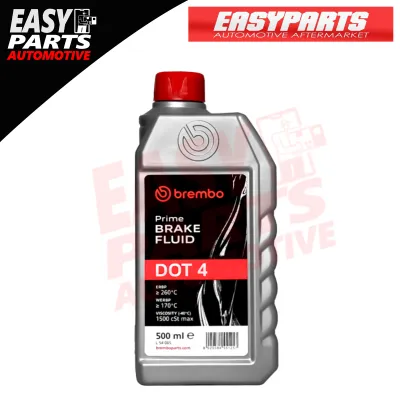
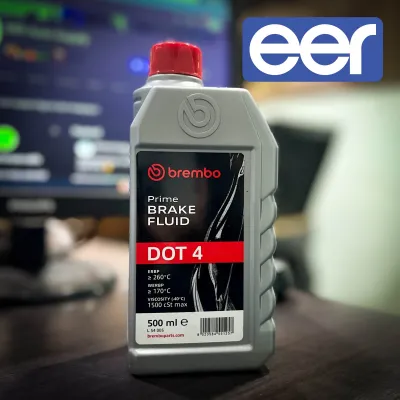
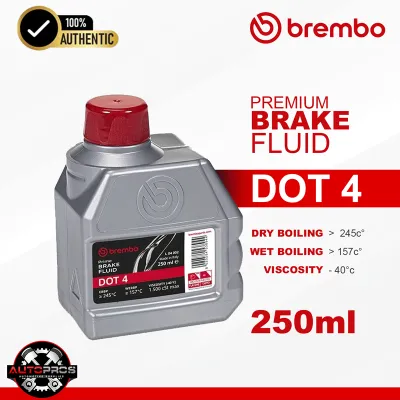
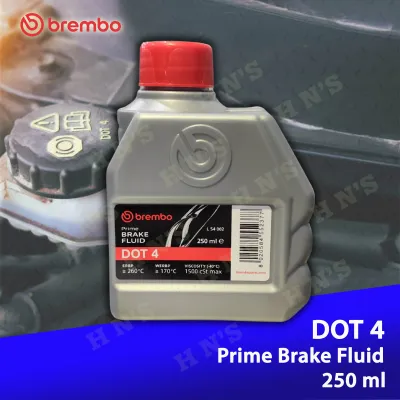
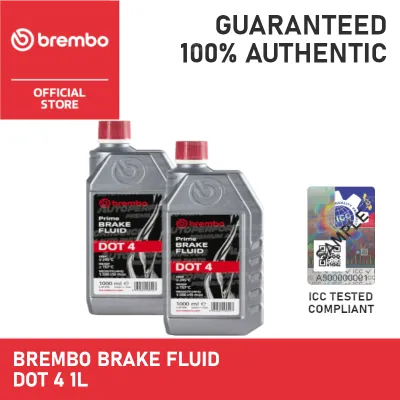
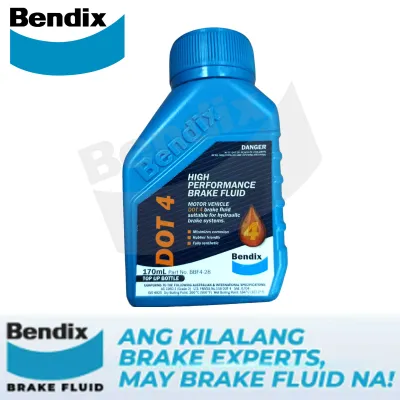
Prices are valid at publication and may change. Please refer to the product page for the latest price.
As a general rule, Brembo DOT4 brake fluid offers higher dry and wet boiling points than DOT3, making it better suited for modern vehicles, heavier loads, and demanding driving environments where extreme heat is generated. Brembo DOT3 fluid serves as the standard baseline formulation, optimized for older or less demanding braking systems that do not experience extreme thermal stress.
If your manufacturer specifies DOT4, you must never use DOT3, as doing so lowers the boiling point of your hydraulic system below safe operating limits. If your vehicle specifies DOT3, upgrading to DOT4 is often chemically possible but requires careful verification of system compatibility, rubber seal tolerances, and ABS calibration. Because the braking system is a critical safety component, always prioritize matching the exact engineering requirements of your vehicle over generic performance promises.
Understanding DOT3 and DOT4 Brake Fluid Standards
Brake fluids are classified under strict international safety standards to ensure consistent performance across different brands and formulations. The most common classification system is the Department of Transportation (DOT) rating, which is defined by the Federal Motor Vehicle Safety Standard (FMVSS) No. 116. These standards mandate specific physical and chemical properties that a fluid must meet to be certified for road use.

Both DOT3 and DOT4 brake fluids are glycol-ether-based hydraulic fluids. A key chemical characteristic of glycol-ether formulations is that they are highly hygroscopic. This means they naturally and continuously absorb moisture from the surrounding atmosphere over time. In a tropical climate like the Philippines, where high relative humidity is a constant environmental factor, this moisture absorption occurs steadily through microscopic pores in flexible rubber brake hoses, master cylinder reservoir vents, and rubber seals.
To address this inevitable moisture contamination, FMVSS 116 establishes two primary performance benchmarks for brake fluids:
- Dry Boiling Point: The temperature at which fresh, uncontaminated brake fluid directly from a newly opened, sealed container begins to boil.
- Wet Boiling Point: The temperature at which the fluid begins to boil once it has absorbed approximately 3.7% water by volume, representing the typical moisture level of fluid that has been in service for several years.
The minimum regulatory standards for these classifications are clearly defined:
- DOT 3: Minimum dry boiling point of 205°C (401°F) and a minimum wet boiling point of 140°C (284°F).
- DOT 4: Minimum dry boiling point of 230°C (446°F) and a minimum wet boiling point of 155°C (311°F).
While premium options like Brembo brake fluid are engineered to exceed these minimum safety thresholds, you must always check the exact product label of the fluid you are purchasing to verify its precise technical specifications and performance ratings.
Key Differences Between Brembo DOT3 and DOT4
While both fluids share a glycol-ether base, their distinct chemical formulations result in measurable differences in thermal stability, viscosity, and long-term maintenance requirements. Understanding these differences allows you to make an informed decision based on your driving habits and vehicle requirements.
Boiling Point and Vapor Lock Resistance
When you apply your brakes, the friction between the brake pads and rotors generates intense thermal energy. This heat is transferred directly to the brake calipers and the hydraulic fluid sitting behind the caliper pistons. If the fluid’s temperature rises above its boiling point, the liquid turns into gas, creating bubbles within the brake lines.
This phenomenon is known as vapor lock, and it represents a severe safety hazard. Because gas is highly compressible—unlike liquid—pressing the brake pedal on a system experiencing vapor lock will simply compress the gas bubbles rather than pushing the caliper pistons. This results in a soft, “spongy” brake pedal and a sudden, dangerous loss of stopping power.
Brembo DOT4 brake fluid provides significantly higher resistance to vapor lock than DOT3 due to its superior wet boiling point. This added thermal margin is highly valuable when navigating steep, winding descents such as Kennon Road or Marcos Highway in Baguio, or when driving in the dense, stop-and-go traffic of Metro Manila, where constant braking generates sustained heat with very little cooling airflow.
Viscosity and Electronic Braking Systems
Viscosity refers to the thickness or resistance to flow of the fluid. In modern vehicles equipped with advanced electronic safety systems—such as Anti-lock Braking Systems (ABS), Traction Control Systems (TCS), and Electronic Stability Programs (ESP)—fluid viscosity is a critical safety parameter.
These electronic systems function by rapidly opening and closing micro-valves within the ABS hydraulic actuator, pulsing the brakes dozens of times per second to prevent wheel lockup and maintain steering control. For these valves to actuate with the precise speed required by the vehicle’s computer, the brake fluid must maintain a specific flow rate, even under extreme temperature variations.
Standard DOT4 fluid is chemically formulated to be slightly more viscous than DOT3 at extremely low temperatures. However, to accommodate modern safety systems, many premium DOT4 formulations are specifically engineered with low-viscosity characteristics. If your vehicle’s manufacturer specifies a low-viscosity fluid (often labeled as DOT 4 LV, Class 6, or ISO 4925 Class 6), you must verify that the specific Brembo fluid you select matches this requirement to ensure your ABS and ESP systems function correctly.
Moisture Absorption and Maintenance Intervals
Because DOT4 brake fluids often incorporate borate esters in their chemical composition to achieve higher boiling points, they handle moisture absorption differently than standard DOT3 fluids. While DOT4 is highly effective at neutralizing the immediate impact of water contamination, its dry boiling point drops more sharply as moisture levels rise.
This chemical behavior means that a vehicle utilizing DOT4 fluid requires strict adherence to scheduled maintenance intervals to preserve its thermal advantages. Over time, as the fluid absorbs moisture from the humid atmosphere, the performance gap between DOT4 and DOT3 narrows. If you neglect your fluid service intervals, the safety margins provided by a premium DOT4 fluid will degrade, leaving your braking system vulnerable to high-temperature failure.
Vehicle Compatibility and Safety Boundaries
Before purchasing any Brembo brake fluid, you must establish clear safety boundaries based on your vehicle’s design. The braking system is the single most important safety mechanism on your vehicle, and any modification or maintenance action must be performed with absolute precision.
Your primary source of truth is always the vehicle manufacturer’s original documentation. Locate your owner’s manual or inspect the master cylinder reservoir cap under the hood to identify the required fluid standard. If your vehicle documentation specifies DOT4, you must never use DOT3 under any circumstances. Using a lower-spec fluid compromises the thermal limits of the system, creating an immediate risk of brake failure during heavy braking.
Conversely, if your vehicle specifies DOT3, upgrading to DOT4 is generally chemically compatible because both are glycol-ether-based. However, this transition is not universally guaranteed for every vehicle model. Some older braking systems utilize internal rubber seals, hoses, and master cylinder components that were formulated specifically for the chemical properties of DOT3. Introducing the different additive packages found in DOT4 can, in some cases, accelerate seal wear or cause minor swelling, leading to internal leaks over time.
Furthermore, before making any purchase, you must verify your specific vehicle model, year, and braking interface against the product documentation. If your owner’s manual is missing, the markings on your reservoir cap are illegible, or your vehicle has been modified with aftermarket braking components (such as upgraded multi-piston calipers), stop immediately. Do not attempt to guess the correct fluid. Consult a qualified automotive professional or contact the component manufacturer directly to verify compatibility.
Additionally, keep in mind that brake fluid is highly corrosive. It can quickly damage your vehicle’s paint, clear coat, and certain plastics upon contact. Always handle the fluid with extreme care, use appropriate protective equipment, and follow the label-authorized instructions precisely.
Can You Mix or Upgrade from DOT3 to DOT4?
Understanding how these fluids interact when combined or transitioned is essential for maintaining system safety and avoiding costly mechanical damage.
Mixing DOT3 and DOT4 in the Same System
Because both DOT3 and DOT4 are glycol-ether-based fluids, they are chemically miscible. This means that if you mix them, they will physically blend together without separating, gelling, or causing an immediate chemical reaction. However, just because they can be mixed does not mean they should be.
When you mix DOT3 and DOT4 fluids, the overall performance of the mixture degrades. The boiling point of the combined fluid will drop significantly, aligning closely with the lower threshold of the DOT3 fluid. This completely negates the thermal advantages of the DOT4 fluid while introducing chemical inconsistencies to your hydraulic system.
Mixing should only be considered as a temporary emergency measure—such as topping off a critically low reservoir to safely reach a service center. If you must mix fluids in an emergency, you should schedule a professional, comprehensive system flush as soon as possible to restore the system to a single, uniform fluid specification.
Flushing and Upgrading from DOT3 to DOT4
If you decide to upgrade your vehicle’s braking system from DOT3 to DOT4 to handle more demanding driving conditions, you must perform a complete, professional system flush. Simply draining the reservoir and topping it off with fresh fluid is highly insufficient and dangerous, as it leaves old, contaminated fluid and trapped moisture inside the brake lines and calipers.
A proper upgrade requires pushing fresh Brembo DOT4 fluid through the entire hydraulic circuit until all old fluid is completely evacuated from every wheel caliper or wheel cylinder. During this process, you must ensure that no air is introduced into the system, as air bubbles are highly compressible and will cause immediate brake failure.
Additionally, many modern vehicles equipped with ABS require a specialized diagnostic scan tool to cycle the internal solenoid valves of the ABS modulator during the bleeding process. Without this tool, old fluid and moisture will remain trapped inside the ABS module, contaminating your fresh fluid and potentially impairing the system’s emergency performance. Because of these technical complexities and the critical safety risks involved, it is highly recommended that you have any brake fluid flush or upgrade performed by a certified, qualified automotive technician.
Decision Framework: Choosing the Right Brembo Fluid
To finalize your choice and ensure your vehicle remains safe and reliable on the road, use the following structured decision framework:
Choose Brembo DOT3 if:
- Your vehicle's owner's manual or master cylinder reservoir cap explicitly specifies DOT3.
- You operate a standard commuter vehicle under normal, light-duty conditions, such as daily city driving on flat terrain.
- You want to maintain the exact OEM baseline specifications without introducing different chemical additives or viscosity profiles to your hydraulic system.
Choose Brembo DOT4 if:
- Your vehicle manufacturer explicitly specifies DOT4 or a compatible higher-spec fluid in the service documentation.
- You frequently drive in demanding, high-heat environments, such as heavy stop-and-go urban traffic, carry heavy passenger or cargo loads, or regularly navigate steep, mountainous routes.
- You have verified that your vehicle's rubber seals, hoses, and electronic safety modules (ABS/ESP) are fully compatible with the chemical and physical properties of DOT4.
Verify first if:
- You are planning to upgrade an older vehicle from DOT3 to DOT4, as you must confirm seal compatibility and ABS calibration before proceeding.
- Your vehicle features advanced electronic stability control that requires a specific low-viscosity formulation (such as Class 6 or LV specifications).
- The markings on your master cylinder reservoir cap are worn or illegible, or if your vehicle features aftermarket braking modifications, requiring professional verification from a qualified technician.
Frequently Asked Questions (FAQ)
How often should I change my Brembo brake fluid?
As a general industry guideline, brake fluid should be completely replaced every 2 years or every 40,000 kilometers, whichever comes first. However, your vehicle manufacturer’s specific service schedule outlined in the owner’s manual always takes precedence. In high-humidity tropical environments like the Philippines, moisture contamination can occur more rapidly, making regular inspections essential. Utilizing a professional electronic brake fluid moisture tester is the most accurate way to assess fluid health; if the water content exceeds 3%, the fluid must be flushed immediately to maintain safety.
Can I use Brembo DOT 5.1 instead of DOT3 or DOT4?
Brembo DOT 5.1 is a glycol-ether-based fluid that is generally compatible as an upgrade for systems designed for DOT4, offering significantly higher dry and wet boiling points. However, you must never confuse DOT 5.1 with DOT 5. DOT 5 is a silicone-based fluid that is completely incompatible with glycol-ether-based systems. Mixing silicone-based DOT 5 with DOT3, DOT4, or DOT 5.1 will cause immediate chemical reactions, leading to swollen seals, fluid gelling, and catastrophic brake failure. Always consult your vehicle’s manual or a qualified professional before changing fluid types.
Community discussion
Share your experience or ask a question. Comments are reviewed before publication.