
Upgrading your scooter’s continuously variable transmission (CVT) is one of the most effective ways to change how your machine responds to the throttle. The pulley set, specifically the movable drive face, plays a critical role in managing how engine power translates to the rear wheel. By altering the physical path the drive belt travels, an aftermarket pulley set shifts the transmission ratio more dynamically, keeping your engine in its optimal power band during acceleration. It is important to understand that an aftermarket pulley set, such as an M Power pulley set, does not add raw horsepower to your engine. Instead, it optimizes the delivery of the power you already have, making your daily ride through congested city streets or open highways feel much more responsive.
Ramp Angle and Acceleration Profile
The ramp angle inside the variator is the physical slope that the roller weights slide along as engine speed increases. As centrifugal force pushes the rollers outward, they travel up these ramps, forcing the pulley halves together and pushing the drive belt outward to change the gear ratio. The design of this angle directly dictates how quickly or gradually your transmission shifts gears.
When evaluating different pulley options, the slope of these ramps determines the balance between low-end acceleration and top-end cruising. A steeper ramp angle typically forces the pulley to close faster, which can help the scooter reach higher gear ratios quickly, though it might cause the engine to bog if the engine lacks the torque to pull that ratio. Conversely, a shallower or more progressive ramp angle keeps the transmission in a lower gear ratio longer, maintaining higher engine revolutions for stronger initial acceleration and mid-range pulling power.
Products mentioned in this guide
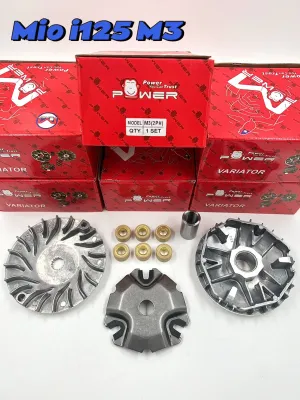
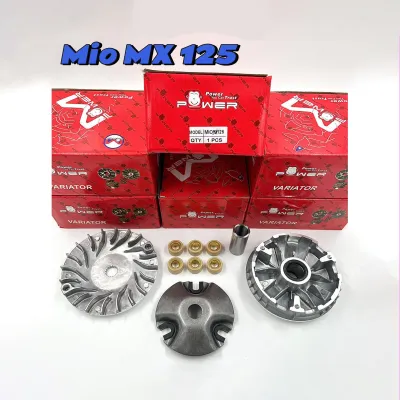
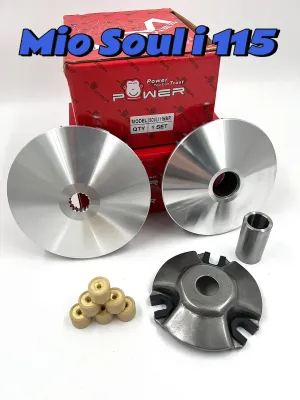
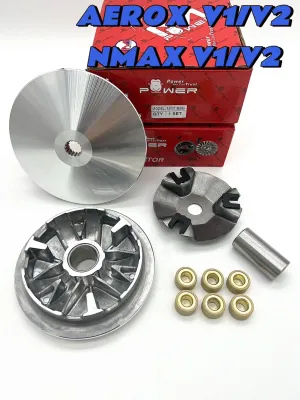
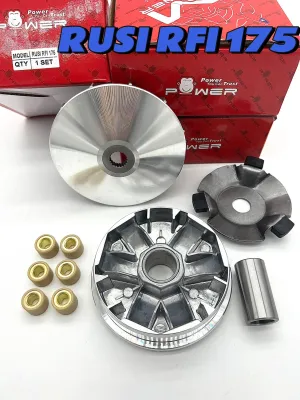
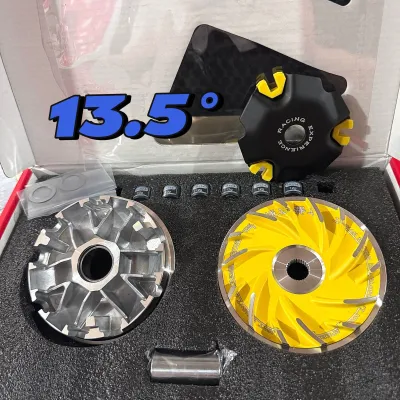
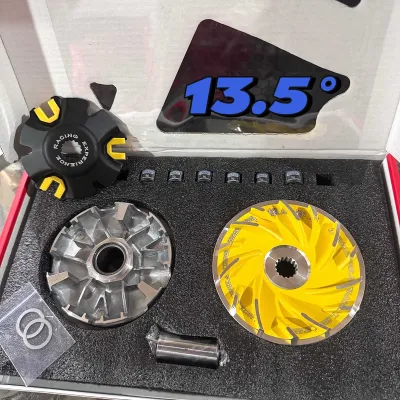
Prices are valid at publication and may change. Please refer to the product page for the latest price.
Before purchasing, you should check the manufacturer’s technical specifications or product diagrams to identify the intended profile of the pulley set. Comparing these specifications with your stock variator’s ramp design will help you determine whether the aftermarket set is engineered for aggressive stop-and-go acceleration or a smoother, more linear power delivery.
Roller Weight Compatibility and Range
Roller weights work in direct partnership with the ramp angle to control the exact RPM at which your transmission shifts. Because the M Power pulley set features modified ramp geometries, using your stock roller weights may not yield the performance characteristics you expect. The physical weight of the rollers determines how much centrifugal force is required to push the pulley face forward against the tension of the center spring.

To achieve the best balance of acceleration and fuel efficiency, you must check the recommended roller weight range specified in the official M Power product documentation. Installing rollers that are too light will cause the engine to rev excessively high without a corresponding increase in speed, which can accelerate component wear. On the other hand, rollers that are too heavy will force the transmission to shift too early, leaving the scooter sluggish when climbing steep flyovers or accelerating from a complete stop.
Fine-tuning your CVT setup often requires a process of trial and error using different weight configurations. Many riders find success by testing a tuning kit with various roller weights to find the exact mass that eliminates flat spots or sudden RPM drops during hard acceleration.
Material Quality and Manufacturing Precision
The high-heat, high-friction environment of a scooter’s CVT case demands durable materials and precise manufacturing. When choosing an aftermarket pulley set, you should verify the material composition by reviewing the official product labels or manufacturer specifications. High-grade aluminum alloys are commonly utilized to balance heat dissipation with structural strength under continuous load.
Machining precision is another critical factor that directly impacts the longevity of your transmission components. A variator face that is not perfectly balanced or has microscopic surface imperfections can cause uneven belt wear, leading to premature belt failure or slipping. Smooth, CNC-machined roller tracks are essential to ensure that the roller weights slide freely without binding or developing flat spots.
You can practically assess the manufacturing standards of a pulley set by inspecting the surface finish and the quality of any anodized coatings. A clean, uniform finish on the belt-mating surface indicates high production standards, which helps minimize friction and prevents the drive belt from glazing over during long, hot rides in tropical climates.
Matching Pulley Specs to Your Riding Needs
Selecting the right specifications for your M Power pulley set depends heavily on your daily riding environment and personal performance goals. For riders who primarily navigate dense city traffic, stop-and-go acceleration is the top priority. In this scenario, you should look for specifications that favor quick low-to-mid-range engagement, allowing you to maneuver safely through tight spaces and pull away cleanly from traffic lights.
If your daily route involves long stretches of highway or provincial roads, your priorities will shift toward maintaining a comfortable cruising speed at lower engine revolutions. For these journeys, a pulley set designed to maximize belt travel at the outer edge of the drive face is ideal, as it allows the engine to run cooler and more efficiently at sustained high speeds.
For riders who frequently carry heavy loads or travel through hilly terrain, maintaining low-end torque and belt grip is essential. You will need a setup that prevents the transmission from shifting into a high ratio too quickly, ensuring the engine stays in its power band to climb inclines without losing momentum or overheating the clutch system.
Compatibility and Installation Requirements
Before purchasing any aftermarket transmission component, you must verify its physical compatibility with your specific vehicle. Always check your scooter’s exact make, model, model year, and engine displacement against the official M Power fitment chart. Even minor variations in crankshaft diameter or spline count between different model years can prevent the pulley set from mounting securely, risking severe engine damage.
Modifying your scooter’s CVT system carries inherent safety risks and requires proper technical execution. During installation, you must use specialized CVT holding tools to secure the variator and clutch outer bells; attempting to jam the pulleys with makeshift tools can bend the crankshaft or crack the engine casing.
If you do not have the specialized tools, a calibrated torque wrench, or the mechanical experience required to torque the variator nut to the manufacturer’s exact factory specifications, you should have the installation performed by a qualified motorcycle mechanic. A loose variator nut can back off during operation, leading to a sudden loss of drive power or catastrophic transmission failure on the road.
Frequently Asked Questions (FAQ)
Will an M Power pulley set increase my scooter's top speed?
An aftermarket pulley set is designed to optimize how quickly and smoothly your scooter reaches its top speed rather than significantly raising the absolute limit. Your scooter’s maximum speed is ultimately restricted by the engine’s maximum RPM limit, the final gear ratio, and available horsepower. While the modified geometry of the pulley may allow the drive belt to ride slightly higher on the pulley face, any noticeable changes in top-speed performance are highly dependent on your overall engine health and weight configuration.
How often should I inspect the pulley set after installation?
You should inspect your aftermarket pulley set during your scooter’s regular transmission service intervals, typically every 5,000 to 8,000 kilometers, or more frequently if you ride regularly in dusty or highly humid conditions. Open the CVT case to clean out accumulated belt dust and check the roller weights for flat spots or uneven wear. Additionally, inspect the drive belt for signs of cracking, fraying, or glazing, and replace it immediately if you observe any degradation to prevent a belt breakage while riding.
Community discussion
Share your experience or ask a question. Comments are reviewed before publication.