
Selecting the correct continuously variable transmission (CVT) fluid for your Toyota vehicle in the Philippines is a critical maintenance decision that directly impacts the lifespan of your drivetrain. Because CVTs operate under high-pressure conditions and rely on precise friction coefficients to prevent belt slippage, using an incompatible fluid can lead to severe transmission damage. To protect your vehicle, you must verify the required specification in your owner’s manual and ensure any aftermarket or original equipment manufacturer (OEM) fluid explicitly lists that exact standard on its label. This is especially important in the local driving environment, where high ambient temperatures, heavy stop-and-go traffic, and high humidity place additional thermal stress on your transmission fluid.
Why Toyota CVTs Require Specific Fluid Formulations
Continuously variable transmissions operate on a fundamentally different mechanical principle than traditional automatic transmissions. Instead of using a series of planetary gears to change ratios, a CVT utilizes a high-strength steel belt or chain wrapped around two variable-diameter pulleys. The transmission fluid in this system must perform multiple, seemingly contradictory roles simultaneously. It must act as a hydraulic fluid to actuate the pulleys, provide wear protection for the bearings, and maintain a highly specific level of steel-on-steel friction to prevent the belt from slipping along the smooth pulley faces.
Using an incorrect or generic automatic transmission fluid (ATF) in a CVT system can lead to catastrophic mechanical failure. Standard ATF is formulated for torque converters and wet clutch packs, which require different friction characteristics. If generic ATF is introduced into a CVT, the steel belt can slip against the pulleys. This slippage generates extreme localized heat, which rapidly degrades the remaining fluid and causes microscopic metal shaving debris to circulate through the transmission, eventually destroying the pulley surfaces and the belt itself.
Products mentioned in this guide
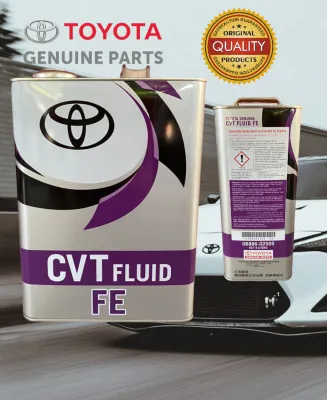
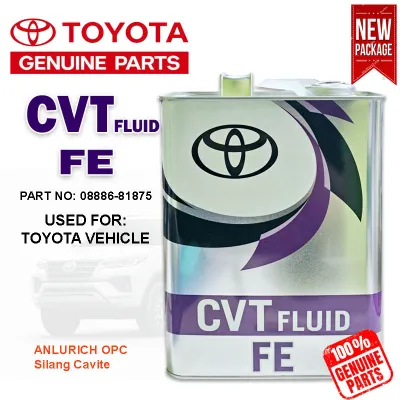
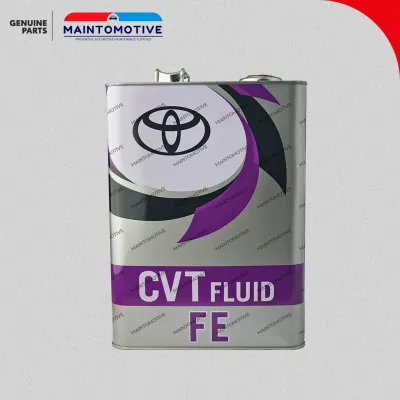
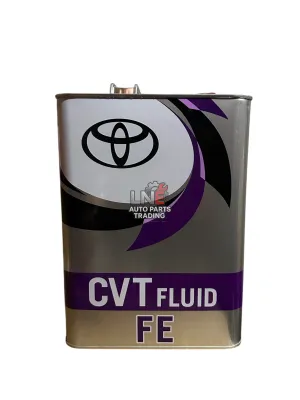
Prices are valid at publication and may change. Please refer to the product page for the latest price.
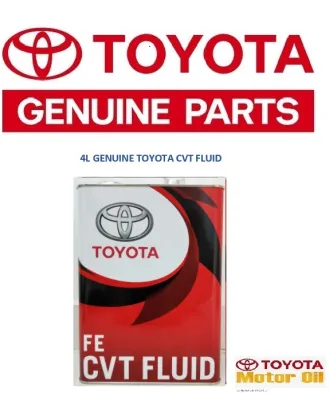
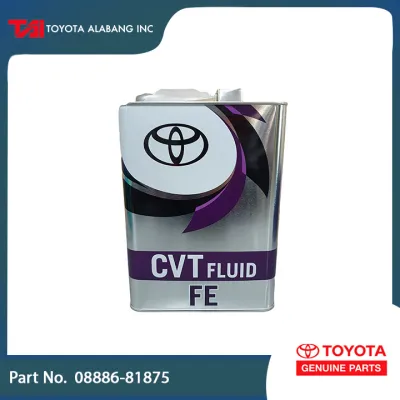
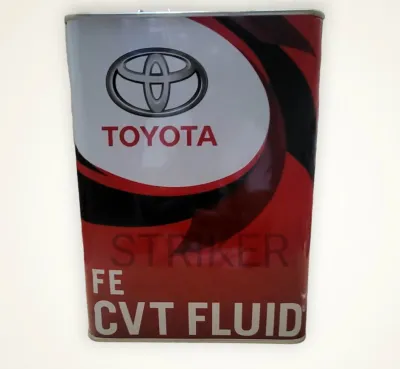
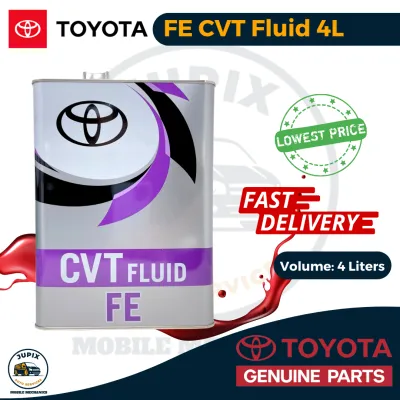
To find the exact fluid specification required for your specific Toyota model, you must consult your vehicle’s owner’s manual. The manual typically lists the required fluid under the specifications, maintenance, or fluid capacities section. For most modern Toyota CVTs driven in the Philippines, the required specification will be either Toyota Genuine Fluid TC or Toyota Genuine Fluid FE. The “TC” specification is generally found in slightly older CVT models, while the “FE” (Fuel Economy) specification is a lower-viscosity fluid designed for newer models to reduce internal drag and improve fuel efficiency. These two formulations have different viscosity profiles and friction properties, meaning they are not always interchangeable.
Evaluating OEM vs. Aftermarket CVT Fluid Options
Original Equipment Manufacturer (OEM) fluids, specifically Toyota Genuine Fluid TC and FE, serve as the baseline standard for compatibility. These fluids are formulated by Toyota’s chemical partners to match the exact metallurgy, seal materials, and operating tolerances of Toyota transmissions. Choosing an OEM fluid removes the guesswork from the maintenance process, as it guarantees the fluid meets the exact viscosity and friction requirements of your vehicle’s CVT under all operating conditions.

Reputable aftermarket brands also manufacture CVT fluids designed to meet or exceed these specifications. When evaluating aftermarket options, look for products from established lubricant manufacturers that explicitly state compatibility with Toyota TC or Toyota FE on the product label. Avoid fluids that only use broad marketing terms like “multi-vehicle” or “universal” without listing specific manufacturer standards, as these may not provide the precise friction properties your transmission needs. Some aftermarket fluids are formulated as multi-vehicle fluids but have undergone testing to verify they meet the specific friction requirements of Toyota’s CVT designs.
Sourcing these fluids involves weighing trade-offs between convenience, cost, and warranty protection. Purchasing directly from an authorized dealership ensures absolute product authenticity and preserves your vehicle’s warranty, though it often comes at a higher price point. Local auto supply shops and established online marketplaces may offer more competitive pricing and convenient delivery, but they require extra vigilance to ensure you are purchasing genuine, compatible products. If your vehicle is still under the manufacturer’s warranty, using non-OEM fluids or servicing the vehicle outside authorized channels may complicate warranty claims if a transmission issue arises.
How to Verify Fluid Compatibility Before You Buy
Before purchasing any CVT fluid, you must perform a thorough compatibility check to safeguard your transmission. Start by cross-referencing the specification codes on the product label with the requirements in your owner’s manual. If your manual specifies Toyota FE, the fluid container must explicitly list “Toyota FE” or “Toyota CVT Fluid FE” as a compatible specification. Never rely on verbal assurances from retail staff or online sellers; the compatibility must be printed clearly on the physical bottle or the manufacturer’s official product data sheet.
Be cautious of products that carry vague compatibility claims. While some high-quality aftermarket fluids are formulated to cover multiple specifications, they must still explicitly list your vehicle’s required Toyota specification on the bottle. If a product label only claims to be “suitable for most CVTs” or “designed for Japanese vehicles” without naming Toyota TC or FE, do not use it. The friction requirements of a Toyota CVT are highly specific, and a fluid that is too slippery or too viscous can cause immediate performance issues or long-term wear.
Physical inspection of the packaging is another crucial step before completing your purchase. Examine the bottle for intact safety seals, clear and aligned label printing, and the presence of batch codes or holographic security stickers. Counterfeit products often exhibit misaligned labels, blurry text, or flimsy seals, which are immediate red flags indicating the fluid inside may not meet safety standards. Additionally, check the manufacturing or packaging date if available; transmission fluid has a long shelf life, but it should be stored in a sealed container away from extreme temperature fluctuations to prevent moisture contamination.
Sourcing Authentic CVT Fluid in the Philippines
The Philippine automotive market has a diverse supply chain, making it essential to know how to spot counterfeit or diluted fluids. Low-grade or counterfeit fluids are sometimes packaged in bottles resembling major brands and sold at unusually low prices on online marketplaces or by unauthorized physical retailers. Because CVT fluid is a high-value consumable, it is a frequent target for counterfeiters who fill genuine-looking bottles with cheap, non-compatible hydraulic oil.
To minimize risk, purchase your CVT fluid from authorized dealerships, established automotive parts chains, or official brand flagship stores on major ecommerce platforms. These sellers maintain direct supply lines from manufacturers or authorized distributors, ensuring the product’s integrity. When shopping online, look for sellers with verified store badges, high positive feedback ratings, and customer reviews that confirm the presence of intact safety seals and proper packaging upon delivery.
If you receive a product that looks suspicious, has a broken safety seal, or lacks clear batch and manufacturing codes, do not pour it into your transmission. Contact the seller immediately to request a replacement or refund, and consult an authorized service center if you are unsure about the authenticity of a product purchased outside official channels. Using a suspect fluid to save a small amount of money can result in a transmission failure that costs tens of thousands of pesos to repair or replace.
Safety and Service Boundaries for CVT Maintenance
Servicing a CVT is a precise procedure that carries significant safety and mechanical risks. Unlike older automatic transmissions, modern Toyota CVTs often lack a traditional dipstick under the hood. Checking and adjusting the fluid level typically requires monitoring the transmission fluid temperature using specialized diagnostic tools to ensure the fluid is within a specific thermal range during the level-check process. This is because CVT fluid expands significantly as it heats up, and checking the level at the wrong temperature will result in an incorrect fluid volume.
Because of these complexities, attempting a do-it-yourself (DIY) fluid change without the proper equipment can lead to underfilling or overfilling, both of which can cause foaming, overheating, and transmission damage. In the hot climate of the Philippines, where ambient temperatures can quickly warm up a vehicle, the window of time to perform a correct fluid level check is relatively short. If you do not have access to a diagnostic scanner to read the transmission fluid temperature, a level workshop floor, and the manufacturer’s specific service instructions, you should have the service performed by a qualified mechanic or an authorized dealership.
Additionally, you must follow the manufacturer’s recommended service procedures regarding whether to perform a simple drain-and-fill or a complete system flush. High-pressure flushes can sometimes dislodge internal debris or damage sensitive solenoids within the valve body. A standard drain-and-fill, performed at the intervals recommended for severe driving conditions—such as the frequent stop-and-go traffic and high-humidity environments common in the Philippines—is generally the safer and more conservative approach to maintaining transmission health. Always consult your vehicle’s service manual or a certified technician to determine the safest maintenance path for your specific model.
Frequently Asked Questions (FAQ)
Can I mix OEM and aftermarket CVT fluids?
Mixing different CVT fluids is highly discouraged due to the risk of chemical incompatibility. Different brands and formulations use distinct additive packages, anti-wear agents, and friction modifiers. Mixing them can alter the fluid’s overall viscosity and friction characteristics, potentially leading to belt slippage, increased wear, or transmission shudder. If you decide to switch from an OEM fluid to an aftermarket alternative, or vice versa, it is best to perform a complete fluid service rather than topping off the existing fluid. This ensures that the transmission operates on a consistent fluid formulation with uniform properties.
How do I know if my Toyota CVT fluid needs replacing?
While you should primarily follow the service intervals outlined in your owner’s manual, certain physical signs indicate your CVT fluid may need replacement. These symptoms include a noticeable shudder or hesitation during acceleration, delayed engagement when shifting from park to drive, or an unusual whining noise from the engine bay. If your vehicle has an accessible check plug or dipstick, you can inspect the fluid’s condition; healthy CVT fluid is typically clear with a slight green or red tint, while degraded fluid will appear dark brown or black and may carry a burnt odor. If you observe any of these signs, have your transmission inspected by a professional immediately.

Community discussion
Share your experience or ask a question. Comments are reviewed before publication.