
Choosing the right flyball honda click 125i weight is one of the most effective ways to customize your scooter’s performance. The Continuously Variable Transmission (CVT) system relies on these small roller weights to determine when and how the transmission shifts. By adjusting their weight, you can tailor your scooter’s power delivery to match your daily driving environment, whether you are navigating congested city streets or cruising along provincial highways.
Selecting the perfect weight requires a clear understanding of your current baseline and how mechanical forces dictate your scooter’s acceleration. There is no single “best” weight for every rider, as every modification involves a direct trade-off between low-end torque and top-end speed. To make an informed decision, you must first establish your factory specifications and evaluate how different weights alter your engine’s behavior.
Establishing the Baseline: Finding Your OEM Flyball Specification
Before making any modifications to your transmission system, you must identify the factory-standard roller weight. The Original Equipment Manufacturer (OEM) weight is carefully engineered by Honda to balance fuel efficiency, engine longevity, and general acceleration for the average rider. This baseline represents a highly optimized compromise designed to perform reliably under a wide range of standard operating conditions.
Products mentioned in this guide
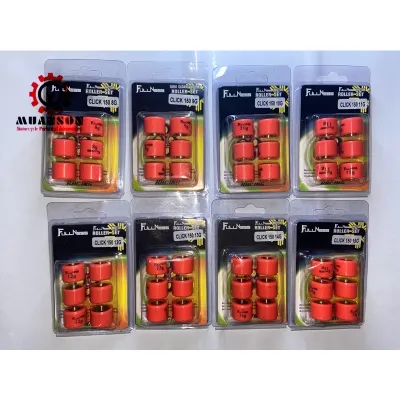
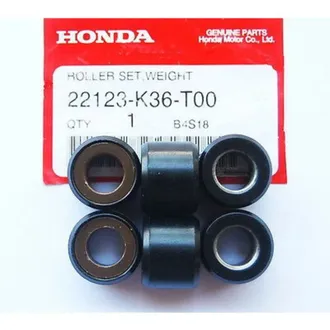
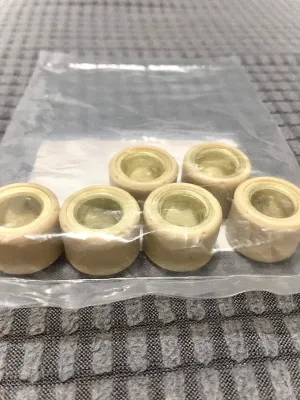
![[KV] Click 125/150 Genuine FLYBALL Set 14G (BLACK) 2212A-K36-T00 From Thailand](https://img.lazcdn.com/g/p/036611b45cedcb3393bfb9ce6179a98c.jpg_400x400q80.jpg_.webp)
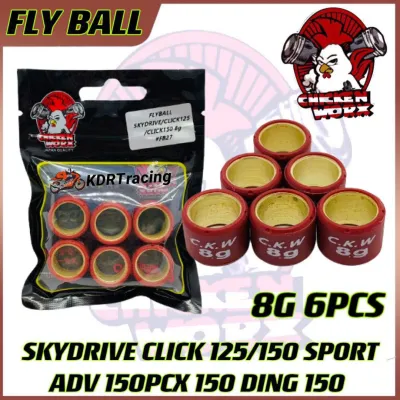

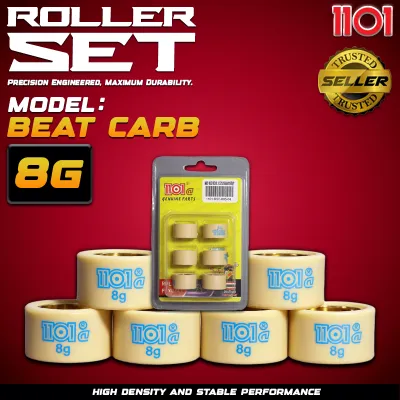
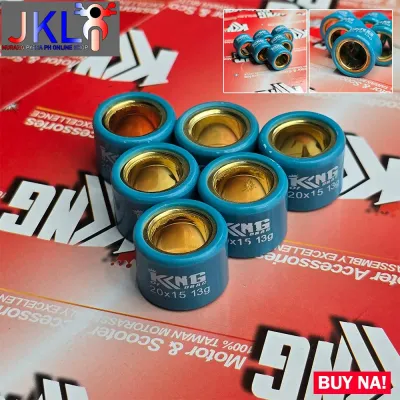
Prices are valid at publication and may change. Please refer to the product page for the latest price.
For many model years of the Honda Click 125i, the factory-standard weight is typically 18 grams per roller. However, because specifications can vary slightly depending on the exact generation, model year, or regional market variations, you must verify this baseline. You can find the exact gram rating by checking your official owner’s manual, consulting an authorized Honda service center, or measuring the original rollers with a precision digital scale if they are not excessively worn.
Knowing this baseline specification is mandatory before installing any aftermarket alternatives. Blindly guessing or installing random weights can lead to poor performance, excessive fuel consumption, or severe transmission damage. By establishing a clear starting point, you can make precise, incremental adjustments—usually changing the weight by only one or two grams at a time—to achieve your desired performance characteristics safely.
Decoding the Specs: How Roller Weight Changes CVT Performance
The CVT system in your scooter operates using centrifugal force. As the engine spins faster, the flyballs inside the variator pulley are pushed outward, sliding up the ramp plate. This outward movement forces the variator pulley to close, which squeezes the drive belt and forces it to ride higher on the pulley, effectively shifting the scooter into a taller gear ratio.

Lighter Rollers (Below OEM Specification)
Lighter rollers require higher engine speeds to generate the centrifugal force needed to push the variator outward. Because they delay this shifting process, the engine is forced to reach and maintain higher Revolutions Per Minute (RPM) before the transmission shifts into a higher gear ratio. This keeps the engine in its peak power band longer during initial acceleration.
The primary benefit of installing lighter rollers is a much quicker off-the-line throttle response and improved initial acceleration. This makes the scooter feel significantly more agile when starting from a complete stop or when making sudden overtaking maneuvers. It is a highly popular modification for riders who prioritize responsiveness over high-speed cruising.
However, this improved acceleration comes with distinct mechanical trade-offs. Running lighter rollers causes the engine to operate at higher RPMs, which increases engine noise, operating temperatures, and fuel consumption. Additionally, because the lighter weights may struggle to push the variator completely outward at high speeds, you may experience a noticeable reduction in your scooter’s top-end speed.
Heavier Rollers (Above OEM Specification)
Heavier rollers generate centrifugal force much faster and at lower engine speeds. As a result, they push the variator outward much sooner, forcing the CVT to shift into a taller gear ratio early in the acceleration curve. This keeps the engine operating at lower RPMs even as your road speed increases.
The main advantage of heavier rollers is a more relaxed, quiet, and fuel-efficient riding experience at sustained cruising speeds. Because the engine does not have to spin as fast to maintain momentum, engine strain and vibrations are significantly reduced. This setup is highly beneficial for riders who cover long distances on open roads and want to maximize their fuel economy.
The drawback of heavier rollers is a sluggish and unresponsive feel during initial acceleration. Because the transmission shifts into a taller gear too quickly, the engine may struggle to reach its optimal power band, making stop-and-go riding feel slow and heavy. In some cases, if the rollers are too heavy, the engine may suffer from “lugging,” where it operates under high load at too low an RPM, putting unnecessary stress on internal components.
Selecting the Ideal Flyball Honda Click 125i Weight Based on Your Riding Conditions
To choose the correct flyball honda click 125i specification, you must carefully analyze your typical daily routes, passenger habits, and overall performance goals. Matching the roller weight to your specific riding environment ensures that your scooter remains efficient and reliable.
- City Commuting (Stop-and-Go): If your daily commute consists of navigating heavily congested urban streets with frequent stops, a slightly lighter setup is highly effective. Dropping your roller weight to 15 grams or 16 grams can provide the rapid throttle response needed to filter safely through traffic and accelerate quickly from red lights.
- Heavy Loads and Uphill Routes: Riding with a pillion passenger, carrying heavy delivery cargo, or frequently traveling up steep mountain roads requires sustained engine torque. In these scenarios, lighter rollers (such as 15 grams or 16 grams) help keep the engine in its optimal power band, preventing the scooter from losing momentum or bogging down on steep inclines.
- Long-Distance Cruising: If your daily routes involve long, open highways with very few stops, maintaining the stock 18-gram rollers or slightly increasing them to 19 grams is the ideal choice. This configuration keeps your cruising RPMs low, minimizes fatiguing handlebar vibrations, and ensures excellent fuel mileage over long distances.
While tuning your CVT can be highly rewarding, you must avoid extreme deviations from the factory specifications. Installing rollers that are excessively light (such as under 12 grams) or excessively heavy (such as over 20 grams) can cause severe belt slippage, extreme heat buildup inside the CVT housing, and rapid wear of the variator ramp plate, slide pieces, and drive belt. Always make small, calculated adjustments to preserve the reliability of your transmission.
Safety Boundaries and Installation Checks for CVT Maintenance
Modifying or maintaining your scooter’s CVT system involves working with critical drive components that directly affect your safety on the road. Before performing any work or purchasing new parts, you must understand the proper safety procedures and inspect the surrounding components for wear. Aftermarket roller sets are generally inexpensive, typically falling into a low price band of a few hundred Philippine Pesos (₱), but prioritizing component quality and correct installation is far more important than saving on cost.
Whenever you open the CVT cover to inspect or replace your flyballs, you must thoroughly examine the drive belt. Check the belt for any signs of cracking, fraying, edge wear, or oil contamination. Replacing your roller weights while leaving a compromised drive belt in place is highly dangerous, as a failing belt can snap violently at high speeds, locking up your rear wheel and causing a serious accident.
During disassembly and reassembly, you must use the proper specialty tools. Never attempt to loosen or tighten the variator nut by jamming a screwdriver, chisel, or makeshift tool into the teeth of the drive face, as this can easily chip the metal, bend the crankshaft, or ruin the delicate threads. Always use a proper universal clutch holder or a dedicated variator holding tool to secure the components safely.
When reinstalling the variator assembly, you must use a calibrated torque wrench to tighten the variator nut to the exact torque specification provided in your official Honda service manual. Failing to torque the nut correctly can cause it to back off during operation, resulting in catastrophic damage to the crankshaft and transmission casing. If you do not possess the proper tools, mechanical experience, or official manufacturer specifications, stop immediately and seek the assistance of a qualified motorcycle mechanic.
Frequently Asked Questions (FAQ)
Can I mix different flyball weights in the variator?
You should never mix different flyball weights or sizes within your variator. While some riders attempt to mix weights to find a middle ground, doing so causes the variator drive face to move unevenly. This uneven movement creates severe high-frequency vibrations, accelerates drive belt wear, and can lead to premature failure of the variator slide pieces and the crankshaft bearings. For safe and smooth operation, all six rollers must be identical in both weight and physical dimensions.
How do I know if my current flyballs need replacing?
You can identify worn flyballs through both visual inspection and changes in your scooter’s performance. Visually, worn rollers will exhibit distinct flat spots or physical deformation rather than maintaining a perfectly smooth, cylindrical shape. On the road, worn rollers prevent the variator from sliding smoothly, which typically manifests as a noticeable drop in top-end speed, sluggish or jerky acceleration, and unusual vibrations coming from the CVT case even when your drive belt is in good condition.
Community discussion
Share your experience or ask a question. Comments are reviewed before publication.