
Upgrading to a 260mm big disc on a Honda Click 125i, 150i, or 160 is one of the most popular modifications among Filipino riders. While many seek this upgrade for its aggressive, sporty look, the primary goal should always be improving stopping power, heat management, and overall road safety. Determining which 260mm big disc brand is “best” for your Honda Click depends heavily on your specific riding environment, budget, and willingness to invest in high-quality supporting hardware.
Braking is a holistic system, not a single component. A premium brake rotor will perform poorly—and could even be dangerous—if paired with a flexing, low-grade caliper bracket or worn-out brake pads. In the Philippines, where riders routinely face intense tropical heat, sudden torrential downpours, and congested stop-and-go city traffic, selecting a reliable brand with verified fitment for your specific Honda Click model is critical. Prioritizing safety, engineering precision, and material quality over brand hype or cheap aesthetics is the key to a successful upgrade.
Critical Safety and Fitment Checks Before Upgrading
Upgrading your Honda Click’s front brake rotor from the stock size to a larger 260mm disc is not a simple “plug-and-play” cosmetic modification. It alters the geometry and mechanical leverage of your front braking system. Before purchasing any aftermarket kit, you must understand and address several critical safety and fitment requirements to ensure your motorcycle remains safe to operate on public roads.
Products mentioned in this guide
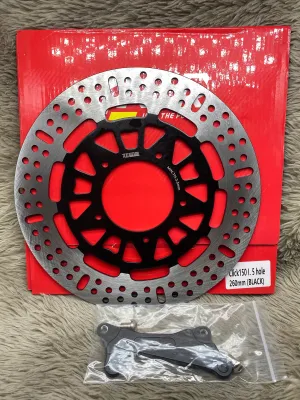
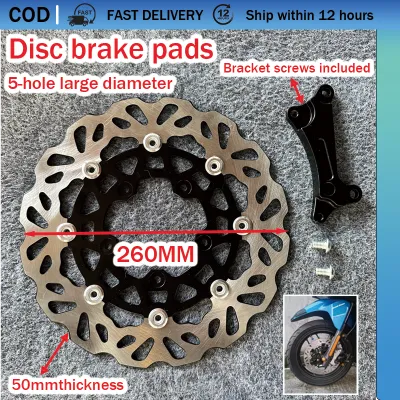
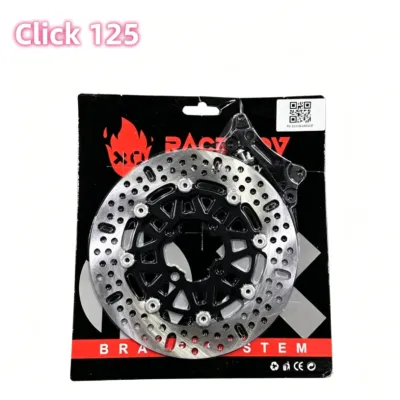
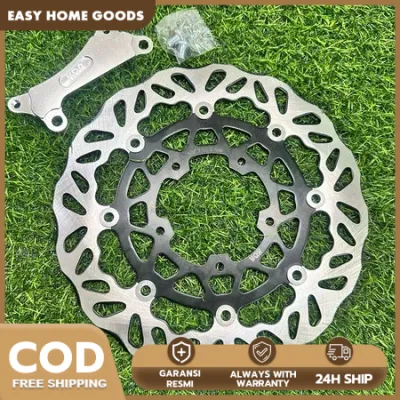
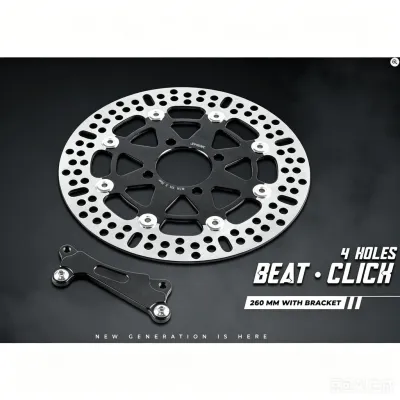
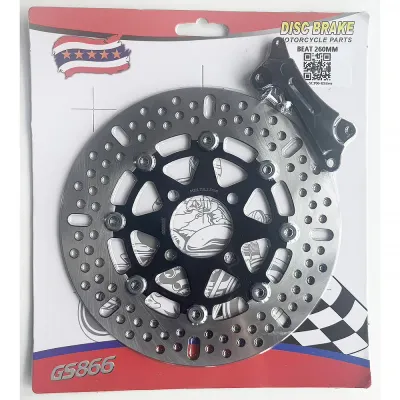
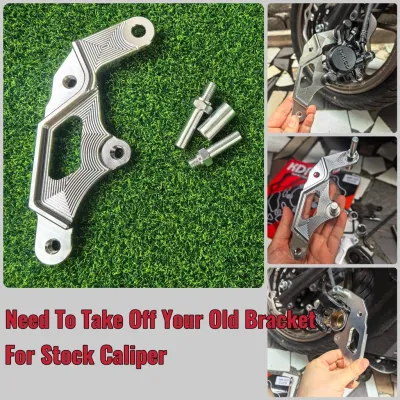
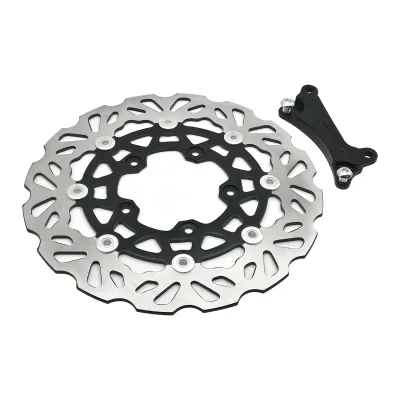
Prices are valid at publication and may change. Please refer to the product page for the latest price.
The Caliper Bracket Requirement
Because a 260mm disc has a larger radius than the stock rotor, your front brake caliper must be relocated further outward to align with the new outer edge of the disc. This relocation requires a specialized caliper adapter bracket. The quality of this bracket is just as important as the disc itself. You should look for brackets CNC-machined from high-grade billet aluminum, such as 6061-T6. CNC machining ensures precise tolerances, preventing caliper misalignment. If the bracket is poorly made or cast from cheap metals, it can flex under hard braking, causing uneven pad wear, brake drag, or even catastrophic failure where the caliper binds against the wheel.
Clearance Verification
A 260mm disc is a substantial increase in size, and clearance issues can arise depending on your Honda Click’s model year and wheel design. Before finalizing your purchase, verify that the outer edge of the new disc and the relocated caliper will not interfere with the inner front fork tubes, the front fender mounting tabs, or the wheel spokes. Even minor flex during hard cornering can cause contact, leading to rapid wear or sudden wheel lockups. Ensure there is at least a 3mm clearance gap around all moving parts.
ABS Compatibility and Sensor Alignment
If you own a Honda Click variant equipped with an Anti-lock Braking System (ABS), such as the newer Click 160 ABS, upgrading the brake disc requires extreme caution. The ABS system relies on a magnetic wheel speed sensor reading a slotted pulser ring on the wheel hub. When you install a larger 260mm disc and relocate the caliper, the sensor’s position relative to the pulser ring must remain absolutely perfect. The gap between the sensor and the ring typically must be within 0.3mm to 1.2mm. If the aftermarket caliper bracket or disc design alters this gap, it will trigger an ABS error code on your dashboard, disabling the system entirely. Always verify with the manufacturer that the 260mm disc kit is explicitly certified for ABS-equipped Click models.
Master Cylinder and Caliper Matching
A larger disc diameter increases the mechanical leverage of your brakes, resulting in a stronger initial bite and shorter stopping distances. However, because the hydraulic ratio between your stock master cylinder and stock caliper remains unchanged, the lever feel will alter. Your stock master cylinder must be in optimal condition to handle the increased leverage and thermal load. If your stock master cylinder is worn or has old, degraded seals, the increased braking force required at the lever may expose these weaknesses, leading to a spongy feel. If you plan to upgrade to a multi-piston aftermarket caliper in the future, ensure the 260mm disc and bracket you choose today are compatible with that specific caliper brand.
How to Compare Big Disc Brands: Key Decision Factors
When comparing different aftermarket brake disc brands in the Philippine market, it is easy to get distracted by colorful anodized centers and aggressive wave patterns. To make an informed decision that guarantees both performance and longevity, you must evaluate brands based on objective technical criteria.

Material and Heat Dissipation
The metallurgy of the brake disc is the single most important factor governing its performance. Standard, budget-friendly discs are typically made of solid, single-piece stainless steel. While durable for light commuting, solid discs are prone to thermal expansion and warping when subjected to prolonged braking on steep descents.
In contrast, premium brands offer “floating” disc designs. A floating disc consists of a stainless steel outer friction ring connected to an aluminum inner carrier by steel rivets or buttons. This two-piece construction allows the outer ring to expand and contract independently of the inner carrier when exposed to extreme heat. In the humid, tropical climate of the Philippines, where sudden afternoon downpours can instantly cool a hot brake disc (causing extreme thermal shock), a floating design is highly effective at preventing warping and maintaining consistent braking performance.
Braking Bite and Modulation
The surface design of the disc—specifically the placement of drilled holes, slots, or wave cuts—plays a vital role in how the brake feels under your hand. Drilled holes help dissipate heat and allow water and road grime to escape quickly, which is crucial during the wet monsoon season. Slots act as a scraper to clean the brake pad surface and prevent gas buildup between the pad and the disc.
The disc’s metallurgy must also match your brake pad compound. Sintered metal pads provide an aggressive bite and high-temperature performance but are highly abrasive. If paired with a softer, low-quality stainless steel disc, they will rapidly wear grooves into the rotor. Organic or ceramic pads are gentler on the disc, offering smoother modulation, but may fade faster under continuous heavy braking.
Hardware and Bracket Quality
A high-quality brake disc brand does not just sell you a rotor; they provide a complete, engineered system. When comparing brands, look closely at the included mounting hardware and caliper relocation brackets. Reputable brands package their kits with high-tensile steel bolts (typically Class 10.9 or 12.9) and hard-anodized, precision-machined aluminum brackets. Cheaper, generic brands often cut corners by including low-grade mild steel bolts that are prone to rusting in high humidity or shearing under the intense torque of an emergency stop.
Authenticity and After-Sales Support
The Philippine motorcycle aftermarket has a significant influx of counterfeit parts, particularly for high-demand models like the Honda Click. Counterfeit brake discs often mimic the appearance of premium brands but use sub-standard alloys that can crack under thermal stress. Prioritize brands with established, authorized distribution networks in the Philippines. Genuine brands feature clear authenticity indicators, such as holographic stickers, unique QR codes, and laser-etched serial numbers. Buying from authorized dealers ensures you receive a genuine product backed by a manufacturer warranty.
Comparing 260mm Disc Tiers: Premium, Mid-Range, and Budget
To help you navigate the wide array of 260mm big disc options available for the Honda Click, we can categorize the market into three distinct tiers based on price, engineering quality, and intended use.
Premium/Track-Oriented Brands
At the top of the market are premium brands like Brembo, TDR Racing, and the high-end floating series from Racing Boy (RCB). These brands utilize advanced metallurgy, featuring high-carbon stainless steel friction rings and lightweight, aircraft-grade aluminum inner carriers. Engineered to withstand extreme thermal stress without warping or fading, they provide outstanding braking modulation. However, these premium discs come at a high cost, often ranging from ₱3,500 to ₱7,000 or more. They are best suited for aggressive riders, those with upgraded multi-piston calipers, or riders who frequently tackle steep mountain roads with heavy loads.
Mid-Tier/Established Aftermarket Brands
The mid-tier segment is the most popular among daily commuters in the Philippines. This category includes reputable, established brands such as standard RCB (Racing Boy) series, JRP, Mutarru, and Sunstar. These brands offer a fantastic balance of daily performance, durability, and affordability, with prices typically ranging from ₱1,500 to ₱3,000.
Mid-tier brands design their 260mm discs specifically for the Honda Click’s hub bolt patterns, ensuring a straightforward installation. Many of these options feature semi-floating or high-quality fixed designs with excellent ventilation patterns. The included caliper brackets are CNC-machined to fit the stock Click forks and caliper perfectly. For the vast majority of riders who navigate the daily traffic of metropolitan areas like Manila or Cebu, a mid-tier disc provides a highly noticeable upgrade in stopping power and wet-weather performance over the stock setup while maintaining absolute safety.
Budget/Generic Options
The lowest tier consists of unbranded, generic, or replica “Thai-style” discs sold on online marketplaces for under ₱1,000. While visually appealing, these budget options present severe safety risks. They are typically made from low-grade steel with poor heat treatment, making them highly susceptible to rapid warping. Furthermore, the included caliper brackets are often cast from cheap, brittle metals that can crack or flex under load, leading to sudden brake failure. Misaligned mounting holes can also damage your wheel hub threads during installation.
Decision Framework
To choose the right tier for your Honda Click, use the following guidelines:
- Choose Premium Brands if: You have upgraded your front caliper to a high-performance multi-piston system, frequently ride at high speeds, carry heavy pillion passengers, or regularly descend steep mountain passes where brake fade is a critical safety hazard.
- Choose Mid-Tier Brands if: You are a daily commuter looking for a reliable, safe, and visually appealing upgrade to improve your Click's stopping power in both dry and wet conditions, and you want a hassle-free installation with guaranteed fitment.
- Avoid Budget/Generic Options because: Saving a few hundred pesos is never worth compromising your motorcycle's primary safety system. The risk of sudden component failure or severe disc warping during an emergency stop far outweighs any temporary financial savings.
Installation, Bedding-In, and Ongoing Maintenance
Once you have selected and purchased a high-quality 260mm big disc kit for your Honda Click, the focus must shift to correct installation, proper bedding-in, and diligent ongoing maintenance. Brakes are a critical safety component; any error during these stages can lead to system failure or accidents.
Professional Installation and Torque Specifications
We strongly advise against attempting a DIY installation of your new brake disc unless you are a trained mechanic with the proper tools. Always refer to your Honda Click’s factory service manual for original torque specifications and installation guidelines.
During installation, a calibrated torque wrench must be used to tighten both the disc-to-hub bolts and the caliper-to-bracket bolts. Over-tightening can strip the threads in your aluminum wheel hub or snap the mounting bolts, while under-tightening can cause the bolts to back out under vibration. Additionally, a medium-strength thread-locking compound (such as blue Loctite) must be applied to the clean threads of all mounting bolts. This prevents the bolts from loosening due to the constant vibrations of the engine and road surfaces.
The Bedding-In Process
When you install a new 260mm brake disc, you must perform a “bedding-in” (or burnishing) procedure. This critical process transfers an even, microscopic layer of brake pad material onto the friction surface of the new disc. Proper bedding-in ensures optimal stopping power, prevents brake squeal, and protects the disc from uneven wear or premature warping.
To bed in your new brakes safely:
- Find a quiet, flat, and traffic-free stretch of road.
- Accelerate your Honda Click to approximately 40 to 50 km/h.
- Apply the front brake smoothly and progressively to slow the scooter down to about 10 km/h. Do not come to a complete stop, as holding the brake pads against a hot, stationary disc can cause uneven pad material transfer.
- Release the brake and ride for a short distance to let the disc cool slightly.
- Repeat this process 10 to 15 times. You will notice the braking feel become progressively firmer and more responsive.
Avoid panic braking or prolonged, heavy braking for the first 100 kilometers of riding to allow the pads and disc to fully mate.
Routine Inspection and Care
To ensure the longevity of your upgraded braking system, establish a routine inspection schedule. Regularly check the disc for deep scoring, cracks around the ventilation holes, or signs of warping (which typically manifests as a pulsing sensation in the brake lever). Periodically verify that all bracket and caliper mounting bolts remain securely tightened to their specified torque.
Clean the brake disc regularly using a dedicated, residue-free aerosol brake cleaner. This removes accumulated road grime, salt, and abrasive brake dust. Never use oil-based cleaners, diesel, gasoline, or harsh household detergents near your brakes, as these substances can easily contaminate the brake pads, glaze the disc surface, and degrade the rubber seals inside your caliper.
Frequently Asked Questions (FAQ)
Will a 260mm big disc drain my Honda Click's battery or affect fuel consumption?
No. A 260mm brake disc is a purely mechanical component and has no connection to your Honda Click’s electrical system, stator, or battery. Regarding fuel consumption, while a larger disc and its relocation bracket add a small amount of unsprung rotational weight, the difference is extremely marginal (typically a few hundred grams) and will have no perceptible impact on your fuel economy during daily riding.
Do I need to change my brake fluid when installing a big disc kit?
While not strictly mandatory if your current fluid is fresh, it is highly recommended to flush and replace your brake fluid with fresh DOT 3 or DOT 4 fluid (as specified on your master cylinder cap) during the installation. Upgrading the disc requires removing and repositioning the caliper, which provides the perfect opportunity to bleed any trapped air and moisture out of the hydraulic system, ensuring a firm, responsive lever feel.
Can I use my stock brake pads with a 260mm aftermarket disc?
Yes, you can physically reuse your stock pads if they still have sufficient friction material and you are retaining the stock caliper. However, this is not recommended. Old pads have already worn unevenly to match the groove pattern of your old disc. Installing them on a flat, new 260mm rotor will reduce the initial contact area, leading to poor braking performance and potential glazing. For the best performance and safety, always pair a new disc with a fresh set of high-quality brake pads.
Community discussion
Share your experience or ask a question. Comments are reviewed before publication.