
Choosing the right CVT (Continuously Variable Transmission) set for your Yamaha Mio i 125 depends entirely on your daily riding environment and personal performance goals. Whether you are navigating the congested, stop-and-go streets of Metro Manila, cruising along flat provincial highways, or regularly tackling steep, hilly terrains in elevated regions, your transmission setup dictates how efficiently your scooter delivers power to the ground. Finding the ideal balance between low-end acceleration, high-speed fuel economy, and long-term reliability requires a clear understanding of how individual CVT components interact under different riding conditions.
The CVT system is a highly dynamic assembly that relies on friction, centrifugal force, and spring tension to continuously adjust your scooter’s gear ratio. In tropical climates characterized by high ambient temperatures and heavy traffic, these components are subjected to intense thermal and mechanical stress. Upgrading or properly maintaining this system is not just about seeking more speed; it is about optimizing power delivery to match your specific daily route while preserving the mechanical integrity of your motorcycle.
Understanding CVT Upgrades for the Mio i 125
Over time, the stock CVT components on your Yamaha Mio i 125 will inevitably experience wear and tear, leading to a noticeable decline in performance. You might first observe a sluggish response when twisting the throttle from a complete stop, or a distinct slipping sensation where the engine revs highly but the scooter fails to accelerate accordingly. Other common warning signs include unusual rattling or humming noises emanating from the transmission casing, a drop in top-speed capability, or a shuddering sensation during low-speed acceleration. These symptoms indicate that the drive belt, roller weights, or pulley faces have worn beyond their service limits and require immediate inspection.
Products mentioned in this guide
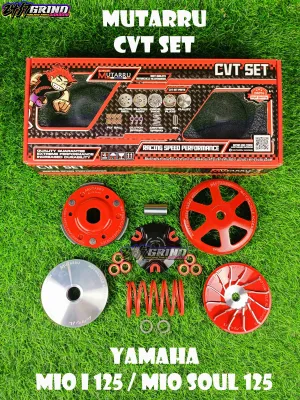
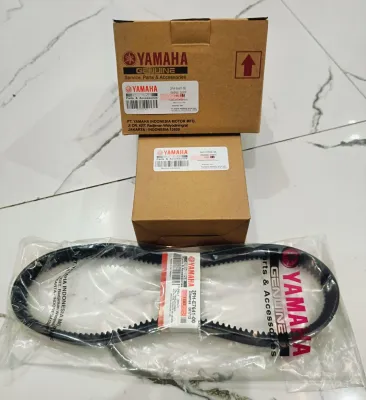
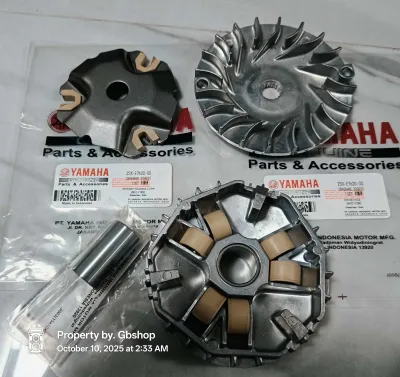
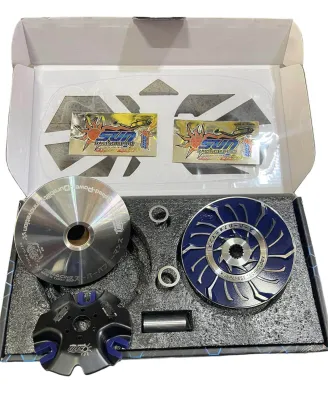
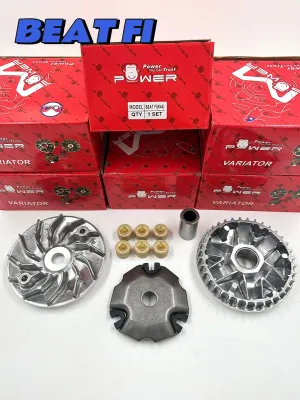
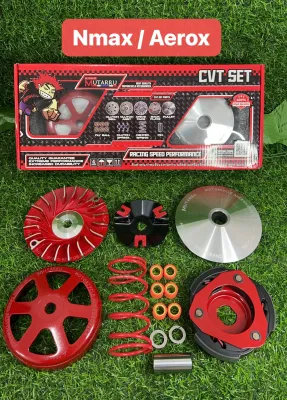
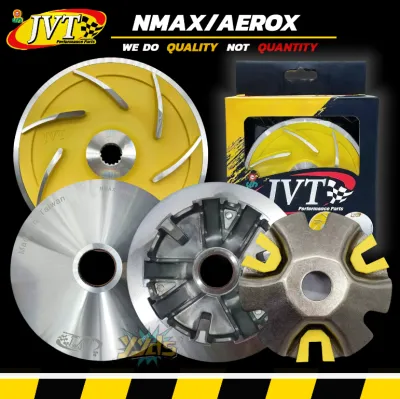
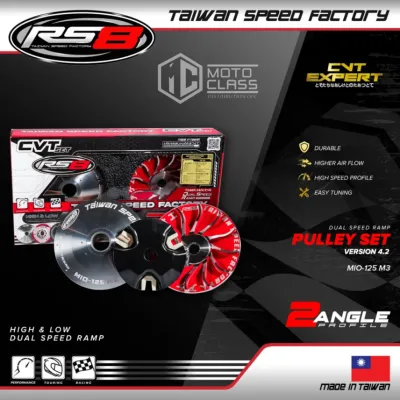
Prices are valid at publication and may change. Please refer to the product page for the latest price.
To understand how to address these issues, you must first familiarize yourself with the core components that make up the CVT assembly. The front pulley system, driven directly by the engine’s crankshaft, consists of the drive face and the variator, which houses the movable roller weights and slide pieces. The rear pulley system, connected to the rear wheel via the final reduction gears, includes the driven face, the clutch assembly, the small clutch springs, and the large center torque spring. Linking these two halves is the drive belt, which rides up and down the pulley sheaves to continuously alter the transmission ratio based on engine speed and load.
When servicing your transmission, you must choose between replacing worn parts with standard original equipment manufacturer (OEM) components or installing aftermarket tuning kits. OEM parts are engineered to restore the factory-spec balance of moderate acceleration, predictable fuel economy, and long-term durability under standard operating conditions. Conversely, aftermarket CVT kits feature modified pulley ramp angles, lighter or heavier roller weights, and stiffer springs designed to alter the shifting characteristics. These aftermarket options allow you to customize the power delivery curve, prioritizing either rapid low-speed acceleration or relaxed, low-RPM highway cruising.
Matching CVT Components to Your Riding Style
For riders whose daily routine consists primarily of urban commuting through dense, stop-and-go traffic, low-speed responsiveness is paramount. To achieve a snappier throttle response and quicker acceleration from a standstill, you can configure your CVT with slightly lighter roller weights than the stock setup. Lighter rollers require higher engine rotational speeds to slide outward via centrifugal force, which effectively keeps the transmission in a lower gear ratio longer and allows the engine to reach its peak powerband more quickly. Pairing these lighter rollers with slightly stiffer clutch springs ensures that the clutch shoes engage the clutch bell at a higher RPM, eliminating initial lag and providing immediate power when navigating tight city streets.

If your daily rides involve long, open stretches of highway where you can maintain steady cruising speeds, your priorities should shift toward fuel efficiency and engine longevity. In this scenario, installing heavier roller weights is highly beneficial, as they slide outward at lower engine speeds, forcing the variator to shift to a higher gear ratio earlier in the acceleration cycle. This configuration keeps the engine operating at lower RPMs while maintaining your desired cruising speed, which significantly reduces fuel consumption, minimizes engine vibrations, and lowers operating temperatures during extended journeys. However, keep in mind that this setup will slightly reduce your initial acceleration from a complete stop.
Tackling steep inclines and carrying heavy loads requires sustained mid-range torque to prevent the engine from bogging down or losing momentum mid-climb. To optimize your Mio i 125 for hilly terrains, you must select a balanced combination of roller weights and a stiffer center torque spring. The stiffer center spring exerts greater lateral pressure on the rear pulley sheaves, resisting the outward movement of the belt and forcing the transmission to back-shift into a lower gear ratio when the engine encounters resistance on a hill. This ensures that the engine remains within its optimal torque range throughout the climb, while a high-grip drive belt prevents slippage and power loss under heavy load.
It is critical to remember that the CVT operates as a highly sensitive, closed system where changing a single component inevitably affects the performance of all other parts. For example, installing extremely light roller weights without adjusting the center spring tension can cause the engine to over-rev without producing effective forward motion, leading to excessive fuel consumption and rapid belt wear. Conversely, installing an excessively stiff center spring on an otherwise stock setup will increase friction and heat, accelerating belt degradation while severely limiting your top speed. Any modification must be approached holistically, ensuring that the rollers, springs, and pulley angles are carefully matched to work in harmony.
Key Specifications to Check Before Buying
Before purchasing any CVT set or individual replacement component, you must verify the exact model year and engine code of your Yamaha Mio i 125. Manufacturers often introduce subtle design updates during a model’s production run, which can result in variations in crankshaft spline counts, variator boss diameters, or pulley face angles. Attempting to install a component that does not match your crankshaft’s exact dimensions can strip the splines, damage the threads, or cause the variator to wobble, leading to catastrophic engine damage. Always cross-reference the part numbers with your motorcycle’s official parts catalog to ensure absolute compatibility.
The drive belt is the sole medium for transferring power within the transmission, making its physical dimensions critical to both performance and safety. You must verify that the replacement belt matches the exact length, width, and cog angle specified by the manufacturer for the Mio i 125’s engine code. A belt that is even slightly too wide will sit too high in the pulleys, reducing your low-end starting torque, while a belt that is too narrow or worn will slip under acceleration, generating extreme heat that can melt roller weights and damage pulley faces. Never attempt to use a belt designed for a different scooter model, even if it appears visually similar.
When evaluating aftermarket CVT options on online marketplaces or at local motorcycle shops, focus on verifiable material specifications rather than subjective marketing claims. Look for drive belts reinforced with high-tensile aramid fibers, which offer superior resistance to stretching and thermal degradation under heavy loads. For roller weights, prioritize self-lubricating composite materials that resist flat-spotting and maintain their round shape over thousands of kilometers. Always rely on the manufacturer’s official technical documentation and specifications to verify heat resistance, weight tolerances, and material composition before making a purchase.
Installation, Tuning, and Safety Boundaries
Working on your motorcycle’s CVT system requires strict adherence to safe mechanical practices and the use of proper specialized tools. Never attempt to loosen or tighten the variator or clutch nuts using makeshift methods, such as wedging screwdrivers into the pulley fins or using a hammer and chisel, as this can easily bend the pulley faces, chip the cooling fins, or bend the crankshaft itself. Always use a dedicated variator holding tool or flywheel holder to secure the pulleys in place, and use a calibrated torque wrench to tighten all fasteners to the exact torque values specified in the official Yamaha service manual.
While basic cleaning and inspection of the CVT can be performed as a do-it-yourself project, you must recognize the clear boundaries where professional mechanical intervention is required. If you encounter stripped threads on the crankshaft, notice any lateral play or wobbling in the pulleys during assembly, or detect unusual vibrations or harsh metallic noises when spinning the transmission manually, halt the installation immediately. Do not attempt to start the engine under these conditions, as a loose or misaligned CVT component spinning at high RPMs can shatter the transmission case, ruin the crankshaft, or cause a sudden rear-wheel lockup while riding. Transport the motorcycle to a qualified mechanic to resolve these issues safely.
After installing any new CVT components, particularly a new drive belt or roller weights, a proper break-in period is essential to ensure optimal performance and longevity. Avoid full-throttle acceleration, sudden hard braking, and high-speed cruising for the first 100 to 150 kilometers of operation to allow the new belt’s sidewalls to wear in evenly and seat perfectly against the pulley faces. Once this break-in period is complete, it is highly recommended to remove the CVT cover to perform a quick visual inspection, verifying that the belt tension remains correct, the roller weights are sliding smoothly, and all fasteners remain securely torqued to specification.
Frequently Asked Questions (FAQ)
How often should I replace the stock CVT drive belt?
The drive belt on your Yamaha Mio i 125 should undergo a thorough visual inspection every 8,000 to 10,000 kilometers, or more frequently if you regularly ride in harsh, dusty, or highly humid tropical environments. During the inspection, look closely for physical signs of wear such as cracks along the inner cogs, fraying cords on the outer edges, glazing or slick spots on the contact surfaces, or a measurable reduction in the belt’s width. Always consult your official owner’s manual for the manufacturer’s recommended replacement intervals, and replace the belt immediately if any visual defects are detected to prevent a sudden, dangerous breakage while riding.
Can I mix aftermarket rollers with the stock pulley?
While it is physically possible to install aftermarket roller weights into your stock variator pulley, doing so requires careful consideration of the rollers’ physical dimensions and wear characteristics. The aftermarket rollers must match the exact diameter and width specifications of the stock pulley channels to prevent them from binding or flipping during operation. Mixing rollers of different weights or wear profiles within the same variator can cause uneven shifting, rapid wear of the pulley ramps, and severe engine vibrations. For the most predictable performance and even wear, it is highly recommended to install a complete, matched set of identical roller weights.
Will upgrading the CVT void my motorcycle's warranty?
In most cases, installing aftermarket transmission components or making unauthorized modifications to your scooter’s drivetrain will void the manufacturer’s warranty on those specific parts and any associated engine components. Standard warranty policies typically cover defects in materials and workmanship under normal, unmodified operating conditions. Before installing any aftermarket CVT kits or modifying your transmission, you should carefully review your motorcycle’s warranty documentation and consult with an authorized local dealership to understand how these changes will affect your coverage.

Community discussion
Share your experience or ask a question. Comments are reviewed before publication.