
Upgrading your scooter’s Continuously Variable Transmission (CVT) is an effective way to customize how your ride responds to your throttle inputs. When looking at aftermarket upgrades, a Sun Racing pulley set is a common choice for riders seeking to eliminate sluggish off-the-line performance or gain better top-end speed. However, simply installing an aftermarket kit without understanding its technical specifications can lead to a mismatched setup that reduces fuel economy or accelerates belt wear. The specifications on a pulley set—specifically the ramp angles, roller weight configurations, and face dimensions—dictate how the transmission shifts, determining whether your engine operates in its peak power band or struggles to deliver power efficiently.
Core Components of a Scooter Pulley Set
To understand how these specifications alter performance, you must first understand what is inside a front pulley assembly, commonly referred to as the variator set. A complete front pulley set typically consists of the drive face (the fixed outer pulley half), the variator body (the movable inner pulley half containing the roller tracks), the ramp plate, the roller weights (or flyweights), and the center boss collar.
The front pulley plays a fundamental mechanical role in your scooter’s CVT system. As the engine rotates, it spins the crankshaft, which is directly connected to the front pulley assembly. The drive belt rides in the V-shaped groove between the fixed drive face and the movable variator body. When engine speed increases, centrifugal force pushes the roller weights outward along the tracks in the variator. This outward movement forces the variator body to slide inward along the boss collar, squeezing the drive belt and forcing it to ride higher up the pulley face. This action changes the transmission’s gear ratio, translating high engine RPM into rotational force at the rear wheel. Upgrading these components alters the speed and efficiency of this mechanical shift, making precise specification interpretation essential before purchase.
Products mentioned in this guide
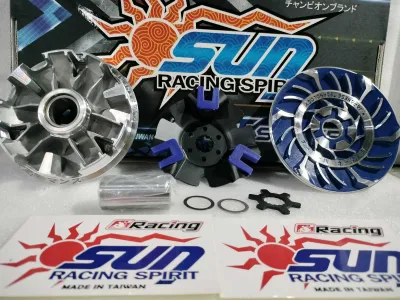
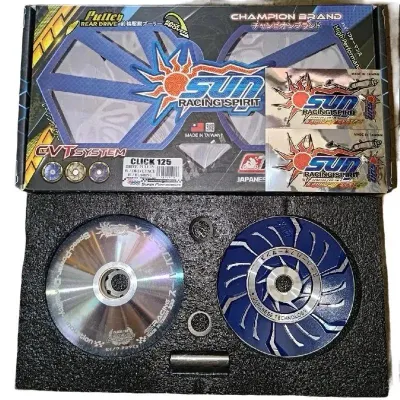

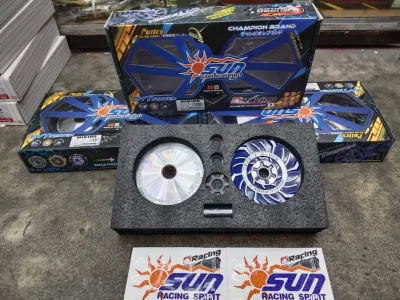
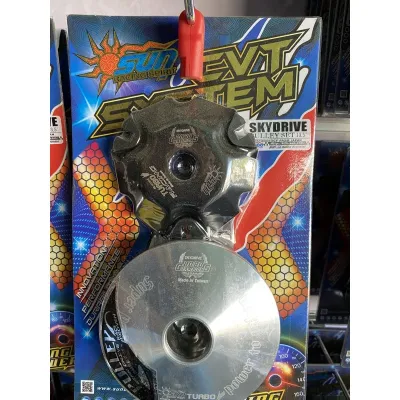
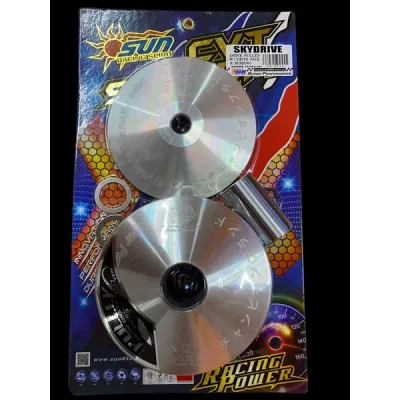
Prices are valid at publication and may change. Please refer to the product page for the latest price.
How Ramp Angles Influence Acceleration and Top Speed
The ramp angle refers to the slope of the internal tracks machined into the variator body. These tracks guide the roller weights as they slide outward under centrifugal force. The geometry of this angle is a primary factor in determining when and how quickly your CVT shifts.

A shallower or lower ramp angle allows the roller weights to slide outward more easily at lower engine speeds. This rapid outward movement forces the variator to close quickly, pushing the drive belt to a larger diameter early in the acceleration curve. This setup improves initial acceleration and low-end torque, making it highly effective for navigating heavy, stop-and-go traffic or launching quickly from a standstill. However, shifting up too early can prevent the engine from reaching its peak horsepower RPM, potentially capping your top-end speed.
Conversely, a steeper or higher ramp angle resists the outward movement of the roller weights. The rollers require more centrifugal force—and therefore higher engine RPM—to climb the steeper tracks. This delays the upshifting process, keeping the transmission in a lower gear ratio longer. By holding the engine in its higher RPM range, a steeper ramp angle allows the scooter to utilize its full horsepower curve, which benefits top-end speed, overtaking power, and high-speed cruising.
When evaluating a Sun Racing pulley set, look at the degree specifications printed on the packaging or product documentation. These are typically compared against your scooter’s original equipment manufacturer (OEM) baseline. For instance, if your OEM variator features a conservative 14-degree ramp, switching to a more aggressive 13.5-degree or customized multi-angle ramp will noticeably shift your power band. Keep in mind that the ramp angle does not operate in isolation; its real-world effect is heavily dependent on the mass of the roller weights you install and the tension of the rear clutch’s torque spring, which acts as the opposing force to the front pulley’s movement.
Roller Weights and Pulley Face Design
While the ramp angle sets the path, the roller weights act as the catalysts for movement. Tuning the mass of these rollers allows you to fine-tune exactly when the CVT shifts. Lighter roller weights require higher engine RPM to generate the centrifugal force needed to climb the ramp tracks. This results in a sportier, high-revving feel with immediate throttle response, though it can lead to increased fuel consumption. Heavier roller weights generate the necessary centrifugal force at lower RPMs, promoting earlier upshifting for a smoother, more relaxed ride that optimizes fuel economy during steady cruising.
Beyond the moving parts, the physical design and material composition of the pulley face play a critical role in transmission efficiency. Performance pulley sets like those from Sun Racing are typically machined from high-grade aluminum alloys to reduce rotational mass and improve heat dissipation. High operating temperatures in tropical environments can cause the drive belt to soften, slip, and wear prematurely.
When selecting a pulley set, check the manufacturer’s specifications for surface treatments and coatings. A smoother, precision-machined pulley face ensures consistent friction across the entire surface of the drive belt. This uniform contact reduces belt slippage under heavy acceleration and minimizes localized hot spots, extending the service life of both the belt and the pulley faces. However, riders must not assume that an aggressive “racing” design is always superior for daily use. Highly aggressive face angles and lightweight components can sacrifice low-speed smoothness, leading to a jerky, high-vibration ride during low-speed maneuvering.
Matching Pulley Specs to Your Riding Scenarios
To get the most out of your transmission upgrade, you must match the pulley specifications to your typical riding environment and performance goals.
For city commuting and navigating heavy urban traffic, a setup that prioritizes low-end responsiveness is ideal. Choosing a pulley set with a moderate to shallow ramp angle combined with slightly lighter roller weights than stock allows for rapid throttle response. This combination helps you accelerate quickly out of tight spots and filter safely between vehicles at low speeds.
If your daily ride involves highway touring and long-distance travel, your priorities shift toward efficiency and comfort. A setup featuring steeper ramp angles and heavier roller weights allows the engine to settle into a lower, more relaxed RPM range while maintaining high cruising speeds. This reduces engine vibration, lowers operating temperatures, and prevents unnecessary engine wear over long distances.
For riders operating in hilly regions or frequently carrying heavy cargo or a passenger, a balanced setup is required. You need sufficient low-end torque to climb steep inclines without causing the drive belt to slip under the extra weight. In these scenarios, a moderate ramp angle paired with mid-weight rollers ensures the engine stays within its torque band without revving excessively. Always evaluate the front pulley set in conjunction with your rear clutch and torque spring specifications; a mismatched CVT system can cause the transmission to “hunt” for the correct ratio or suffer from severe belt slippage.
Compatibility Checks and Installation Safety
Before purchasing any aftermarket transmission component, physical compatibility must be verified using your vehicle’s specific documentation. Never assume a pulley set fits simply because it is labeled for a certain engine class or displacement. You must cross-reference the product specifications with your scooter’s service manual, paying close attention to the crankshaft spline count, the boss collar’s outer and inner diameters, and the overall length of the assembly. An incorrect interface can strip the crankshaft splines, resulting in catastrophic engine damage.
Installing a new variator set requires strict adherence to safety protocols and correct mechanical procedures. The CVT system operates under high spring tension and rotational forces. To perform this work safely:
- Verify Instructions: Always check the Sun Racing product packaging labels and your scooter manufacturer's service instructions before starting the installation; if any instructions or specifications conflict, stop and consult a qualified professional.
- Secure the Vehicle: Always secure the vehicle on a stable center stand and block the rear wheel to prevent movement.
- Use Proper Tools: Use the correct rotor holding tools or variator locking tools to hold the pulley face secure while loosening or tightening the nut; never use improvised tools like screwdrivers or chisels, which can chip the aluminum fins or bend the crankshaft.
- Torque to Spec: Always use a calibrated torque wrench to tighten the variator nut to the exact torque specification defined by your scooter's manufacturer. Over-tightening can strip the threads or crush the boss collar, while under-tightening can cause the nut to back off during operation, destroying the CVT cover and crankshaft.
If you do not possess the specialized locking tools, a calibrated torque wrench, or the mechanical experience required to perform this installation safely, have the pulley set installed by a qualified professional mechanic. Additionally, be aware that modifying your scooter’s factory transmission components may void your vehicle’s manufacturer warranty.
Frequently Asked Questions (FAQ)
Do I need to replace the drive belt when installing a new pulley set?
While it is not strictly mandatory if your current drive belt is relatively new and measures within the manufacturer’s width specifications, installing a fresh, high-quality belt alongside a new pulley set is highly recommended. An old, worn, or glazed belt will not seat properly in the newly machined grooves of the aftermarket pulley faces. This mismatch reduces contact friction, negating the performance benefits of your upgrade and increasing the risk of the belt slipping or snapping under load.
Will a racing pulley set improve my scooter's fuel efficiency?
Performance-oriented racing pulley sets are generally engineered to keep the engine operating in a higher RPM range to maximize power delivery and acceleration, which typically increases fuel consumption. If your goal is to optimize fuel economy, you should look for a setup that allows the engine to cruise at lower, more efficient RPMs. This is typically achieved using heavier roller weights and touring-focused ramp angles rather than aggressive racing profiles.
Community discussion
Share your experience or ask a question. Comments are reviewed before publication.