
Finding the right dual sports helmet in the Philippines requires balancing off-road versatility, street safety, and budget constraints. A dual sports helmet combines the sun-blocking peak and extended chin bar of a motocross helmet with the face shield and wind protection of a full-face street helmet. This hybrid design is highly popular among adventure riders, dual-sport enthusiasts, and daily commuters who navigate both paved highways and rough provincial roads. However, because these helmets must perform in diverse environments, choosing one involves understanding how safety certifications, shell materials, and aerodynamic features scale across different price points.
Verifying Safety Standards and Dual-Purpose Design Trade-Offs
In the Philippines, the Land Transportation Office mandates that all motorcycle riders wear helmets with valid safety markings. The primary local indicator of compliance is the Import Commodity Clearance (ICC) sticker or the Philippine Standard (PS) mark. These stickers prove that the helmet has undergone local quality testing and meets the safety standards set by the Bureau of Philippine Standards. When purchasing a dual sports helmet, verifying the presence of a genuine, tamper-evident ICC sticker on the rear of the shell is the first step to ensuring street legality and basic impact protection. Some imported helmets may also carry Singapore’s PSB certification or other regional marks, which serve as additional quality indicators alongside the mandatory local stickers.
While local stickers are legally required, international safety standards provide supplementary benchmarks for impact absorption and structural integrity. The most common international certifications found on helmets in the local market are the United States Department of Transportation (DOT) standard and the Economic Commission for Europe (ECE) standard, specifically ECE 22.05 or the more rigorous ECE 22.06. ECE 22.06 testing involves multi-directional impact assessments and rotational force measurements, offering a higher level of safety assurance. Riders should look for these certifications molded or printed directly onto the helmet shell beneath the clear coat or on the rear label.
Products mentioned in this guide
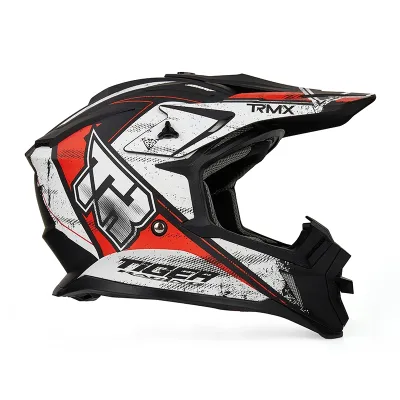
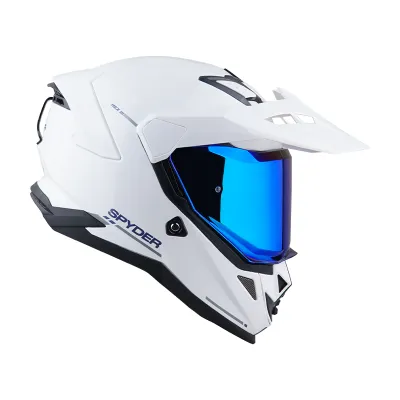
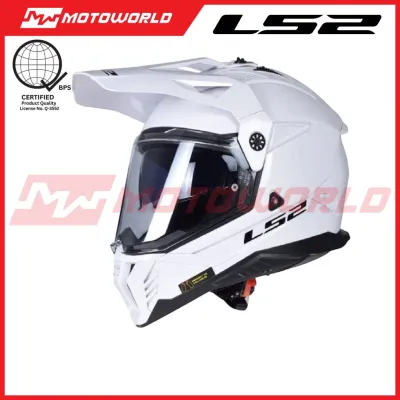
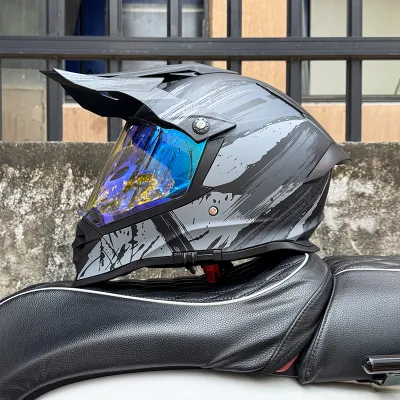
Prices are valid at publication and may change. Please refer to the product page for the latest price.
The hybrid nature of a dual sports helmet introduces specific aerodynamic and physical trade-offs that riders must consider. The extended chin bar, designed to mimic off-road helmets, provides excellent ventilation and breathing room, which is highly beneficial in the hot and humid tropical climate of the Philippines. However, this extended profile can increase wind resistance and noise at high speeds. Similarly, the peak visor is invaluable for blocking the intense tropical sun and shielding the face from low-hanging branches on dirt trails, but it acts as a sail at highway speeds, catching the wind and causing neck strain or aerodynamic lift. Understanding these compromises helps riders choose a helmet that aligns with their primary riding environment, whether it is mostly high-speed highway touring or low-speed trail riding.
Setting Realistic Expectations Across Budget Tiers
When shopping for a dual sports helmet, budget tiers generally dictate the quality of materials, overall weight, ventilation efficiency, and long-term durability. While all legally sold helmets must meet baseline safety standards, higher-priced options utilize advanced composites and sophisticated engineering to reduce weight and improve rider comfort during long hours in the saddle. Understanding what each price bracket offers allows riders to set realistic expectations and select a helmet that matches their riding frequency and intensity.

Entry-Level Options
Entry-level dual sports helmets, typically positioned in the lower price bracket under ₱5,000, are primarily constructed using injection-molded Acrylonitrile Butadiene Styrene (ABS) plastic or basic polycarbonate shells. While ABS plastic is highly impact-resistant and capable of passing safety certification tests, it is inherently heavier than composite materials, often resulting in a helmet weight that can cause neck fatigue during extended rides. Ventilation systems in this tier are usually basic, featuring simple open-and-close vents with minimal internal EPS channeling, which can lead to heat buildup in slow-moving traffic. The interior padding is typically made of standard foam and basic fabrics that may wear out or compress more quickly over time. These helmets are highly suitable for daily city commutes, light weekend trail riding, and beginner riders who prioritize affordability and basic legal compliance over long-distance comfort.
Mid-Range Options
Mid-range dual sports helmets, generally falling into the middle price bracket between ₱5,000 and ₱15,000, offer a significant step up in material quality and rider comfort. Shells in this category are often made from fiberglass composites or advanced polycarbonate blends, which substantially reduce the overall weight of the helmet while maintaining high structural strength. This weight reduction is crucial for minimizing neck strain during weekend touring or moderate off-road trail riding. Additionally, mid-range helmets feature more sophisticated ventilation systems with deep channels carved into the internal Expanded Polystyrene (EPS) liner, allowing for efficient airflow that pulls heat and moisture away from the rider’s head. The interior liners are typically made from moisture-wicking, antimicrobial fabrics that are fully removable and washable—a critical feature for maintaining hygiene in hot, humid riding conditions.
Premium Options
Premium dual sports helmets, occupying the top price bracket exceeding ₱15,000, represent the pinnacle of helmet technology, safety engineering, and material science. These helmets utilize advanced carbon fiber, aramid, or multi-layer organic fiber composite shells to achieve the highest possible strength-to-weight ratios, resulting in an exceptionally lightweight helmet that offers superior energy dissipation during an impact. The peak visors on premium models are aerodynamically tuned and wind-tunnel tested to minimize drag and lift at high speeds, often featuring cutouts that allow wind to pass through cleanly. Furthermore, premium helmets are equipped with advanced safety features such as Emergency Quick Release Systems (EQRS), which allow medical responders to easily remove the cheek pads and slide the helmet off an injured rider’s head without straining the neck. These helmets are designed for high-intensity enduro riding, long-distance adventure touring, and professional riders who demand the absolute best in safety, comfort, and durability.
Evaluating Fit, Comfort, and Off-Road Features
Selecting the right dual sports helmet goes beyond choosing a budget tier; it requires a practical, hands-on evaluation of fit, comfort, and specific off-road features. A helmet that does not fit correctly cannot protect the head effectively, regardless of its price or certifications. When trying on a helmet, riders should ensure it fits snugly around the crown of the head and the cheeks without causing painful pressure points. The helmet should not rotate or slide when the head is shaken. Because head shapes vary—ranging from round oval to intermediate oval and long oval—it is essential to try on different brands and styles to find the shell shape that matches your anatomy.
For riders who plan to transition frequently between street and off-road environments, compatibility with off-road goggles is a critical feature to evaluate. The eye port of the dual sports helmet must be wide enough to accommodate standard riding goggles when the face shield is raised or removed. Riders should test this compatibility in-store, checking that the goggle frame fits securely against the face without pinching the nose or leaving large gaps along the sides where dust, mud, or rain could enter. Some helmets feature integrated channels or textured areas on the rear of the shell to keep the goggle strap securely in place during rough rides.
The peak visor and interior customization options also require close inspection before purchase. The peak visor should feature an adjustable mechanism that allows the rider to tilt it up or down to block the sun or accommodate goggles. This mechanism must be robust, with durable mounting screws that can withstand constant trail vibrations without loosening. Additionally, riders should check if the helmet manufacturer offers interchangeable cheek pads of varying thicknesses. This allows for fine-tuning the fit to accommodate different facial structures, and it ensures there is sufficient space to install communication systems, intercom speakers, or hydration tubes without compromising comfort or safety.
Securing Genuine Helmets and Avoiding Counterfeits
The popularity of dual sports helmets has unfortunately led to an influx of counterfeit and substandard gear in the market. To ensure maximum protection, riders must prioritize purchasing through authorized physical dealers and official brand stores. Buying from an authorized physical retail store allows for direct inspection of the helmet’s build quality, verification of safety stickers, and the opportunity to try on different sizes for an accurate fit. Furthermore, authorized dealers provide genuine manufacturer warranties and reliable after-sales support, which is essential if a visor mechanism breaks or replacement cheek pads are needed.
When shopping on e-commerce platforms or online marketplaces, riders must exercise extreme caution to avoid purchasing dangerous fake gear. It is critical to verify the seller’s credentials by looking for official mall badges, high store ratings, and detailed buyer reviews that include real photos of the product and its packaging. Extremely low prices that seem too good to be true are a primary indicator of counterfeit products. Genuine certified helmets are manufactured to strict standards, and their pricing reflects the quality of materials and testing involved.
Upon receiving a helmet purchased online, a thorough physical inspection is necessary before taking it out on the road. Riders should check for a manufacturing date stamp, usually located on a label sewn onto the chin strap or printed on the internal EPS liner; helmets older than five years from the manufacture date should generally be avoided as the protective materials degrade over time. Additionally, inspect the holographic anti-counterfeit labels, the quality of the paint and graphics, and the overall weight and feel of the helmet. High-quality packaging, including a branded box, a thick helmet bag, and an instruction manual, is also a strong indicator of an authentic product.
Frequently Asked Questions (FAQ)
Can I use a dual sports helmet for everyday city commuting?
Yes, a dual sports helmet is highly practical for everyday city commuting. The extended chin bar provides excellent breathing room and airflow, which is a major advantage in heavy, slow-moving traffic under the hot tropical sun. Additionally, the wide eye port offers an expansive field of vision, making it easier to spot pedestrians, lane-splitting motorcycles, and hazards in urban environments. However, commuters should be prepared for slightly higher wind noise compared to dedicated full-face street helmets, and the peak visor may catch the wind when transitioning to faster elevated highways.
Should I remove the peak visor for sustained highway riding?
If your route involves sustained highway riding at higher speeds, removing the peak visor can significantly improve comfort and reduce neck fatigue. At highway speeds, the peak visor acts as a sail, catching the wind and causing aerodynamic lift or buffeting that strains the neck muscles. Most dual sports helmets are designed with removable peak visors, allowing riders to easily convert them into a standard full-face configuration for long-distance highway touring. If removal is not an option, adjusting the peak to its highest position can help channel air more efficiently.
How do I know when it is time to replace my helmet?
A helmet must be replaced immediately after any significant impact or crash, even if there is no visible damage to the outer shell, as the internal EPS liner compresses to absorb impact energy and cannot protect the head a second time. Under normal use, safety organizations recommend replacing a helmet every five years from the date of first use, or seven years from the date of manufacture, due to the natural degradation of glues, resins, and protective liners. Observable signs that indicate it is time for a replacement include a loose fit caused by degraded interior padding, a frayed or damaged chin strap, or cracking in the internal EPS foam.

Community discussion
Share your experience or ask a question. Comments are reviewed before publication.