
The clutch spring is a critical component for transferring engine power to the transmission in your 100cc motorcycle. Choosing a replacement with incorrect specifications can lead to clutch slippage, hard shifting, or premature wear of the clutch basket. To restore your motorcycle’s performance, you must verify specific physical dimensions and material standards before purchasing a replacement. Relying solely on a product label that claims to fit “universal 100cc models” can result in poor clutch engagement or accelerated wear on the clutch basket.
Core Dimensions: Wire Diameter, Free Length, and Coil Count
When evaluating a replacement clutch spring, physical dimensions are the most critical factors to verify. The wire diameter is the thickness of the spring wire itself. Even a fraction of a millimeter difference in wire diameter significantly alters the spring stiffness. A thicker wire increases the force required to compress the spring, which translates to a heavier clutch lever pull but a firmer clutch engagement.
Free length refers to the total height of the spring when it is completely uncompressed. You must measure this dimension carefully from end to end. Installing a spring with a shorter free length than the original specification reduces the pre-load tension inside the clutch assembly. This lack of tension prevents the clutch plates from locking together tightly, causing the engine to rev high without transferring power to the rear wheel.
Products mentioned in this guide
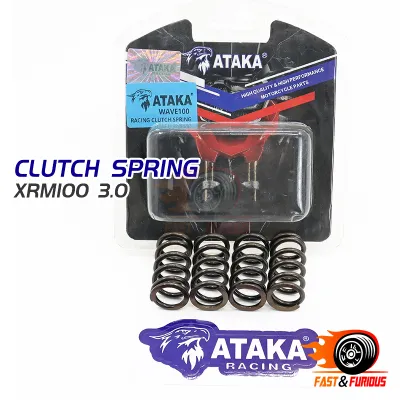
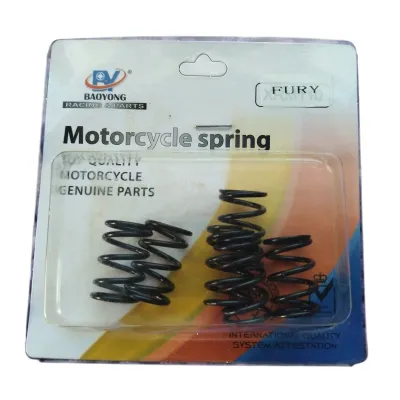
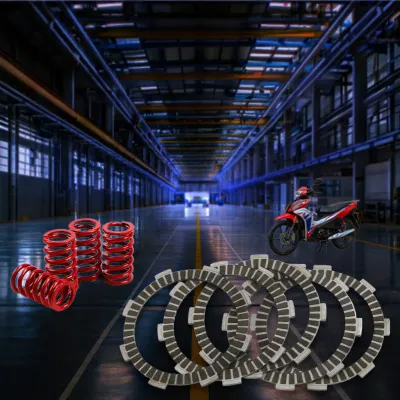
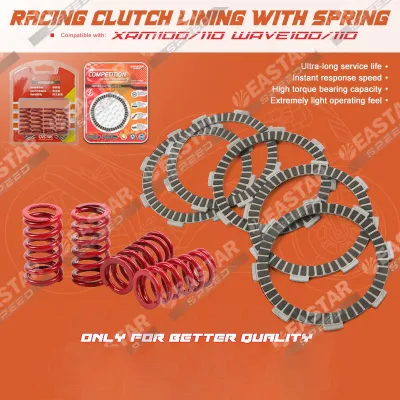
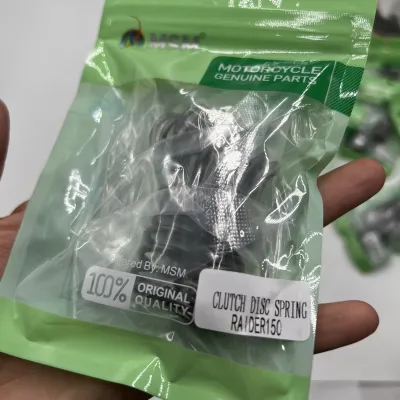
Prices are valid at publication and may change. Please refer to the product page for the latest price.
The number of active coils—the individual turns of the wire that compress during operation—also dictates the spring rate. A spring with fewer coils is generally stiffer than a spring of the same length and wire diameter with more coils. If the coil count is incorrect, the clutch lever feel will change, and the spring may bind or reach its solid height before the clutch lever is fully pulled.
To verify these dimensions, do not rely on visual estimation. Use a digital caliper to measure your old springs. Measure the wire diameter at multiple points and check the free length of all springs in the set to ensure consistency before installation.
Material Grade and Heat Resistance Labels
The operating environment inside a motorcycle engine is harsh, characterized by high temperatures and constant exposure to engine oil. Clutch springs must maintain their tension under these conditions without sagging. When shopping for replacements, check the manufacturer’s packaging or official product documentation for references to heat-treated high-tensile steel or specific alloy designations, such as silicon-manganese steel.

High-quality materials resist thermal fatigue, which is the gradual loss of spring tension caused by repeated heating and cooling cycles. In tropical climates and congested urban areas, engine temperatures rise quickly during prolonged idling. A spring made from inferior steel will quickly lose its structural integrity under these conditions, leading to premature sagging and a soft clutch lever.
Be cautious of unmarked, generic, or unusually cheap clutch springs sold on online marketplaces. These budget options often bypass proper tempering and heat-treatment, making them highly susceptible to rapid deformation under load.
Do not assume the quality of a spring based on its color, paint, or surface finish. Some aftermarket manufacturers coat their springs in bright colors for aesthetic appeal, but this coating does not indicate the grade of the underlying metal. Always verify the material specifications through official product labels, manufacturer catalogs, or trusted retail documentation.
Verifying OEM Part Numbers and Aftermarket Compatibility
To guarantee a perfect fit, the most reliable method is to cross-reference the original equipment manufacturer (OEM) part number. You can find this unique identifier in your motorcycle’s official parts catalog, owner’s manual, or service guide. Having the exact OEM part number allows you to search for direct replacements that match the factory specifications precisely.
When looking at aftermarket options, compare the manufacturer’s compatibility list against your OEM part number. Avoid products labeled as “universal” for all 100cc motorcycles, as they often require physical modifications that introduce imbalances and risk damaging internal transmission components.
It is also vital to confirm the specific model year and variant of your Wave 100. Manufacturers occasionally introduce minor design revisions mid-cycle, which can alter the depth of the clutch basket or the diameter of the spring wells. A spring designed for an older model year might not seat correctly in a newer variant, even if both motorcycles share the same engine displacement.
If you encounter conflicting part numbers or if the aftermarket packaging lacks clear compatibility details, do not guess. Consult an authorized dealer or a qualified motorcycle mechanic to verify the fitment. Taking this extra step prevents the hassle of purchasing incompatible parts and protects your engine from potential damage.
Pre-Installation Checks and Safety Boundaries
Before installing your new clutch springs, inspect the entire clutch assembly. New springs cannot resolve slipping if the friction plates are worn thin or if the steel plates are glazed. Inspect the clutch basket for deep grooves that can prevent the plates from moving smoothly.
When reassembling the clutch, always refer to the official service manual for the exact torque specifications of the clutch spring bolts and the clutch center nut. Under-tightening these fasteners can cause them to back out during operation, leading to catastrophic engine failure. Conversely, over-tightening can easily strip the delicate aluminum threads of the clutch lifter plate or snap the bolts.
Working on a motorcycle transmission requires specific tools to ensure safety and precision. If you do not have a clutch holding tool or a calibrated torque wrench, do not attempt to improvise with impact wrenches or screwdrivers. Doing so risks cracking the clutch hub or damaging the engine cases. In the absence of proper tools, halt the installation and bring the components to a qualified professional.
Finally, a clutch replacement job is an excellent opportunity to perform an oil change. Drain the old engine oil completely and dispose of it in accordance with local environmental regulations. Refill the crankcase with the correct grade and volume of fresh motorcycle-specific oil, ensuring it meets the wet-clutch compatibility standards (such as JASO MA or MA2) to guarantee optimal lubrication and grip for your new springs.
Frequently Asked Questions (FAQ)
Can I use a stiffer aftermarket clutch spring for better acceleration?
Stiffer aftermarket clutch springs can reduce clutch slippage under heavy loads or during aggressive riding, which some riders perceive as improved acceleration. However, this modification comes with significant trade-offs. The primary drawback is a much heavier clutch lever pull, which can lead to severe hand fatigue during daily commutes in heavy traffic. Additionally, the increased tension puts extra stress on your clutch cable, lever pivot, and internal lifter mechanism, potentially causing these parts to wear out or snap prematurely. For a standard, unmodified 100cc commuter motorcycle, sticking to OEM-equivalent spring rates is highly recommended to maintain a comfortable ride and preserve the longevity of your drivetrain components.
How do I know if my current clutch spring is sagging or worn out?
You can diagnose worn clutch springs through both riding symptoms and physical measurements. On the road, a slipping clutch is the most common sign; you will notice the engine RPMs rising sharply when you twist the throttle, but the motorcycle’s speed does not increase proportionally. You might also experience difficulty shifting gears or finding neutral when the engine is idling. To confirm spring fatigue physically, remove the springs and place them side-by-side on a flat surface. Use a digital caliper to measure their free length and compare the readings to the service limit specified in your manual. If any spring is shorter than the limit, or if there is a noticeable height difference among the springs in the set, replace the entire set immediately to ensure even pressure distribution across the clutch pack.
Community discussion
Share your experience or ask a question. Comments are reviewed before publication.