
Lifting a vehicle for a tire change or roadside inspection requires the right tools working in perfect harmony. The wrench you need for a car jack depends entirely on the jack’s mechanical interface, its lifting mechanism, and the physical space available under your vehicle. While some jacks rely on specialized crank handles, others feature standard hexagonal drive nuts or hydraulic release valves that require precise socket sizes or open-end wrenches. Using an incorrect or poorly fitting tool can lead to rounded bolt heads, slipped grips, or sudden mechanical failures, posing severe safety risks during roadside emergencies.
To ensure a safe and efficient lifting process, you must match the wrench style and size to your specific jack model. This guide breaks down how to identify your jack’s interface, select the most effective wrench style, measure for the exact size, and evaluate tool quality to keep your roadside kit reliable.
Before performing any lifting, tire changes, or roadside work, establish a strict safety boundary. Always park your vehicle on a flat, level surface, engage the parking brake, and place wheel chocks behind the tires. Never rely solely on a jack to support a vehicle; always use properly rated jack stands to secure the load before placing any part of your body underneath. Always consult your vehicle’s original owner’s manual for specific lifting points, weight limits, and safety instructions before operating any lifting equipment.
Products mentioned in this guide
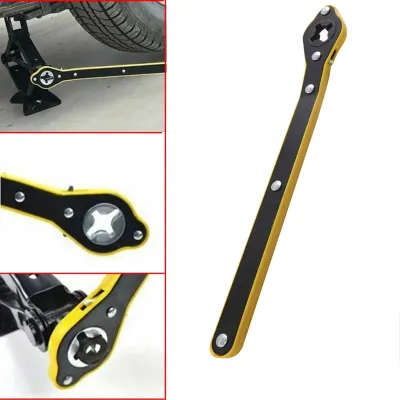
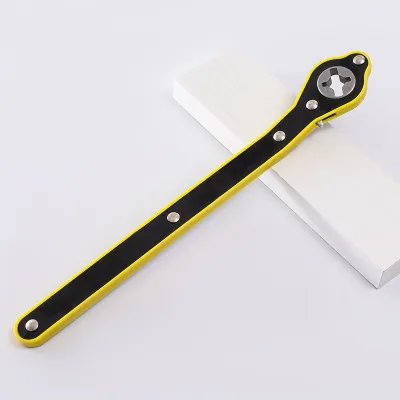
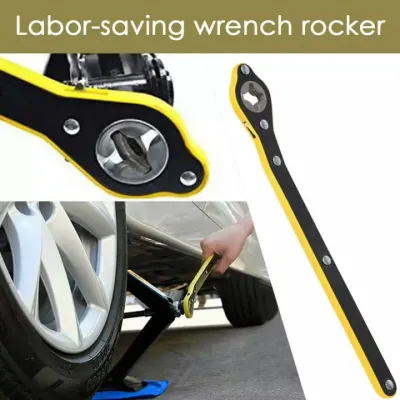
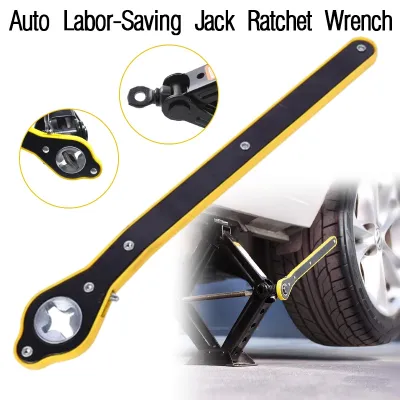
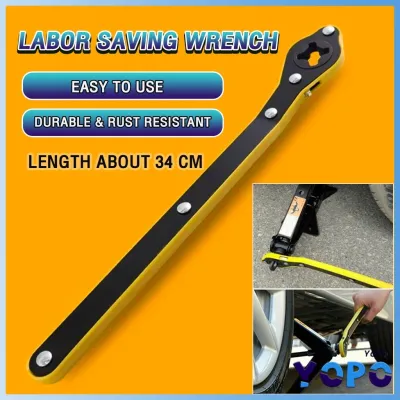
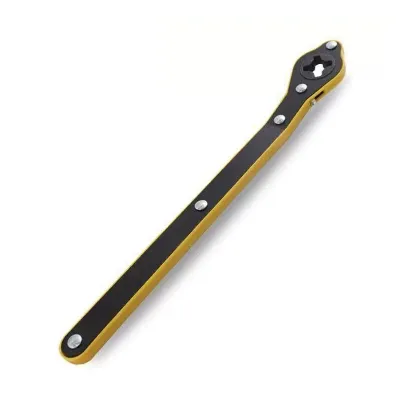
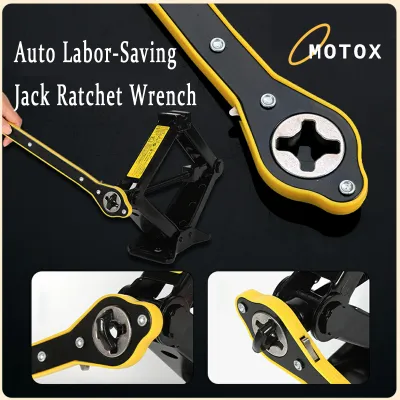
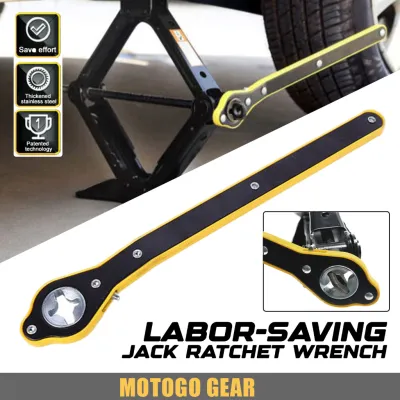
Prices are valid at publication and may change. Please refer to the product page for the latest price.
Identify Your Car Jack Type to Understand the Interface
Before selecting a wrench, you must identify the specific type of car jack stored in your trunk or garage. Different jacks utilize distinct mechanical designs to convert manual force into lifting power, and each design features a unique interface for tool engagement.
Scissor jacks are the most common emergency lifting tools supplied with passenger cars. These jacks rely on a central threaded screw mechanism that runs horizontally through the middle of a diamond-shaped frame. To raise or lower the vehicle, you must apply continuous rotational force to the drive nut located at one end of the screw. Because this process requires dozens of full rotations under load, the interface demands a tool that can remain securely attached while spinning continuously.
Hydraulic bottle jacks and floor jacks operate on a completely different principle. Instead of a continuous screw, they use a hydraulic piston pressurized by a manual pump arm. However, these jacks still feature critical mechanical interfaces that require a wrench. Specifically, they utilize a manual release valve to lower the vehicle safely, and some models feature adjustable extension screws or lock nuts at the top of the piston to adjust the starting height. Operating these valves and nuts requires a tool that can deliver precise, controlled torque to prevent sudden drops.
Farm jacks, often referred to as Hi-Lift jacks, are heavy-duty mechanical tools popular among off-road enthusiasts navigating rugged terrain. These jacks utilize a climbing pin and lever mechanism to lift high-clearance vehicles. While the primary lifting action is performed with a large integrated handle, these jacks often feature structural bolts, base plate attachments, or accessory mounts that require regular adjustment. Maintaining these components requires robust, fixed-size wrenches capable of handling extreme outdoor conditions.
To determine the exact tool requirements for your lifting equipment, always begin by checking the manufacturer’s manual, warning labels, or stamped markings on the jack’s body. These resources provide official specifications regarding drive nut sizes, maximum load capacities, and approved operating procedures. Never guess the interface requirements, as using an incompatible tool can damage the jack and compromise vehicle stability.
Choose the Right Wrench Style for Your Jack Design
Once you understand your jack’s interface, you can select a wrench style that balances leverage, speed, and safety. The right style prevents hand fatigue and ensures you can operate the jack efficiently in confined spaces.

Socket wrenches and ratchets are highly recommended for scissor jacks. A ratcheting handle allows you to turn the drive nut continuously without having to remove and reposition the tool after every partial turn. This is incredibly valuable when working within the tight confines of a wheel well or under a low-clearance chassis. By pairing a standard ratchet with a deep socket that matches the drive nut, you create a secure, enclosed connection that minimizes the risk of the tool slipping off under load.
Combination or open-end wrenches are the ideal choice for operating the release valves and lock nuts on hydraulic bottle and floor jacks. These valves are often positioned in recessed or awkward locations near the base of the jack. A combination wrench, which features an open end on one side and a closed box end on the other, provides the flexibility needed to grip flat-sided valves or small hex heads securely. The closed box end is particularly useful for high-torque lock nuts, as it distributes force evenly across all sides of the hardware.
Adjustable wrenches are often viewed as a convenient, one-size-fits-all backup option for automotive toolboxes. However, they have inherent limitations when used on car jacks. The adjustable jaws of these wrenches can flex or loosen slightly under heavy loads, which can lead to rounded bolt heads or sudden slips. While an adjustable wrench may serve as a temporary emergency tool for low-torque tasks, such as gently turning a hydraulic release valve, it should not be relied upon as the primary tool for heavy lifting operations.
Many vehicles come equipped with OEM lug wrenches or specialized jack handles designed by the manufacturer to double as the primary drive tool for the factory-supplied scissor jack. These tools often feature a hooked end that slots directly into the jack’s drive loop, or an integrated socket that fits the drive nut perfectly. While these OEM tools are highly compact and convenient, they often lack the leverage and smooth operation of a dedicated aftermarket ratchet, making them more physically demanding to use during a roadside tire change.
Determine the Exact Wrench Size Before Buying
Purchasing a wrench without verifying the exact size of your jack’s drive nut or valve can leave you with an unusable tool during an emergency. Taking precise measurements beforehand ensures a perfect fit and prevents costly hardware damage.
Never infer tool or jack compatibility based solely on generic category terms. You must verify your specific vehicle model, year, jack mounting positions, interface dimensions, and road legality by consulting the official documentation provided by both the vehicle and jack manufacturers.
The most reliable way to find the correct size is to consult the vehicle owner’s manual, the jack’s original documentation, or the manufacturer’s official website. If the original paperwork is unavailable, look closely at the jack itself; many manufacturers stamp the required socket or wrench size directly onto the metal frame or the drive nut.
If no written specifications are available, you can measure the hardware yourself using digital calipers or a physical sizing gauge. When using calipers, measure the distance across the flat parallel sides of the drive nut or bolt head, rather than the corners. This measurement will give you the exact width across flats, which corresponds directly to standard wrench sizes.
Understanding the critical difference between metric and imperial (SAE) measurements is vital for automotive safety. While some metric and imperial sizes are close in dimension—such as 19mm and 3/4 inch—they are not perfectly interchangeable. Using a 3/4-inch wrench on a 19mm nut may feel like a decent fit initially, but the slight clearance (or “play”) can cause the tool to slip and strip the corners of the nut when high torque is applied. Always use the exact measurement system specified by the manufacturer to ensure full engagement.
Before committing to a purchase, test the fit using an existing tool set if possible. Place the socket or wrench over the jack’s drive nut and attempt to wiggle it. There should be zero play, and the tool should slide on smoothly without forcing. If you experience any slipping or loose movement, re-measure the hardware to avoid purchasing an incorrect replacement.
Evaluate Wrench Quality and Safety Features
When lifting a vehicle weighing thousands of kilograms, tool failure is not an option. Evaluating the material, construction, and safety features of a wrench before buying ensures it can withstand the high forces required for automotive lifting.
First, examine the material and construction of the tool. Look for product labels indicating that the wrench is made from drop-forged chrome vanadium (Cr-V) or chrome molybdenum (Cr-Mo) steel. These alloy steels undergo heat treatment to maximize tensile strength and durability, ensuring the tool will not bend, crack, or shatter under heavy loads. High-quality steel is essential for maintaining structural integrity over years of roadside use.
Handle length and leverage must be carefully balanced against the physical clearance available under your vehicle’s chassis. A longer handle provides greater leverage, reducing the physical effort required to lift the vehicle. However, if the handle is too long, it may strike the ground or the vehicle’s bodywork during rotation. For scissor jacks, a medium-length ratchet paired with a short extension bar often provides the perfect balance of leverage and clearance.
If you choose a ratcheting wrench, evaluate the ratcheting mechanism’s tooth count and design. A higher tooth count (such as 72 or 90 teeth) requires a much smaller swing arc to engage the next gear tooth, allowing you to operate the jack efficiently in extremely tight spaces. Ensure the direction switch is robust and easy to operate, and look for a low-profile head design that can slip into narrow gaps without binding.
Finally, consider the grip design and finish, especially given the tropical climate of the Philippines. High humidity and frequent rainfall can quickly cause rust and corrosion on unprotected steel tools. Opt for wrenches with a high-polish chrome finish or a protective powder coating to resist rust. Additionally, a slip-resistant, ergonomic grip—such as a textured rubber or dual-material handle—ensures you can maintain a secure hold even when your hands are sweaty, greasy, or wet from a sudden downpour. For example, spending ₱500 to ₱1,500 on a high-quality, corrosion-resistant socket wrench is a practical investment that ensures your emergency kit remains reliable for years.
Frequently Asked Questions (FAQ)
Can I use an adjustable wrench instead of a fixed-size socket?
Using an adjustable wrench on high-torque jack components carries significant safety and mechanical risks. Under the heavy loads required to lift a vehicle, the adjustable jaws of the wrench can flex, causing the tool to slip off the drive nut. This slippage can instantly round off the sharp corners of the nut, making it incredibly difficult to turn even with the correct tool later. An adjustable wrench should only be used as a temporary, low-torque emergency measure—such as gently turning a hydraulic release valve—and never as the primary tool for heavy lifting.
What should I do if the original jack handle is lost?
If you lose your original jack handle, the safest approach is to source an exact OEM replacement from an authorized dealership or parts supplier. This ensures the replacement tool matches the original specifications for fit and leverage. Alternatively, you can assemble a highly durable aftermarket replacement using a high-quality socket that matches your jack’s drive nut, paired with a heavy-duty breaker bar or a ratcheting wrench. This combination often provides superior leverage and durability compared to the original factory tool.
Are impact wrenches safe to use on car jacks?
Using power tools like impact wrenches on manual car jacks is generally unsafe and highly discouraged. The uncontrolled, high-speed rotational force of an impact wrench can easily over-torque the jack, stripping the internal threads of a scissor jack’s screw or damaging the structural components of a hydraulic jack. Manual control is strongly preferred during lifting operations, as it allows you to feel any binding, resistance, or shifts in vehicle stability, ensuring a controlled and safe lift.
Community discussion
Share your experience or ask a question. Comments are reviewed before publication.