
Choosing the right flyball weight for your Honda Click 125 is one of the most effective ways to customize your scooter’s performance without altering the engine itself. Whether you are navigating the dense, stop-and-go traffic of Metro Manila or climbing the steep, winding roads of Antipolo, your scooter’s Continuously Variable Transmission (CVT) dictates how efficiently power is delivered to the rear wheel. Upgrading to an aftermarket option like a JVT flyball for the Honda Click 125 allows you to fine-tune this power delivery. The ideal weight depends entirely on your daily riding conditions, payload, and whether you prioritize snappy off-the-line acceleration or relaxed, fuel-efficient cruising.
Decoding Flyball Specifications: Size vs. Weight
Before adjusting your transmission’s performance, you must understand physical compatibility. Flyballs (often referred to globally as variator rollers) have two primary specifications: physical dimensions and weight.
The physical dimensions—specifically the outer diameter and width—are completely non-negotiable. For the Honda Click 125, the variator requires a specific size (typically 18×14 mm, though you must verify your exact model year’s technical documentation before purchasing). Forcing an incorrect size into the variator pulley will cause severe, immediate transmission damage, including torn belts, gouged variator faces, and potential engine lockup. This is a strict compatibility requirement, not a tuning choice.
Products mentioned in this guide
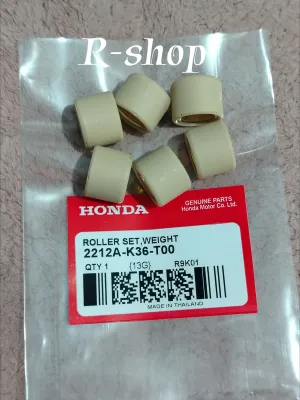
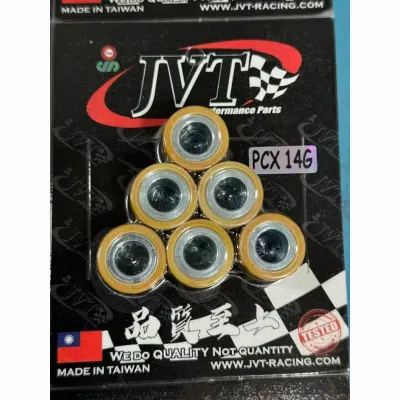
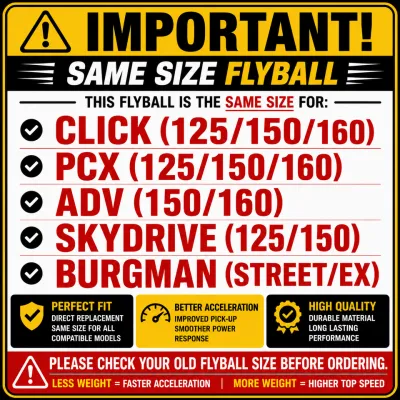
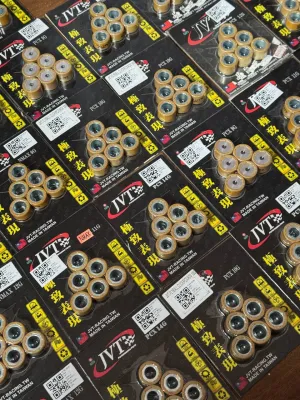
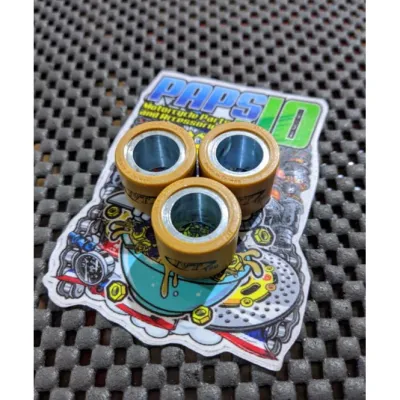
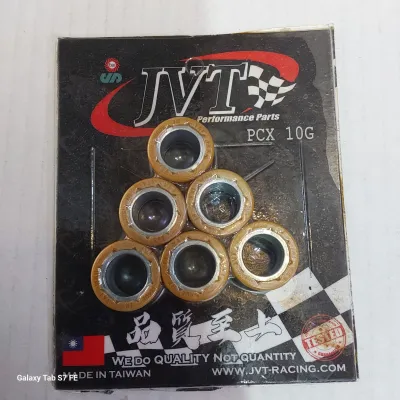
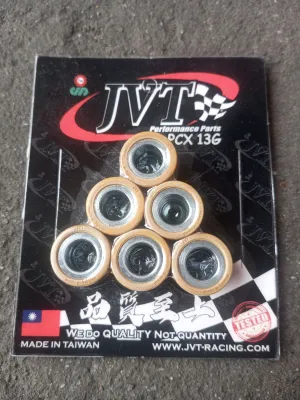
Prices are valid at publication and may change. Please refer to the product page for the latest price.
The weight, measured in grams, is the actual variable you can safely alter to tune your CVT. To establish a baseline, check your official owner’s manual, consult an authorized Honda dealer, or have a qualified mechanic physically weigh your stock OEM rollers. Knowing your stock weight (which is typically around 15 to 18 grams depending on the generation of the Click 125) is essential before swapping to aftermarket choices like JVT flyballs.
How a JVT Flyball for the Honda Click 125 Changes Your Riding Feel
To understand how changing the gram weight alters performance, you must look at how a CVT operates. As your engine spins faster, centrifugal force pushes the flyballs outward along the ramp plate inside the variator. This movement forces the two halves of the front pulley together, squeezing the drive belt outward and effectively shifting the scooter into a higher “gear.”

Lighter flyballs require higher engine speeds (RPM) to generate enough centrifugal force to push the pulley halves together. Consequently, the transmission stays in a lower gear ratio longer. This keeps the engine in its peak powerband during initial acceleration, giving you a much snappier throttle response and better climbing torque. However, because the engine must spin faster to maintain speed, you may experience a slight reduction in top-end speed and a noticeable increase in fuel consumption.
Conversely, heavier flyballs slide outward at lower engine speeds. This forces the CVT to shift to a higher gear ratio earlier in the acceleration curve. The engine runs at lower, more relaxed RPMs at cruising speeds, which reduces engine vibration and improves fuel economy on flat roads. The trade-off is a sluggish off-the-line response, making the scooter feel heavy and slow to respond when you twist the throttle quickly.
A common tuning myth is that heavier rollers automatically guarantee a faster top speed. In reality, if the rollers are too heavy, the engine will lack the horsepower to push the belt to the very edge of the pulley, actually reducing your top speed. True performance optimization relies on keeping your engine operating within its most efficient powerband for your typical riding environment.
Matching Flyball Weights to Your Daily Riding Scenarios
Selecting the correct gram weight is not about finding a single “best” number, but rather matching the weight to your daily riding environment in the Philippines.
- City Commuting (Stop-and-Go): If your daily route consists of heavy traffic in urban areas where you rarely exceed 60 km/h, a slightly lighter setup is highly beneficial. Dropping 0.5 to 1.0 grams below the stock OEM weight allows for quick, responsive overtaking and effortless maneuvering through tight spaces.
- Highway and Long-Distance Cruising: For riders who frequently travel long provincial highways or bypass roads at sustained speeds, slightly heavier weights (0.5 to 1.0 grams over stock) are ideal. This setup lowers your cruising RPMs, which minimizes engine strain, dampens handlebar vibrations, and maximizes your fuel mileage over long distances.
- Hilly Terrain and Heavy Loads: If you live in mountainous regions, regularly carry a pillion passenger, or use your scooter for heavy cargo and delivery services, lighter flyballs are highly recommended. Keeping the weight lower ensures the CVT does not bog down or shift too early while climbing steep inclines, keeping the engine safely within its torque range.
When making adjustments, always make small, incremental changes of 1 to 2 grams at a time. Drastic jumps can throw your CVT out of balance. Keep in mind that extreme weight modifications may also require you to upgrade other transmission components, such as installing a stiffer center clutch spring, to maintain proper belt tension and prevent slippage.
Safe Verification and Installation Steps for CVT Rollers
Before installing any new components, a thorough inspection of your existing transmission is necessary.
First, inspect your current rollers for flat spots, deep grooves, or physical deformation. Worn rollers cannot slide smoothly along the variator ramps, which causes severe CVT shuddering, erratic acceleration, and belt slippage regardless of the weight you choose.
Second, always verify that the aftermarket packaging—such as a set of JVT flyballs—explicitly lists the correct dimensions matching your Honda Click 125. Never rely solely on generic category labels or online product listings without cross-referencing physical measurements.
During installation, pay close attention to the orientation of the flyballs. Many aftermarket rollers have a directional design, featuring a fully covered plastic side (the stopper side) and an open brass side. The closed, plastic-covered side must face the direction of the rotational force inside the variator pulley to prevent metal-on-metal contact and premature wear of the variator walls.
Because working on a CVT involves high-tension springs and precise torque specifications, always consult the official Honda service manual or have a qualified mechanic perform the installation. Using the wrong torque on the variator nut can lead to the pulley coming loose at high speeds, resulting in catastrophic transmission failure, belt destruction, and severe safety hazards on the road.
Frequently Asked Questions (FAQ)
Can I mix different flyball weights in the variator?
Mixing different weights—such as alternating three lighter and three heavier rollers in a crisscross pattern—is a common practice among track tuners, but it is generally discouraged for daily commuting. While it can theoretically create an intermediate shifting curve, it often leads to uneven pressure distribution across the variator plate. Over time, this imbalance causes uneven wear on the variator boss, premature flat spots, and unpredictable shifting behavior. For reliable daily riding, always install a uniform set of six identical weights.
How do I know if my current flyballs need replacement?
You can identify worn-out flyballs through several clear riding symptoms. If you experience sluggish or delayed acceleration, severe shuddering or vibration when pulling away from a stop, or if your scooter struggles to reach its usual top speed, your rollers may be worn. A physical inspection is the only way to confirm; if you observe any flat spots, cracked outer shells, or exposed inner metal, replace the rollers immediately to prevent damage to your drive belt and variator face.
Community discussion
Share your experience or ask a question. Comments are reviewed before publication.