
Determining the correct jack stand capacity requires more than guessing your vehicle’s weight. It involves locating the manufacturer’s gross weight rating, understanding how weight shifts when a vehicle is lifted, and applying a safety margin. Working under a vehicle in the Philippines, whether it is a compact sedan navigating city streets or a loaded utility vehicle traversing provincial roads, requires absolute certainty in your garage equipment. High humidity and tropical conditions can also affect tool maintenance, making structural integrity even more critical. This guide provides a step-by-step framework to calculate the exact capacity you need, ensuring you select the right heavy-duty equipment for safe garage work.
Step 1: Locate Your Vehicle's Actual Weight
To find your vehicle’s actual weight, look beyond general estimates or online forum posts. Every vehicle has unique specifications based on its trim level, engine size, and optional equipment. The most reliable way to find this information is to locate the manufacturer’s official weight metrics rather than relying on generic vehicle classes.
You will encounter two primary weight terms: Curb Weight and Gross Vehicle Weight Rating (GVWR). Curb weight represents the weight of the vehicle with all standard equipment, operating fluids, and a full tank of fuel, but without any passengers or cargo. GVWR is the maximum operating weight of the vehicle as specified by the manufacturer, including the chassis, body, engine, fluids, accessories, passengers, and cargo.
Products mentioned in this guide
943 Lazada user ratings
🔨Durability:Provides excellent stability, Secure double locking mechanism, 👌Ease of Use:easy to manuever when installed Thanks for this affo…Read full reviewShow less
🔨Durability:Provides excellent stability, Secure double locking mechanism, 👌Ease of Use:easy to manuever when installed Thanks for this affordable and durable jack stand.
Durable and sturdy construction, Provides excellent stability, Perfect for car maintenance, Easy to use and adjust, Reliable and trustworthy…Read full reviewShow less
Durable and sturdy construction, Provides excellent stability, Perfect for car maintenance, Easy to use and adjust, Reliable and trustworthy product,
Perfect for car maintenance, Great value for the price, No brand, but great quality, Red color adds a stylish touch,
Red color adds a stylish touch, Durable and sturdy construction,
Prices are valid at publication and may change. Please refer to the product page for the latest price.
To find these numbers, inspect the manufacturer’s weight placard. This is typically a metal plate or a durable sticker located on the driver’s side door jamb, near where the door latches. If it is not there, check the inside of the glove box, the fuel filler door, or refer directly to the technical specifications section of your owner’s manual.
Using the GVWR is the safest baseline for calculating your required lifting capacity. In the Philippines, family vehicles such as multi-purpose vehicles (MPVs), mid-size SUVs, and utility pickups are frequently loaded with passengers, heavy cargo, aftermarket bull bars, or specialized tools. If you perform maintenance on a vehicle that is partially loaded or modified, relying on the lighter curb weight can lead to underestimating the actual load placed on your jack stands, creating a hazardous working environment.
Step 2: Understand Jack Stand Weight Ratings
Understanding how manufacturers label and rate jack stands is critical to preventing dangerous misinterpretations when purchasing garage equipment. A common point of confusion is the distinction between “per stand” and “per pair” capacity ratings. Many jack stands sold in local auto supply shops or on online marketplaces are labeled with a prominent tonnage rating, such as “3 tons,” which actually refers to the combined capacity of a matching pair of stands.

This means that if a package is labeled as a 3-ton set, each individual jack stand is only rated to support 1.5 tons (approximately 1,360 kilograms). Attempting to support a 3-ton load on a single stand from that pair can cause structural failure. Always read the fine print on the packaging and the product documentation to verify whether the listed capacity is for a single unit or the pair.
Tonnage ratings translate directly to real-world lifting limits. In standard automotive terms, one ton equals approximately 907 kilograms (or 1,000 kilograms for a metric ton). A pair of stands rated for 4 tons can safely support up to 3,628 kilograms when used together, provided the weight is distributed evenly across both stands.
Before using any lifting equipment, verify the physical warning label stamped, cast, or permanently riveted onto the metal body of the jack stand itself. Product titles on online platforms or cardboard retail boxes can occasionally contain translation errors or misleading marketing terms. The physical label on the tool is the official certification of its capacity and must be your primary source of truth.
Step 3: Calculate the Required Capacity with Safety Margins
Calculating the required capacity for your jack stands involves understanding weight distribution and applying a generous safety buffer. When you lift only one end of a vehicle—such as raising the front wheels to perform an oil change—the jack stands do not support the entire weight of the vehicle. However, they do support more than a simple 50 percent split of the total weight.
As the vehicle is tilted upward, the center of gravity shifts, transferring a larger portion of the weight toward the lifted end. Additionally, the front end of most front-wheel-drive vehicles houses the engine, transmission, and transaxle, making the front axle significantly heavier than the rear. Therefore, a simple division of the vehicle’s weight by two is insufficient and unsafe.
To calculate the minimum safe capacity, use the vehicle’s GVWR as your baseline. A highly recommended industry standard is to select a pair of jack stands whose rated capacity meets or exceeds the entire GVWR of the vehicle, even if you only plan to lift one axle. For example, if your SUV has a GVWR of 2,500 kilograms, you should use a pair of jack stands rated for at least 3 tons (approximately 2,721 kilograms).
Establishing this safety buffer is essential for several reasons. During repair work, you may apply significant leverage forces when loosening stubborn suspension bolts or rusted components, which can cause the vehicle to rock slightly. This movement creates dynamic loads that temporarily exceed the static weight of the vehicle. A robust safety margin ensures the stands can handle these sudden shifts without compromising structural integrity.
Step 4: Match Capacity to Your Maintenance Scenario
Matching your jack stand capacity to your specific maintenance scenario ensures you have the right tool for the job. Routine maintenance on a standard compact sedan involves different physical demands than heavy-duty repairs on larger utility vehicles. While a lighter vehicle exerts less static force, the type of repair work you perform also dictates the stability requirements of your setup.
If you are performing basic tasks like oil changes or brake pad replacements on a standard sedan, standard-capacity stands may suffice. However, if you are working on larger vehicles common in the Philippines, such as mid-size SUVs, MPVs, or light commercial trucks, you will need a heavy-duty jack for car setups. These larger vehicles have higher ground clearance and require stands that can extend further while remaining completely stable.
Consider the physical impact of your repair tasks. If you are removing heavy components like a transmission, an axle assembly, or engine parts, the balance of the vehicle will shift dramatically. Furthermore, applying high torque with long breaker bars or impact wrenches can introduce lateral forces that test the lateral stability of your stands.
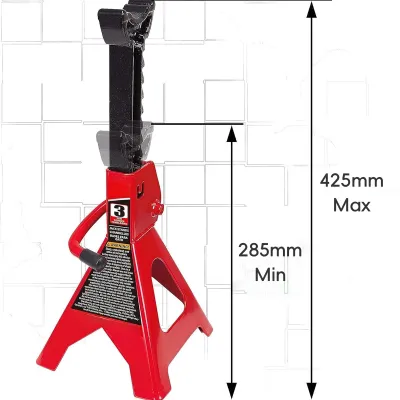
Upgrading to higher-tonnage heavy-duty stands is often necessary not just for the weight capacity, but for the physical dimensions of the tools. Heavy-duty stands feature wider base plates that distribute the weight over a larger surface area, preventing tipping. They also utilize thicker steel or cast-iron construction and offer greater maximum height clearance, allowing you to work comfortably and safely without extending the center post to its absolute limit.
Essential Safety Checks Before Lifting
Before placing any portion of your vehicle’s weight onto jack stands, you must perform several non-negotiable physical and environmental safety checks. Working under a vehicle carries inherent risks of serious injury or property damage. Always consult your vehicle’s original owner’s manual for specific lifting procedures, approved lift points, and safety warnings before operating any lifting equipment.
Begin by inspecting the jack stands themselves. Check for any signs of structural compromise, such as cracked welds, bent metal frames, or worn locking teeth. Ensure the locking pins or ratcheting pawls engage fully and securely. In the humid, tropical climate of the Philippines, moisture can accelerate rust, so inspect your equipment closely to ensure surface rust has not developed into deep, structurally weakening corrosion.
Next, identify the correct manufacturer-specified lift points on your vehicle. These are typically reinforced areas of the frame, dedicated lift pads, or sturdy pinch welds along the rocker panels. Placing a jack stand under unapproved areas, such as floor pans, suspension control arms, or steering linkages, can cause the metal to crush, slip, or suffer severe structural damage.
Evaluate your working environment. The ground beneath your vehicle must be completely level, solid, and capable of supporting concentrated point loads. Avoid working on asphalt during hot afternoons, as the intense tropical heat can soften the surface, causing the narrow feet of the jack stands to sink and tilt. Always work on a flat, reinforced concrete surface.
If you observe heavy rust on the vehicle’s frame, damaged or bent lift points, or if your working surface is uneven or soft, halt the operation immediately. Do not attempt to lift the vehicle under these conditions. Instead, consult a qualified professional mechanic to address the structural issues or perform the maintenance in a fully equipped workshop.
Frequently Asked Questions (FAQ)
Can I use two different jack stands with different weight ratings?
No, you should never mix and match jack stands with different weight ratings on the same axle. When using stands of unequal capacities, the overall safety limit of the lifting setup is dictated by the lowest-rated stand. Furthermore, different brands or models may have slight variations in height, base width, and locking mechanisms, which can cause uneven weight distribution and severe instability. Always use a matching pair of identical stands from the same manufacturer.
Do I need heavy-duty jack stands for a standard sedan?
While a standard sedan is relatively light and technically falls within the limits of lower-capacity stands, upgrading to heavy-duty jack stands offers significant benefits. Heavy-duty stands provide a wider, more stable base footprint that resists tipping, and they offer greater height clearance. This extra height makes under-car maintenance much more comfortable and future-proofs your garage tools if you eventually acquire a larger vehicle.
Community discussion
Share your experience or ask a question. Comments are reviewed before publication.