
Removing a flywheel or magneto from a motorcycle or small engine is a precise task where using the wrong tool can quickly lead to stripped threads, a cracked engine casing, or a bent crankshaft. In the Philippines, where underbone motorcycles, scooters, and small utility engines are vital for daily commuting and livelihoods, keeping these machines running requires proper maintenance tools. A magneto puller is a highly specialized tool designed to safely pop the flywheel off the tapered crankshaft. To avoid costly damage, you must understand how to match the puller’s specifications to your specific engine before making a purchase.
Decoding Thread Diameter and Pitch Specifications
To select the correct threaded puller, you must understand metric thread designations. These are typically written as a diameter followed by a pitch, such as M27 x 1.0 or M24 x 1.5. The \”M\” stands for metric, the first number represents the outer diameter of the threads in millimeters, and the second number indicates the thread pitch, which is the distance between adjacent thread crests in millimeters.
Forcing a puller with a mismatched thread pitch—even if the diameter feels roughly correct—will cross-thread and permanently destroy the internal threads of your flywheel. Because many motorcycle manufacturers use fine-pitch threads to maximize grip, a standard coarse-thread bolt will not work.
Products mentioned in this guide
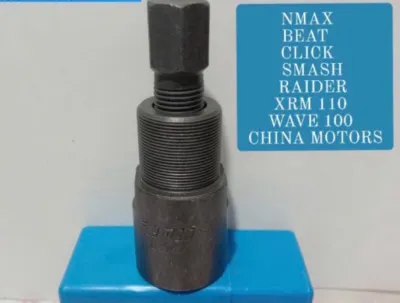
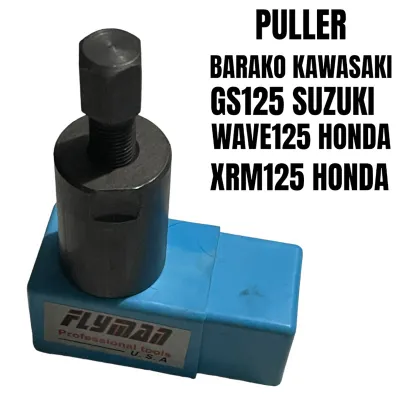
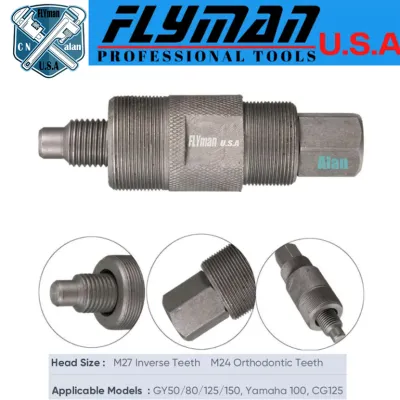
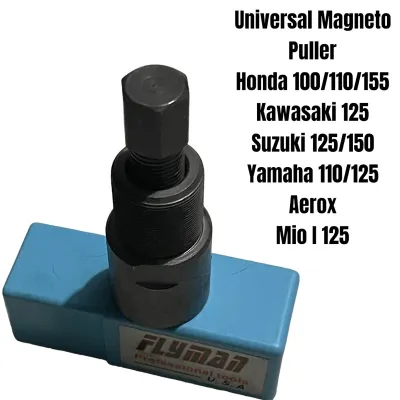
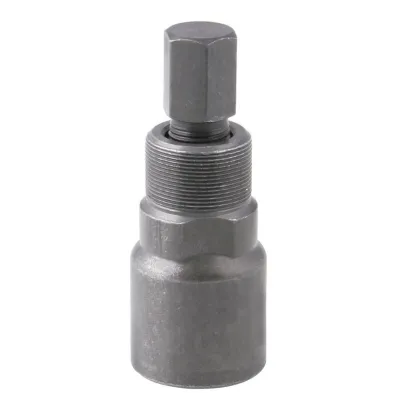
Prices are valid at publication and may change. Please refer to the product page for the latest price.
Before purchasing a tool from an online marketplace or local auto supply shop, always verify your engine’s requirements. You can find these specifications in your motorcycle’s official service manual. Alternatively, you can use a metric thread pitch gauge to measure the threads on your flywheel directly, or use a vernier caliper to confirm the internal diameter of the flywheel hub.
Choosing Between Bolt-Type and Jaw-Type Pullers
Flywheels come in various designs, which dictates whether you need a bolt-type (threaded) puller or a jaw-type (grip) puller.

Bolt-type pullers are the standard choice for most modern motorcycle flywheels. These tools thread directly into the center hub of the flywheel or secure to pre-tapped holes surrounding the center nut using multiple smaller bolts. They provide a highly stable, centered pulling force that minimizes the risk of tilting or slipping during extraction. However, they require an exact thread match to function safely.
Jaw-type pullers, often featuring two or three adjustable arms, are used when the flywheel lacks internal threads but has a solid outer lip or rear groove that the jaws can securely grip. When using a jaw-type puller, the arms must be perfectly aligned and tightened to prevent them from slipping off under tension, which can chip the flywheel or damage the surrounding engine casing.
If your flywheel lacks both internal threads and a safe, manufacturer-approved outer gripping lip, do not attempt to pry it off with screwdrivers or use improvised jaw configurations. Doing so can warp the rotor or damage the engine seals. In these cases, stop immediately and consult a qualified motorcycle mechanic or the engine manufacturer for specialized extraction procedures.
Evaluating Tool Configuration and Clearance Limits
Even if the thread specifications match, the physical dimensions of the puller must fit within the tight confines of your engine bay.
Physical clearance is a major consideration, especially on compact scooters and underbone motorcycles where the frame, fairings, or crankcase walls sit extremely close to the flywheel. Ensure that the puller body, center bolt, and any turning handles have enough clearance to rotate freely without striking adjacent components.
Thread engagement depth is equally critical for a safe extraction. The puller must thread into the flywheel deep enough to distribute the immense pulling force across multiple threads. As a general rule, ensure the puller is threaded in fully—typically at least five to six full turns—before tightening the center forcing bolt. Shallow thread engagement concentrates the force on just a few threads, which can easily strip them out under load.
For larger utility engines or heavily seized rotors, consider the stability of the tool configuration. While a single center-bolt puller is highly efficient for standard jobs, some heavy-duty flywheels require multi-bolt puller flanges that distribute the load across three or more points, preventing the flywheel from flexing or warping during removal.
Verifying Compatibility and Safe Extraction Practices
Before attempting to remove the magneto, perform a final verification check to ensure a safe and successful repair.
Always cross-reference the puller’s labeled specifications with the engine manufacturer’s official service data or part numbers. Do not rely solely on generic online compatibility lists, as engine specifications can vary by model year, region, or engine displacement.
If the flywheel is seized due to tropical humidity or rust, apply an approved penetrating oil to the crankshaft taper and external rusted areas. Be sure to follow both the puller manufacturer’s and the chemical manufacturer’s guidelines regarding material compatibility, ensuring the oil does not degrade nearby rubber stator seals or electrical insulation.
Never use excessive force, heavy impact wrenches, or open flames to loosen a stubborn flywheel. High-impact shocks can bend the crankshaft, while extreme heat can permanently demagnetize the rotor or damage the underlying stator coils. Instead, apply steady, controlled torque to the puller’s forcing bolt, tapping the end of the bolt gently with a brass hammer if necessary to help break the taper seal.
Frequently Asked Questions (FAQ)
Can I use a universal puller kit for any motorcycle brand?
While universal puller kits contain multiple double-ended adapters and jaws designed to fit various common engine sizes, they do not cover every possible configuration. Specific motorcycle models may require unique thread diameters, pitches, or left-hand (reverse) threads that are not included in standard kits, making individual verification of your engine’s specifications essential before purchase.
What should I do if the magneto puller threads into the flywheel but feels tight?
If the puller begins to bind or feels tight after only one or two turns, stop immediately and back the tool out. Do not force it with a wrench. A tight fit usually indicates a thread pitch mismatch or dirt and debris trapped in the threads. Clean the flywheel threads with a wire brush and re-verify both the diameter and pitch of your tool to prevent stripping the flywheel.
Community discussion
Share your experience or ask a question. Comments are reviewed before publication.