
When your underbone’s engine revs but your rear wheel lags, finding the right raider 150 carb clutch lining set becomes a critical maintenance priority. In the tropical, high-humidity climate of the Philippines, wet clutch systems are subjected to intense thermal and mechanical stress. The ideal choice for your motorcycle depends entirely on your daily riding habits, budget, and performance expectations.
For daily commuters navigating stop-and-go city traffic, an original equipment manufacturer (OEM) or OEM-equivalent set offers predictable, smooth engagement and long-term reliability. Conversely, if you use your motorcycle for mountain touring, carry heavy loads, or participate in closed-circuit track days, a specialized aftermarket set verified for high-friction materials and spring compatibility is necessary to prevent slippage under thermal stress. There is no single “best” set; instead, you must balance grip, lever feel, and wear life according to your specific riding habits.
Assessing Your Riding Needs: Daily Commute vs. Performance Riding
The Suzuki Raider 150 Carburetor version, often called the “King of Underbones” in local riding circles, is a high-revving machine that places unique demands on its wet clutch system. To select the correct lining set, you must first analyze where and how you ride, as different environments subject the clutch plates to vastly different mechanical and thermal stresses.
Products mentioned in this guide
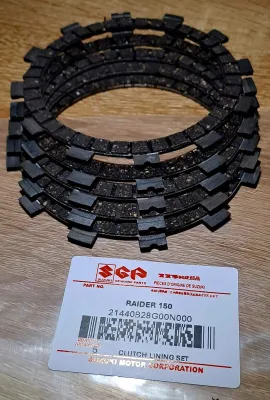
![[KV] Suzuki RAIDER150 CLUTCH LINING SET 21440B28G00NKIT - 5Pcs in 1Set](https://img.lazcdn.com/g/p/9fdec289877c2ba93420339d1dec1626.jpg_400x400q80.jpg_.webp)
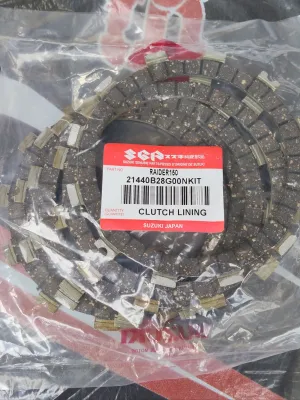
![[KRCP] RAIDER150 Genuine CLUTCH LINING SET 21440B28G00NKIT From Japan](https://img.lazcdn.com/g/p/0d07bd6b4bb21239baecc52d1a135a06.jpg_400x400q80.jpg_.webp)
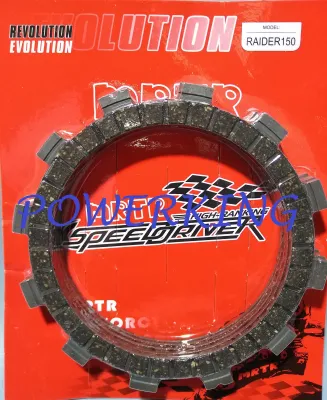
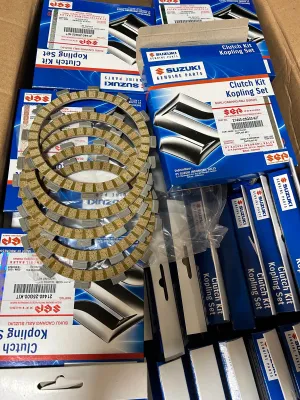
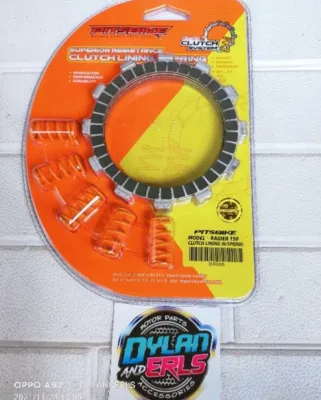
Prices are valid at publication and may change. Please refer to the product page for the latest price.
Daily Commuting and City Riding
If your daily route involves navigating congested urban avenues in major metropolitan areas like Metro Manila or Cebu, your clutch is subjected to constant engagement and disengagement. In these stop-and-go conditions, the primary stress factor is friction-induced heat buildup at low speeds. For this use case, you require a clutch lining set that prioritizes smooth, progressive engagement.
A harsh, sudden grab will not only make your daily commute tiring but can also accelerate wear on your clutch basket and primary drive gear. Standard commuter riding demands consistent performance across a wide temperature range without requiring heavy lever pull effort, allowing you to filter through traffic comfortably. Constant low-speed clutch slipping also degrades engine oil faster, making material compatibility with your choice of lubricant a key factor.
Performance Riding, Touring, and Heavy Loads
For riders who frequent open highways, steep mountain passes like the Marilaque Highway, or carry heavy cargo, the clutch faces a different set of challenges. High-RPM shifting and sustained high-speed runs generate substantial thermal energy within the clutch assembly. Under these conditions, standard organic linings can suffer from “clutch fade,” where the friction coefficient drops as temperatures rise, leading to slippage.
If your riding style involves aggressive downshifting, rapid acceleration, or carrying pillion passengers over steep inclines, you need a lining material designed to maintain its grip under extreme heat. However, these high-friction materials often require stiffer clutch springs to function correctly, which will increase the physical effort needed to pull the clutch lever.
By identifying your primary riding environment, you can avoid the twin pitfalls of over-specifying a stiff, aggressive racing clutch for a daily commute or under-specifying a standard clutch for high-stress performance riding.
Comparing Options for Your Raider 150 Carb Clutch Lining Set: OEM vs. Aftermarket
When shopping for a new raider 150 carb clutch lining set, you will generally choose between Suzuki Genuine Parts (OEM) and a wide array of aftermarket options. Understanding the mechanical trade-offs of each category prevents premature wear and ensures your transmission operates as intended.

Suzuki Genuine Parts (OEM)
OEM clutch linings are engineered specifically for the Raider 150 Carb’s engine characteristics, oil flow patterns, and clutch basket metallurgy. These sets utilize a refined organic compound designed to deliver a smooth, predictable engagement curve. Because they are factory-tested, they offer highly consistent quality control and a predictable service life under normal operating conditions.
The primary benefit of OEM parts is their seamless integration; they do not require stiffer springs or specialized engine oils to prevent slipping, making them the safest choice for standard restoration and daily commuting. Additionally, the organic compound used in OEM plates is gentle on the aluminum clutch hub and steel separator plates, preserving the lifespan of these expensive internal components.
Aftermarket Upgrades
Aftermarket manufacturers often market their products using performance buzzwords and materials like Kevlar, carbon fiber, or brass-infused compounds. While these materials can offer enhanced thermal stability, packaging labels are not automatic proof of superior performance or durability. For instance, a “carbon-Kevlar” lining might resist heat fade during aggressive riding, but it may also require a longer break-in period and stiffer clutch springs to achieve its rated friction coefficient.
Without verified technical specifications from the manufacturer—such as the exact dynamic friction coefficient and recommended operating temperature range—relying solely on material names can lead to disappointing performance, accelerated wear on your aluminum clutch hub, or a clutch that refuses to disengage fully. Carbon-fiber linings, while highly resistant to heat, can be abrasive to stock steel plates, leading to accelerated wear of the separator plates if not paired correctly.
Before purchasing an aftermarket kit, always verify if the manufacturer specifies a required spring tension or a particular type of motorcycle oil (such as JASO MA or MA2 standards) to ensure proper wet-clutch operation.
| Feature / Dimension | Suzuki Genuine Parts (OEM) | Aftermarket High-Friction Sets |
|---|---|---|
| Primary Target Audience | Daily commuters, stock restorers | Performance riders, heavy-duty haulers |
| Engagement Feel | Smooth, progressive, light lever pull | Sharp, aggressive, potentially heavier lever pull |
| Thermal Resistance | Standard (suitable for typical operating temps) | High (designed to resist fade under high RPMs) |
| Spring Requirements | Standard OEM springs | Often requires stiffer, high-tension springs |
| Verification Needed | Part number compatibility with Carb model | Friction material specs, spring compatibility, oil requirements |
| Lifespan Expectation | Highly predictable under normal use | Variable; depends on material quality and riding style |
Critical Specifications to Verify for the Raider 150 Carb
Installing an incompatible clutch set can cause severe transmission issues, ranging from a clutch that slips constantly to one that drags and makes shifting gears difficult. To ensure a perfect fit, you must verify several critical physical specifications against your Suzuki Raider 150 Carb service manual before finalizing your purchase.
Plate Count and Configuration
The Raider 150 Carburetor model utilizes a specific clutch basket configuration. You must verify the exact number of friction plates (linings) and steel separator plates included in the kit. A standard Raider 150 Carb clutch assembly typically uses five friction plates and four steel plates, but you must verify your specific model year’s parts catalog, as variations exist between the early carburetor models, the later “reloaded” carburetor versions, and the fuel-injected (FI) variants. Mixing up these configurations can leave you with a clutch pack that is either too thick to allow the pressure plate to seal or too thin to engage fully.
Plate Thickness and Tolerances
Friction plate thickness is a critical dimension that dictates the total stack height of the clutch assembly. New OEM friction plates generally measure within a precise thickness range specified by the manufacturer (typically around 2.9 to 3.1 millimeters, though you must consult your specific service manual to verify). If an aftermarket lining set is too thick, the clutch may drag, making it hard to find neutral when stopped. If it is too thin, the clutch springs will not apply sufficient clamping force, resulting in immediate slippage under load.
Separator Plate Flatness
When replacing your clutch linings, do not ignore the steel separator plates. These plates must be perfectly flat to distribute pressure evenly across the friction material. You can check for warped steel plates by placing them on a flat piece of glass and attempting to slide a 0.05mm feeler gauge underneath. If the gauge slides under any part of the plate, the plate is warped and must be replaced. Warped steel plates cause uneven contact, which leads to localized hot spots and rapid lining failure.
Clutch Spring Free Length and Tension
The clutch springs provide the clamping force necessary to hold the friction and steel plates together. Over time, these springs compress and lose their tension due to constant heat cycles. When replacing your clutch linings, always measure the free length of your existing springs using a vernier caliper and compare it to the service limit specified in your manual.
If you are upgrading to a high-friction aftermarket lining set, check if the kit requires specialized high-tension springs. Be cautious: excessively stiff springs can cause rapid wear on the clutch release mechanism, stretch your clutch cable prematurely, and make city riding uncomfortable due to an extremely heavy lever pull.
Relying solely on “Racing” or “High-Performance” labels without checking these precise physical dimensions is a common mistake that can lead to rapid clutch failure or physical damage to your clutch hub and basket.
Decision Framework: Which Clutch Lining Set Fits You Best?
To make your final decision straightforward, use this structured framework to match a clutch lining set to your mechanical setup and riding habits.
Choose OEM or Standard-Equivalent Sets if:
- Urban Commuting is Your Priority: Your Raider 150 Carb is primarily used for daily commuting, personal transport, or delivery work in urban traffic.
- You Value Comfort: You prefer a light, comfortable clutch lever pull that reduces hand fatigue during long rides in heavy traffic.
- You Want a Hassle-Free Install: You want a straightforward, drop-in installation without the need to modify your clutch springs, pressure plate, or engine oil viscosity.
- You Prefer Smooth Power Delivery: You prioritize smooth, predictable power delivery and long-term component durability over aggressive bite.
Choose High-Friction Aftermarket Sets if:
- You Ride in Demanding Conditions: You ride aggressively, participate in sanctioned track events, or frequently travel through steep mountainous terrain.
- Your Engine is Modified: You have modified your engine's displacement or exhaust system, requiring increased clamping force to handle the additional torque.
- You Prefer Instant Engagement: You are willing to accept a heavier clutch lever pull and a more sudden, aggressive engagement style.
- You Are Prepared to Upgrade Supporting Parts: You are prepared to verify the manufacturer's friction specifications and pair the linings with compatible, high-tension clutch springs.
Verify First if:
- Your Clutch Basket is Worn: You must inspect the physical condition of your inner clutch hub and outer clutch basket before installing any new lining set. If the fingers of your clutch basket have developed deep grooves or "notches" from the tabs of the old friction plates, the new plates will hang up and fail to slide smoothly. This mechanical interference will cause the clutch to slip or drag, completely ruining your new lining set regardless of its material quality or brand. If notches are present, the basket must be smoothed within manufacturer tolerances or replaced entirely.
Safe Installation and Break-In Procedures
Replacing a clutch lining set is a precise mechanical task that directly affects the safety and drivability of your motorcycle. An improperly installed clutch can lock up the rear wheel or fail mid-ride, posing a severe safety risk.
Before beginning disassembly, consult the official Suzuki Raider 150 Carb service manual for the exact torque specifications, diagonal tightening sequences for the clutch spring bolts, and recommended engine oil specifications. If you do not possess a calibrated torque wrench, a clutch sleeve hub holder, or the technical experience required for internal engine work, you should have the installation performed by a qualified professional mechanic.
Additionally, always replace the clutch cover gasket with a new one during reassembly. Reusing an old gasket can lead to oil leaks, which can drop oil onto the rear tire and create a severe safety hazard.
If you perform the installation yourself, remember to pre-soak your new friction plates in clean, fresh motorcycle engine oil (matching the type you will use in your crankcase) for at least several hours—ideally overnight—before assembly. Installing friction plates dry will cause immediate, irreversible thermal damage upon the first engine start, glazing the lining material and ruining its friction properties.
Once installed, a proper break-in period is essential to ensure the longevity of your new clutch. For the initial period of operation, avoid sudden high-RPM launches, heavy cargo loads, and aggressive downshifting. This allows the new friction material to mate evenly with the steel separator plates, preventing localized hot spots and ensuring consistent grip for the lifespan of the clutch. Refer to the specific instructions provided by your clutch lining manufacturer for their recommended break-in duration.
Frequently Asked Questions (FAQ)
How do I know if my Raider 150 clutch plates are worn out?
You can identify worn clutch plates through several distinct operational symptoms. The most common sign is clutch slippage, where the engine RPMs rise sharply when you twist the throttle, but the motorcycle’s actual road speed does not increase proportionally. You may also experience a spongy feeling at the clutch lever, difficulty shifting gears, or finding neutral when the engine is idling.
While these operational signs are highly indicative of wear, the only definitive way to confirm failure is to measure the thickness of the individual friction plates using a micrometer or vernier caliper and compare the measurements against the wear limits specified in your Raider 150 Carb service manual.
Should I replace the clutch springs when changing the lining set?
It is highly recommended to inspect and measure your clutch springs whenever you replace the lining set. Because clutch springs are constantly subjected to high temperatures and mechanical compression, they lose their tension over time, which reduces the clamping force on your new plates.
Use a vernier caliper to measure the free length of each spring; if any spring measures below the service limit specified in the service manual, replace the entire set. Additionally, if you are upgrading to a high-friction aftermarket lining kit designed for performance use, you must verify if the manufacturer recommends pairing it with stiffer, high-tension springs to prevent slippage under load.
Community discussion
Share your experience or ask a question. Comments are reviewed before publication.