
Choosing the right fly ball—commonly known as CVT roller weights—for your Honda Click 125i depends entirely on your daily riding environment, load requirements, and performance preferences. Because there is no single universal weight that suits every rider, finding your ideal setup requires understanding how these small components interact with your scooter’s continuously variable transmission (CVT). By adjusting the weight of your fly balls, you can customize whether your scooter prioritizes quick, responsive acceleration for navigating congested city streets or a smoother, lower-RPM cruise for long highway stretches.
To make an informed decision, you must first establish your scooter’s factory baseline by consulting the official manufacturer documentation. From there, you can systematically evaluate your typical routes, passenger loads, and riding style to determine whether lighter, heavier, or stock-weight rollers will deliver the performance characteristics you need. This guide outlines the mechanical principles of CVT tuning, helps you match roller weights to your daily driving conditions, and provides a safe, structured methodology for testing and installation.
How CVT Roller Weights Control Your Scooter's Performance
To understand how changing your fly balls affects your Honda Click 125i, you must first understand the physics of the continuously variable transmission. The CVT operates using two pulleys connected by a drive belt: the drive pulley (variator) connected to the engine crankshaft, and the driven pulley connected to the rear wheel clutch. The variator contains a set of roller weights that sit inside angled ramps. As the engine spins, centrifugal force pushes these roller weights outward along the ramps, forcing the movable face of the drive pulley closer to the fixed face. This action forces the drive belt to ride higher on the pulley, effectively shifting the transmission into a higher gear ratio.
Products mentioned in this guide
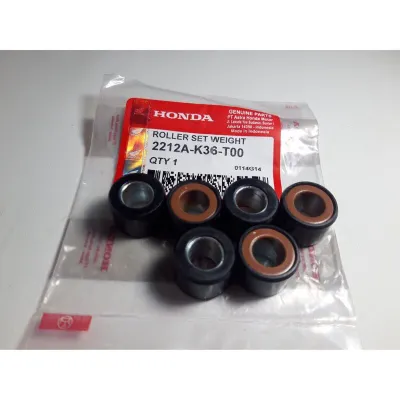
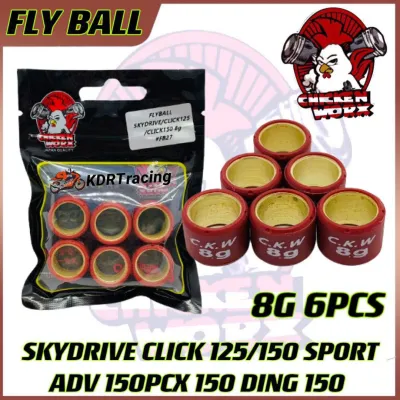
![[KV] Click 125/150 Genuine FLYBALL Set 14G (BLACK) 2212A-K36-T00 From Thailand](https://img.lazcdn.com/g/p/036611b45cedcb3393bfb9ce6179a98c.jpg_400x400q80.jpg_.webp)
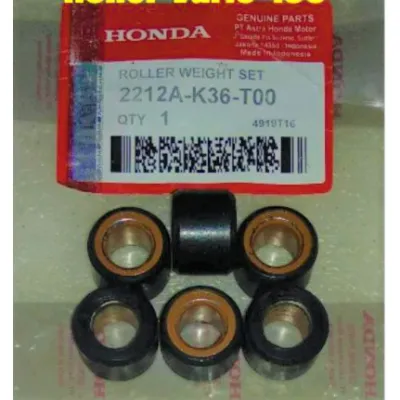
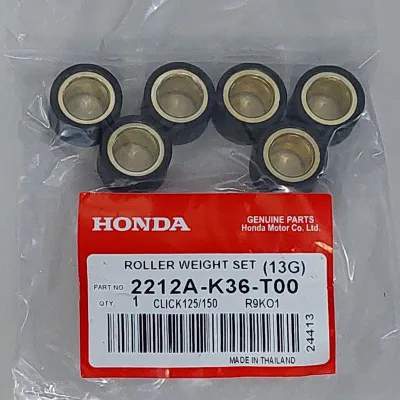
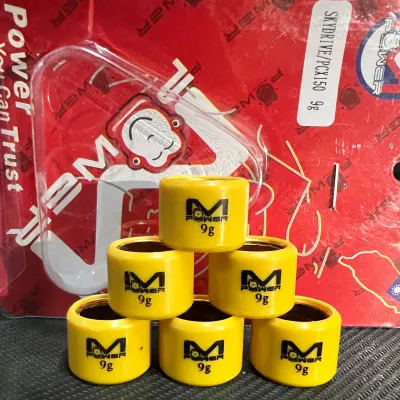
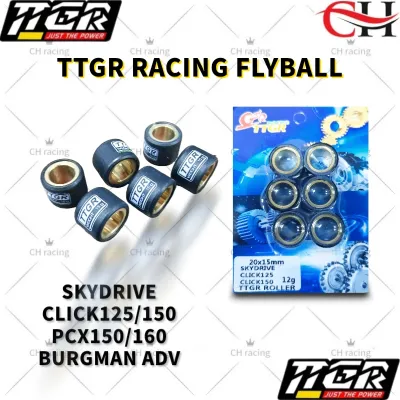
![SS88 Roller Ball/Flyball 20x15 [13G] [14G] [15G] [16G] [17G] [18G] [19G] Honda Click/PCX/ADV150 | Fly Ball | Speed Depot](https://img.lazcdn.com/g/p/85c79b9632126bf8487ef168d8709f48.jpg_400x400q80.jpg_.webp)
Prices are valid at publication and may change. Please refer to the product page for the latest price.
Lighter roller weights require higher engine speeds (RPM) to generate the centrifugal force needed to push them outward. Consequently, installing lighter fly balls delays the outward movement of the variator, keeping the transmission in a lower gear ratio for a longer period. This allows the engine to rev higher and stay within its peak powerband during initial acceleration, resulting in a more immediate throttle response and stronger pulling power from a complete stop.
Conversely, heavier roller weights slide outward at lower engine speeds, pushing the variator faces together much sooner. This shifts the transmission into a higher gear ratio early in the acceleration curve. While this reduces initial acceleration, it allows the engine to maintain cruising speeds at lower RPMs. This early upshifting can significantly reduce engine vibration, lower fuel consumption, and provide a quieter, more relaxed ride during sustained high-speed travel.
It is critical to recognize that altering your roller weights does not increase or decrease the engine’s maximum horsepower or torque. The engine’s physical power output remains exactly the same. Changing the fly balls simply alters the timing and RPM range at which that power is delivered to the rear wheel, allowing you to optimize the transmission’s behavior for specific riding scenarios.
Matching Roller Weights to Your Daily Riding Conditions
Selecting the appropriate fly ball weight requires a realistic assessment of where and how you ride your Honda Click 125i. If your daily commute consists primarily of stop-and-go city traffic, frequent stoplights, and tight lane-filtering, lighter roller weights are often highly beneficial. The increased low-end responsiveness allows you to accelerate quickly out of congested areas and maintain agility at low speeds. This setup is also highly advantageous if your daily route involves climbing steep hills or elevated flyovers, where maintaining engine RPM is crucial to prevent the transmission from bogging down.

For riders who primarily travel long distances on open highways, bypass roads, or provincial routes, heavier roller weights are generally more suitable. By allowing the transmission to shift into a higher gear ratio sooner, heavier rollers keep the engine RPMs low at cruising speeds. This not only reduces the mechanical strain and heat buildup within the engine but also minimizes the high-frequency vibrations that cause rider fatigue during long journeys. Additionally, keeping the engine in a lower RPM range during steady-state cruising can improve overall fuel efficiency.
Your typical passenger and cargo load must also play a major role in your decision. Frequently carrying a passenger (angkas) or hauling heavy delivery bags increases the total weight the scooter must move. If your roller weights are too heavy under these conditions, the transmission will upshift prematurely, leaving the engine struggling to pull the load and causing sluggish acceleration. If you regularly carry heavy loads, retaining the stock roller weight or opting for slightly lighter rollers is recommended to preserve the necessary climbing and pulling torque.
Environmental factors also influence CVT performance. In tropical climates with high ambient temperatures and humidity, the CVT system runs naturally hotter. High heat can soften the outer plastic shell of the rollers and accelerate wear. When choosing aftermarket fly balls, prioritize high-quality, heat-resistant materials that can withstand these demanding operating conditions without flat-spotting or deforming prematurely.
Locating the Factory Baseline for the Honda Click 125i
Before purchasing or installing any aftermarket fly balls, you must identify the original equipment manufacturer (OEM) specifications for your specific model year. Honda Click 125i specifications can vary slightly across different generations and production runs. To find the exact weight (measured in grams) and physical dimensions (measured in millimeters) of your stock rollers, consult the official Honda Owner’s Manual or the factory Service Manual. Using these official documents ensures you have an accurate baseline from which to measure any performance changes.
When you disassemble your CVT to inspect or replace the rollers, take the time to physically examine the stock components. Over time, normal wear and tear will shave material off the rollers, creating flat spots and reducing their effective weight. Do not use worn, deformed rollers to establish your baseline weight, as their performance will not accurately represent the factory standard. If you do not have access to a high-precision digital scale to verify the weight of your current rollers, refer strictly to the official specifications provided by the manufacturer.
Avoid relying on unverified information from online forums, social media groups, or generic aftermarket compatibility charts. Many aftermarket kits are marketed as universal fits but may have slight dimensional variances that can damage your variator ramp plate. Always cross-reference the product part numbers and dimensions with your official Honda documentation to confirm that the replacement rollers are explicitly designed for the Honda Click 125i variator.
A Systematic Approach to Testing and Swapping Rollers
Modifying your CVT components requires a methodical approach to ensure safety and achieve predictable results. First, you must use the correct tools for disassembly and reassembly. Never attempt to lock the variator or clutch bell in place using makeshift tools like screwdrivers, chisels, or pliers. Doing so can easily chip the aluminum cooling fins of the drive face, bend the crankshaft, or damage the clutch housing. Instead, invest a few hundred pesos ₱ in a dedicated variator holding tool or flywheel holder designed specifically for scooter transmissions.
When tuning your CVT, change only one variable at a time. If you decide to test a different fly ball weight, keep all other transmission components—such as the drive belt, clutch springs, and center spring—completely stock. If you install lighter rollers, a stiffer center spring, and an aftermarket clutch all at once, you will not be able to isolate which component caused a specific change in performance, making it incredibly difficult to fine-tune the system.
Keep a detailed written log of your adjustments and real-world riding feedback. After installing a new set of rollers, test the scooter on a familiar, safe stretch of road under normal riding conditions. Note how the engine responds from a complete stop, how quickly it accelerates when overtaking at mid-range speeds, and how it behaves when climbing a known incline. Documenting these observations will help you determine whether you need to adjust the weight further or revert to a previous setup.
Every time you open the CVT casing to swap or inspect your fly balls, perform a comprehensive inspection of the surrounding components. Check the drive belt for cracks, fraying, or excessive side wear, and measure its width against the service limit specified in your manual. Inspect the plastic variator slide pieces (sliders) for excessive play, and check the clutch lining for glazing or contamination. Installing new roller weights in a CVT system with a worn belt or damaged sliders will result in poor performance and can accelerate the wear of your new parts.
Critical Safety Limits and When to Seek Professional Help
Working on your scooter’s transmission carries inherent mechanical risks that require strict adherence to safety protocols. The most critical step in reassembling the CVT is tightening the variator nut and clutch bell nut. You must never guess the tightness of these fasteners or rely solely on an impact wrench without verification. Always use a calibrated torque wrench to tighten the nuts to the exact torque specifications detailed in the Honda service manual. A loose variator nut can back off while the engine is running, causing the spinning components to detach inside the casing, which can destroy the crankshaft threads, ruin the engine case, and cause an immediate rear-wheel lockup while riding.
After reassembling the CVT and before riding, start the engine while the scooter is securely on its center stand. Listen closely for any unusual noises. If you detect abnormal rattling, high-pitched squealing, severe vibrations, or if the rear wheel spins rapidly at idle, shut off the engine immediately. These symptoms indicate that a component is misaligned, the belt is pinched, or a fastener is not properly seated. Do not attempt to ride the scooter until the issue has been thoroughly diagnosed and corrected.
If you do not own a calibrated torque wrench, a proper variator holding tool, or if you feel uncomfortable performing these mechanical steps, do not attempt this procedure yourself. Take your scooter and your chosen roller weights to a certified motorcycle mechanic at an authorized service center. Additionally, if you open the CVT casing and discover deep grooves, scoring, heat discoloration (bluing) on the pulley faces, or metal shavings, stop immediately and seek professional assistance, as these are signs of severe component damage that requires expert repair.
Frequently Asked Questions (FAQ)
Can I mix different roller weights in the CVT?
Yes, you can mix different roller weights to achieve an intermediate overall weight, but you must do so with strict physical symmetry. For example, if you want to achieve a middle-ground performance that sits between two standard weights, you can install three lighter rollers and three heavier rollers. However, you must alternate them in a strict, symmetrical pattern (light, heavy, light, heavy, light, heavy) inside the variator. Never place different weights next to each other or use an uneven number of weights. Failing to maintain perfect balance will cause the variator to wobble, leading to severe engine vibrations, rapid wear of the variator boss, and potential damage to the crankshaft bearings.
How do I know if my current fly balls are worn out?
You can identify worn fly balls through a simple visual and physical inspection once the variator is disassembled. Perfectly functioning rollers must be completely round so they can roll smoothly up and down the variator ramps. If you observe flat spots, deep grooves, cracks in the outer plastic coating, or if the inner metal core has become exposed or loose, the rollers are worn out and must be replaced. On the road, worn rollers typically manifest as a noticeable loss of top-end speed, sluggish or inconsistent acceleration, or the engine revving excessively high without a corresponding increase in actual road speed, as the flat spots prevent the variator from opening fully.
Community discussion
Share your experience or ask a question. Comments are reviewed before publication.