
Selecting the correct GY6 racing pulley set requires matching the transmission’s mechanical behavior to your specific riding environment. Whether you need aggressive acceleration for navigating dense city traffic or relaxed, high-RPM efficiency for longer highway rides, the right combination of drive face angles, roller weights, and spring tension will define your scooter’s power delivery. This guide outlines how to identify your performance goals, verify physical compatibility, and safely configure your drivetrain without relying on guesswork.
In tropical climates like the Philippines, where high ambient temperatures and humidity are constant factors, scooter transmissions face unique thermal demands. Stop-and-go traffic in congested urban centers generates significant heat within the continuously variable transmission (CVT) case. Upgrading to a racing pulley set is not just about seeking higher speeds; it is about optimizing how efficiently your engine transfers power to the ground under these challenging conditions. By understanding the relationship between your daily commute and your scooter’s mechanical limits, you can make an informed decision that enhances performance while preserving engine reliability.
Understand Your Riding Goals and Pulley Mechanics
Before purchasing any aftermarket transmission parts, you must clearly define your primary riding scenario. A scooter used daily for navigating tight city streets requires a completely different setup than one used for long-distance provincial touring. City riding demands rapid low-end acceleration to safely pull away from intersections and maneuver through slow-moving traffic. This requires the transmission to stay in a lower gear ratio longer, keeping the engine in its peak torque range during sudden throttle changes.
Products mentioned in this guide
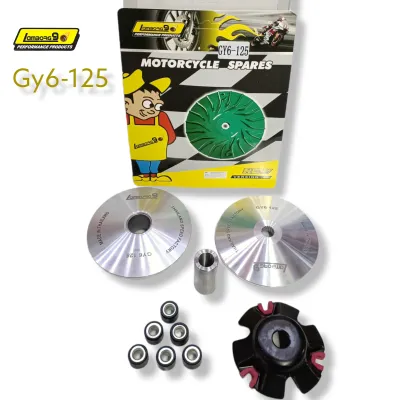
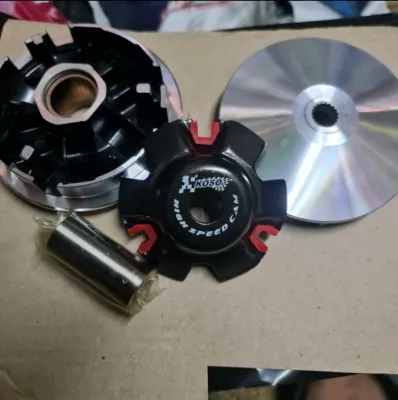
![[Thai][Yellow] Gy6 Racing 13.5 pulley and drive face](https://img.lazcdn.com/g/ff/kf/S39299586d60e47b599bfc403b3bf6c96H.jpg_400x400q80.jpg_.webp)
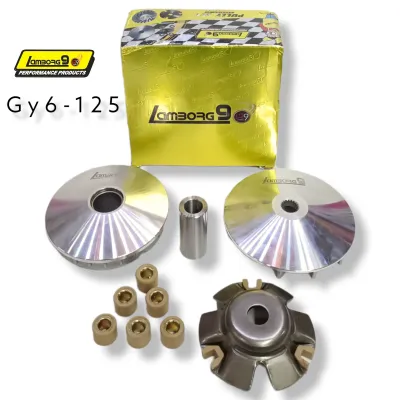
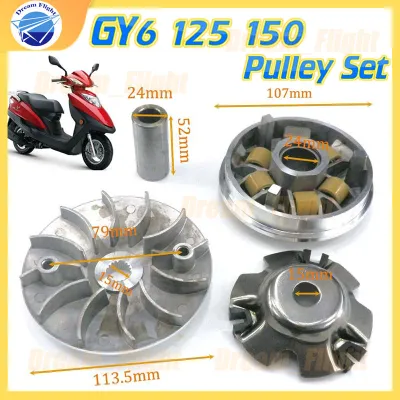
![[Thailand] Gy6 125 pulley set with drive face and bola](https://img.lazcdn.com/g/p/89347ee6f49afa7636a8b9b25f4e3c2f.jpg_400x400q80.jpg_.webp)

Prices are valid at publication and may change. Please refer to the product page for the latest price.
Conversely, highway touring or long-distance commuting requires sustained high-speed cruising with minimal engine strain. For these journeys, your goal is to achieve a higher top-end gear ratio at lower engine revolutions per minute (RPM). This setup reduces fuel consumption, lowers operating temperatures, and minimizes vibration, making the ride more comfortable and extending the lifespan of your engine components. Trying to build a transmission that excels equally at both extremes is a common pitfall; instead, aim for a balanced configuration that favors your most frequent riding environment.
The mechanics of a GY6 CVT rely entirely on centrifugal force and mechanical resistance. The front pulley assembly, or variator, is mounted directly to the engine’s crankshaft. As engine speed increases, the variator spins faster, forcing the internal roller weights outward along their precision-engineered ramps. This outward movement pushes the movable half of the variator closer to the fixed drive face, squeezing the drive belt and forcing it to ride higher up the pulley. At the same time, the belt pulls deeper into the rear clutch pulley against the resistance of the contra spring, smoothly changing the overall gear ratio.
Verify Engine and Drivetrain Compatibility
The GY6 engine platform is incredibly popular and highly modular, but this modularity can lead to compatibility issues if you do not verify your specific engine variant. The GY6 design exists in several displacements, most notably the 125cc (often designated as the 152QMI) and the 150cc (157QMJ) variants. While many aftermarket parts claim universal fitment across these displacements, subtle differences in crankcase clearance, starter clutch designs, and shaft lengths can prevent a racing pulley set from seating correctly. Always locate the engine code stamped on the lower left side of your crankcase to confirm your exact model before ordering parts.

Beyond displacement, you must verify the physical dimensions of your crankshaft. Measure the crankshaft spline count, outer diameter, and thread pitch. Standard GY6 engines typically feature a 15mm crankshaft with 19 splines, but some older models, specialized variants, or aftermarket replacement crankshafts may use different configurations. If the splines on your new variator or ramp plate do not match the crankshaft perfectly, the assembly will wobble, quickly stripping the splines, damaging the oil seals, or causing the cooling fan to disintegrate at high RPMs.
Additionally, consider how a racing pulley set affects your drive belt requirements. Aftermarket variators often feature larger diameters or steeper face angles designed to push the belt higher than the stock setup. This change can alter the required belt length and width. Using a stock belt with an aggressive racing variator might lead to excessive belt slip, premature wear, or even contact with the inner walls of the crankcase. Always check the pulley manufacturer’s specifications to see if they recommend a specific belt size or material, such as a reinforced Kevlar belt, to handle the altered transmission geometry.
Select the Right Components for Your Setup
A complete GY6 racing pulley set is more than just a single variator wheel; it is a carefully balanced system of interacting components. A typical high-performance kit includes the variator body, an optimized ramp plate, low-friction slider keys, a set of precision roller weights, and a matching drive face. To achieve your performance goals, you must understand how these individual parts work together and avoid the temptation to mix mismatched components from different brands without a clear tuning strategy.
Modifying only one part of your CVT while leaving the rest of the system stock often results in disappointing performance. For example, installing a racing variator with stock, heavy roller weights may cause the transmission to shift too quickly, bogging down the engine before it can reach its power band. Conversely, installing ultra-light rollers without upgrading the rear contra spring can cause the belt to slip under load, generating excessive heat and reducing acceleration. A successful upgrade requires adjusting the front pulley geometry, roller mass, and rear spring tension in unison.
Drive Face and Ramp Plate Design
The face angle of the variator and the matching outer drive face directly dictate how the drive belt transitions through the gear ratios. Stock GY6 variators generally feature conservative face angles designed to maximize fuel economy by shifting the belt into a high gear ratio as quickly as possible. Racing-oriented variators, however, utilize optimized face angles—often slightly steeper or more progressive—that alter the belt’s travel speed. This design allows the engine to rev higher and stay within its peak horsepower range during acceleration.
Equally important is the design of the internal ramp plate and the slider keys. The ramp plate guides the roller weights as they move outward under centrifugal force. High-performance ramp plates feature smoother, extended ramp profiles that allow the rollers to travel further, enabling the belt to ride higher on the pulley face for potential top-speed improvements. The slider keys, which cushion the contact between the ramp plate and the variator body, must be made of high-durability, low-friction composite materials to ensure smooth shifting and prevent premature wear or binding.
Roller Weights and Contra Spring Pairing
Tuning your GY6 transmission relies heavily on finding the correct balance between the mass of your roller weights and the stiffness of your rear contra spring. Roller weights act as the force that closes the front pulley, while the contra spring acts as the resisting force that keeps the rear pulley closed. Lighter roller weights require higher engine RPMs to generate the centrifugal force needed to overcome the contra spring, resulting in faster engine revving and improved low-end acceleration. Heavier rollers slide outward at lower RPMs, keeping the engine speed down for quieter, more efficient cruising.
The rear contra spring, located behind the clutch assembly, plays a critical role in maintaining belt tension and preventing slippage. A stiffer aftermarket contra spring increases the clamping force on the drive belt, which is essential for preventing slip when climbing steep hills or carrying heavy loads. However, a stiffer spring also requires lighter roller weights to allow the transmission to shift. If the spring is too stiff and the rollers are too light, the engine will scream at high RPMs without transferring power efficiently to the rear wheel.
When configuring your setup, always start with the baseline roller weights and spring recommendations provided by the kit manufacturer. Avoid copying specific configurations found on online forums, as differences in rider weight, local terrain, and engine wear will yield different results. Adjust your roller weights incrementally—typically in half-gram or one-gram steps—and test the scooter’s behavior after each change to find the sweet spot where acceleration is crisp without causing the engine to over-rev.
Installation Safety and Post-Install Tuning
Modifying your scooter’s drivetrain carries significant safety responsibilities. Because the CVT operates at extremely high rotational speeds, any installation error can lead to catastrophic component failure, engine damage, or a loss of vehicle control. Always refer to your scooter’s original manufacturer service manual for specific torque values, safety warnings, and assembly diagrams. If you do not have the proper tools, mechanical experience, or confidence to perform this work safely, have the racing pulley set installed by a qualified motorcycle mechanic.
To prevent damage during installation, never use improper tools like locking pliers or pipe wrenches to hold the variator. You must use a dedicated variator holding tool or flywheel holder to secure the assembly while tightening the crankshaft nut. Additionally, always use a calibrated torque wrench to tighten the nut to the exact specification listed in your service manual. Over-tightening can strip the delicate threads on the crankshaft, requiring an expensive engine teardown to replace, while under-tightening can cause the variator to spin loose during operation, destroying the splines and locking up the transmission.
Establish clear stop conditions before you begin. If you inspect your crankshaft and find worn, flattened, or damaged splines, do not attempt to install the new racing pulley set. Similarly, if the variator boss does not slide smoothly onto the shaft, or if the threads on the crankshaft nut are cross-threaded, halt the installation immediately and consult a professional. Forcing components onto a damaged shaft will inevitably lead to failure on the road.
Once the installation is complete and verified, conduct a structured road test in a safe, open area away from heavy traffic. Start with gentle acceleration to ensure the belt seats properly and there are no unusual noises, vibrations, or slipping sensations. Gradually increase speed to evaluate how the transmission shifts. Note the engine’s RPM during initial take-off, mid-range acceleration, and high-speed cruising. Fine-tuning your GY6 racing pulley set is an iterative process; be prepared to remove the CVT cover and adjust your roller weights several times to achieve the perfect balance for your performance goals.
Frequently Asked Questions (FAQ)
Will a racing pulley set automatically increase my scooter's top speed?
A racing pulley set optimizes the efficiency of your transmission and allows the drive belt to utilize the full surface area of the pulley faces, which can sometimes yield a modest increase in top speed. However, a pulley set does not increase your engine’s horsepower. Your ultimate top speed is still limited by your engine’s displacement, aerodynamic drag, rider weight, and the physical limits of your final drive gear ratio. The primary benefit of a racing pulley set is improved acceleration and a more responsive power band, rather than a massive increase in absolute top speed.
How do I know when to replace the rollers or drive face?
CVT components are subject to high friction and heat, requiring regular inspection every few thousand kilometers. You should replace your roller weights immediately if they develop flat spots, as these flat areas prevent the rollers from sliding smoothly, leading to erratic shifting and flat spots in your acceleration. Inspect the drive face and variator sheaves for deep grooves, pitting, or uneven wear patterns where the belt rides. Additionally, check the slider keys on the ramp plate for excessive play; loose sliders can cause the ramp plate to rattle and wear out the variator body prematurely.

Community discussion
Share your experience or ask a question. Comments are reviewed before publication.