
Selecting the right clutch spring for your Yamaha Mio i 125 is one of the most effective ways to fine-tune your scooter’s acceleration, throttle response, and overall rideability. Because the Mio i 125 utilizes a Continuously Variable Transmission (CVT), its performance depends entirely on the balance of mechanical forces rather than manual gear shifts. The clutch springs play a defining role in this system by determining exactly when and how smoothly engine power is transferred to the rear wheel. Choosing the correct stiffness requires a clear understanding of your daily riding conditions, your scooter’s current modifications, and how different spring ratings interact with other CVT components.
In the Philippines, where daily riding conditions range from the congested, stop-and-go traffic of Metro Manila to the steep, winding mountain roads of Benguet, a one-size-fits-all approach to CVT tuning does not work. If you install springs that are too stiff for your daily commute, you will experience high engine revs, poor fuel efficiency, and unnecessary wear on your transmission. Conversely, springs that are too soft can cause your clutch to engage too early, resulting in sluggish off-the-line acceleration and engine bogging under load. By matching your clutch spring stiffness to your specific riding style and maintaining a balanced CVT setup, you can optimize your Mio i 125 for maximum efficiency, responsiveness, and durability.
Understanding the Clutch Spring's Role in the Mio i 125 CVT
To make an informed decision, you must first understand how the CVT in your Yamaha Mio i 125 operates and where the clutch springs fit into this system. The CVT relies on centrifugal force to automatically adjust gear ratios as your engine speed changes. Within the rear pulley assembly, there are two distinct types of springs that perform entirely different functions: the small clutch shoe springs (often called clutch springs) and the large main torque spring (frequently referred to as the center spring).
Products mentioned in this guide
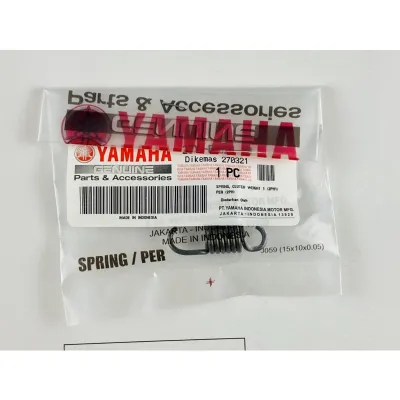
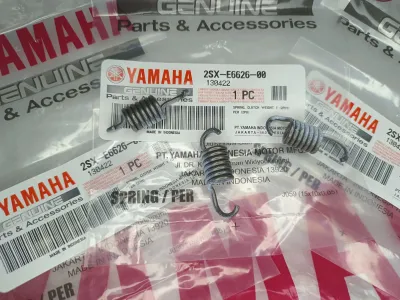
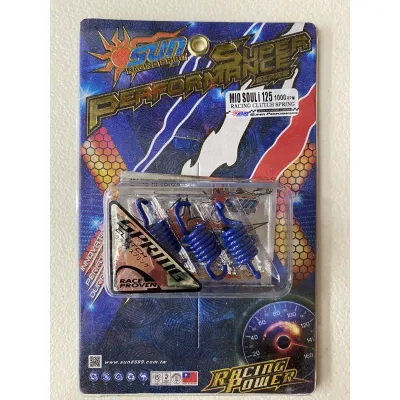
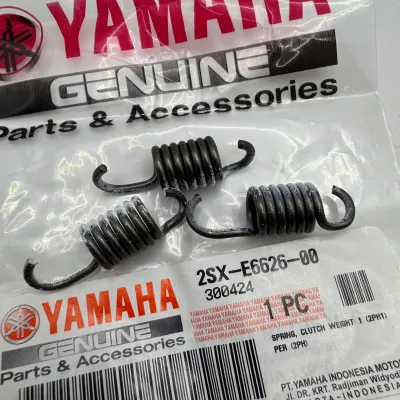
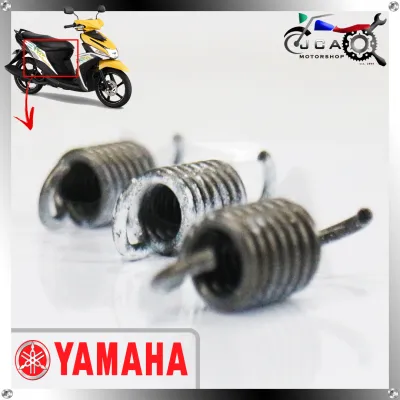
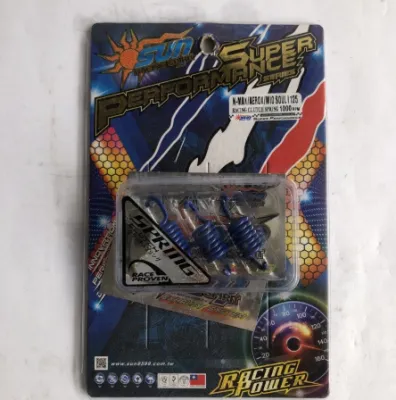

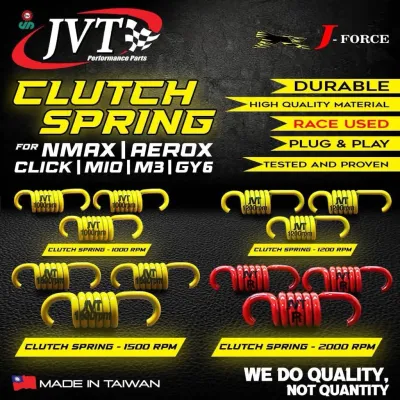
Prices are valid at publication and may change. Please refer to the product page for the latest price.
The small clutch shoe springs are tension springs hooked directly onto the three clutch shoes inside the rear clutch assembly. Their primary purpose is to hold the clutch shoes inward, preventing them from making contact with the surrounding clutch bell while the engine is idling. As you twist the throttle and engine RPM increases, centrifugal force pushes the clutch shoes outward. Once the centrifugal force overcomes the tension of these small springs, the shoes swing outward and make firm contact with the inner surface of the clutch bell, which then spins the rear wheel and moves the scooter forward. The stiffness of these springs directly dictates the engagement RPM—the exact engine speed at which the clutch begins to grab and transfer power.
In contrast, the large main torque spring, or center spring, is a compression spring positioned between the clutch carrier and the rear sliding sheave. While the small clutch shoe springs control initial engagement timing from a standstill, the main torque spring regulates the belt clamping force and controls how quickly the transmission shifts to a higher or lower virtual gear ratio (backshifting) while the scooter is already moving. Changing the stiffness of your clutch shoe springs alters the initial bite and acceleration from a complete stop, whereas changing the main torque spring affects mid-range acceleration, uphill climbing power, and throttle recovery when slowing down and speeding up again.
Identifying Your Riding Style and CVT Goals
Before purchasing an aftermarket clutch spring, you must evaluate your primary riding environment and what you want to achieve with your Mio i 125. Because different spring stiffnesses shift the power delivery characteristics of your scooter, your choice should align directly with your daily routes and load requirements.

City Commuting and Stop-and-Go Traffic
For riders who use their Mio i 125 primarily for daily commuting through heavy traffic, stock or slightly softer clutch springs are generally the most practical choice. In congested urban areas, you want early, smooth, and predictable clutch engagement at lower engine speeds. A softer spring setup allows the clutch shoes to engage the bell at lower RPMs, which minimizes the jerky “on-off” throttle sensation common in heavy traffic. This early engagement also keeps the engine running at lower, quieter rotation speeds during slow-speed filtering, which significantly improves fuel economy and reduces heat buildup within the CVT casing.
Aggressive Riding or Highway Cruising
If your daily routes involve open highways, provincial roads, or if you prefer a sportier riding style with rapid off-the-line acceleration, stiffer clutch springs are highly beneficial. Stiffer aftermarket springs (such as 1000 RPM or 1200 RPM upgrades) require higher centrifugal force—and therefore higher engine RPM—to expand the clutch shoes. This delay allows the engine to rev higher and reach its optimal power band before the clutch locks with the bell. When the clutch finally engages, the engine is already producing more horsepower and torque, resulting in a much faster, more responsive launch from a standstill.
Load Carrying and Pillion Riding
Carrying a passenger (pillion) or hauling heavy cargo on a daily basis puts significant strain on your Mio i 125’s transmission. Under heavy loads, a stock clutch spring setup can sometimes engage too early, causing the engine to bog down or struggle to pull the weight from a complete stop. Furthermore, the added weight can cause the clutch shoes to slip against the bell, leading to severe shuddering, vibrations, and localized overheating of the clutch lining. Upgrading to a slightly stiffer clutch spring helps prevent this by delaying engagement until the engine has generated sufficient torque to pull the heavier load smoothly, ensuring a firm, slip-free lockup.
Matching Spring Stiffness and RPM Ratings to Your Setup
When shopping for aftermarket Mio i 125 clutch springs, you will encounter various stiffness ratings expressed in RPM increments, such as 1000 RPM, 1500 RPM, or 2000 RPM. Understanding how to interpret these ratings and how they interact with your existing CVT components is critical to avoiding a mismatched setup.
Interpreting Aftermarket RPM Ratings
It is a common misconception that a “1000 RPM” clutch spring means the clutch will engage at exactly 1000 RPM engine speed. In reality, these ratings indicate how much additional engine speed is required to overcome the spring tension compared to the stock setup. For example, a 1000 RPM spring will delay clutch engagement by roughly 1000 RPM past the stock engagement point. For a stock Mio i 125, which typically begins to engage around 3000 to 3400 RPM, installing 1000 RPM springs will push that engagement point closer to 4000 or 4400 RPM. A 2000 RPM spring is generally far too stiff for a stock or mildly tuned 125cc engine, as it forces the engine to rev excessively high before the scooter even begins to move, causing severe overheating and rapid wear.
Balancing the CVT Triangle
Your CVT operates as a balanced system composed of three primary tuning variables: the clutch shoe springs, the roller weights (locally referred to as flyballs), and the main torque spring. Altering one component without considering the others can ruin your scooter’s performance. For instance, if you install lighter roller weights to improve acceleration, your engine will naturally rev higher before the front pulley forces the belt outward. If you combine these light rollers with excessively stiff clutch shoe springs, your engine may scream at high RPMs before the clutch engages, leading to massive fuel consumption, belt slip, and accelerated clutch wear. Always aim for a balanced configuration where your roller weights and clutch springs complement each other rather than work against one another.
Physical Compatibility and Inspection Checks
Before buying any aftermarket spring set, you must verify its physical compatibility with the Yamaha Mio i 125 clutch assembly. Do not assume that all Yamaha scooter springs are interchangeable; springs designed for the older Mio Sporty, Mio Soulty, or larger Maxi-scooters like the NMAX have different physical dimensions. You must check:
- Spring Length: The overall length of the spring must match the distance between the mounting holes on your Mio i 125 clutch shoes to prevent loose fitment or over-stretching during installation.
- Wire Thickness: Stiffer springs achieve their rating through thicker steel wire. Ensure the wire thickness does not interfere with the surrounding clutch carrier components.
- Hook Design: The angle and shape of the mounting hooks must align perfectly with the holes in your stock clutch shoes to prevent the springs from unhooking or snapping under high tension.
The Danger of Mixing Springs
Under no circumstances should you mix different spring stiffnesses within the same clutch assembly. For example, installing two 1000 RPM springs and one stock spring to “split the difference” is a dangerous practice. This uneven tension causes the clutch shoes to engage the clutch bell at different times and with unequal force. The result is severe clutch shudder, violent vibrations through the chassis, uneven wear on the clutch linings, and potential warping of the clutch bell. Always purchase and install clutch shoe springs as a matched set of three identical springs.
Step-by-Step Selection and Verification Process
To ensure you select the correct clutch spring and install it successfully, follow this step-by-step selection and verification checklist.
Step 1: Inspect Your Existing Clutch Assembly
Before spending money on new aftermarket springs, disassemble your rear pulley and inspect the condition of your existing clutch shoes and clutch bell. Check the thickness of the friction linings on the clutch shoes. If the linings are worn down close to the metal backing, or if they show signs of severe glazing (a smooth, shiny, glass-like surface caused by excessive heat), you must replace the clutch shoes entirely. Installing brand-new, stiffer springs on worn-out or glazed clutch shoes will not fix slipping issues; in fact, the higher engagement RPM of stiffer springs will only accelerate the destruction of degraded friction material.
Step 2: Cross-Reference with Your Current CVT Setup
Analyze your current roller weight configuration before choosing a spring stiffness. If your Mio i 125 is completely stock, a mild upgrade to 1000 RPM clutch springs is generally the safest and most effective choice for a slight boost in off-the-line responsiveness without sacrificing daily drivability. If you have already lightened your roller weights significantly, stick to stock or very mild clutch springs to prevent your engine from revving excessively high before moving.
Step 3: Purchase from Reputable Brands
Always source your clutch springs from established aftermarket brands or official Yamaha OEM channels. Reputable manufacturers provide precise stiffness ratings, use high-quality spring steel that resists tension loss over time, and offer explicit fitment guarantees for the Mio i 125. Avoid unbranded or generic “universal” springs sold on cheap online marketplaces, as these often lack proper quality control, leading to inconsistent stiffness ratings, rapid sagging, or sudden spring breakage while riding.
Step 4: Post-Installation Safety Verification
Once the new springs are installed, perform a thorough safety check before heading out onto public roads. Place your Mio i 125 securely on its center stand on flat ground. Start the engine and let it warm up to a stable idle. The rear wheel should not spin rapidly while the engine is idling. Slowly twist the throttle and note the engine sound and the exact point at which the rear wheel begins to rotate.
- Abnormal Vibrations: If you feel intense shuddering or hear metallic clanking as the clutch engages, immediately shut off the engine and inspect the clutch assembly for improper spring seating or uneven shoe expansion.
- Test Ride: Take the scooter for a low-speed test ride in a quiet, controlled area. Ensure the clutch disengages smoothly when you roll off the throttle and come to a stop, without stalling the engine or dragging.
Common Mistakes and Safety Boundaries
Modifying your scooter’s CVT requires precision and strict adherence to mechanical safety limits. Avoiding common pitfalls will protect your investment and ensure your safety on the road.
Over-Stiffening and Unbalanced Tuning
The most common mistake among Mio i 125 owners is installing excessively stiff clutch shoe springs (such as 1500 RPM or 2000 RPM) on an otherwise stock engine. Without a corresponding increase in engine power or a stiffer main torque spring to maintain belt tension, overly stiff shoe springs will cause the clutch to engage violently at very high RPMs. This creates extreme friction, leading to rapid heat buildup inside the CVT casing. Over time, this heat will glaze the clutch shoes, warp the clutch bell, degrade the CVT grease, and cause the drive belt to slip and wear out prematurely.
Reusing Damaged Components
Never attempt to save money by mounting new springs onto damaged, warped, or out-of-round clutch bells. If your clutch bell has turned a bluish color from excessive heat, its structural integrity has been compromised, and it is likely no longer perfectly round. Reusing a heat-damaged bell with new springs will cause persistent clutch shudder, uneven engagement, and rapid wear on your new components.
Safety Boundary and Tool Requirements
Working on your Mio i 125’s CVT involves high-tension springs and high-torque fasteners that require specialized tools to handle safely.
- Required Tools: To safely remove the clutch bell and disassemble the clutch carrier, you must use a universal clutch holder (flywheel holder) or an impact wrench to loosen the clutch bell nut.
- Spring Compression Danger: The main torque spring is under significant compression. Attempting to remove the large clutch secure nut without a dedicated clutch spring compressor tool can cause the clutch assembly to fly apart violently, risking severe personal injury or damage to the parts.
- Torque Specifications: When reassembling the CVT, all fasteners must be tightened to the exact torque specifications outlined in the official Yamaha service manual using a calibrated torque wrench. Under-tightening can cause the clutch nut to back off while riding, leading to catastrophic transmission failure, while over-tightening can strip the crankshaft or input shaft threads.
- Professional Assistance: If you do not possess a calibrated torque wrench, a clutch holder, a spring compressor, or the necessary mechanical experience, do not attempt this installation yourself. Bring your Mio i 125 and your chosen clutch springs to a qualified motorcycle mechanic at a reputable service center in the Philippines to ensure a safe, professional, and reliable installation.
Community discussion
Share your experience or ask a question. Comments are reviewed before publication.