
Selecting the right center spring for your Honda Click’s Continuously Variable Transmission (CVT) is essential for maintaining smooth acceleration and reliable power delivery. Often referred to as the torque spring, this component regulates the clamping force on your drive belt and dictates how your transmission shifts under load. Upgrading to an aftermarket option like an NCY center spring can resolve sluggish throttle response, especially when navigating steep inclines or carrying heavy loads. However, choosing the wrong stiffness can lead to premature belt wear, reduced top speed, or excessive engine strain. Finding the perfect balance requires understanding how spring specifications interact with your daily riding conditions in tropical climates.
Decoding NCY Center Spring Specifications
Aftermarket center springs are typically categorized by RPM ratings, such as 1000 RPM, 1500 RPM, or 2000 RPM. These ratings do not represent the engine speed at which your scooter starts moving; instead, they indicate the relative stiffness compared to a standard factory spring. A higher RPM rating means a stiffer spring, which requires more centrifugal force from the rear pulley to compress. This delay keeps the transmission in a lower gear ratio longer, providing quicker throttle response when you twist the grip.
Physical dimensions are just as critical as the stiffness rating when selecting a replacement part. The free length of the spring—its total height when uncompressed—and its outer diameter must match the specifications of your specific Honda Click engine displacement, whether it is a 125cc or 150cc variant. Installing a spring with an incorrect installed length can cause the spring to bind before the pulley fully opens, preventing the transmission from reaching its highest gear ratio.
Products mentioned in this guide
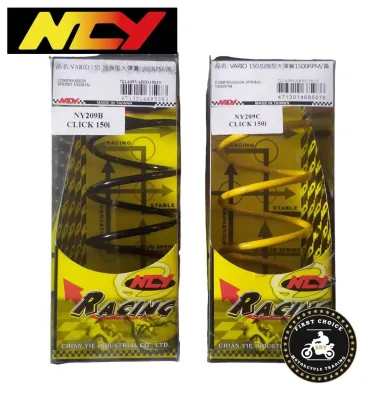
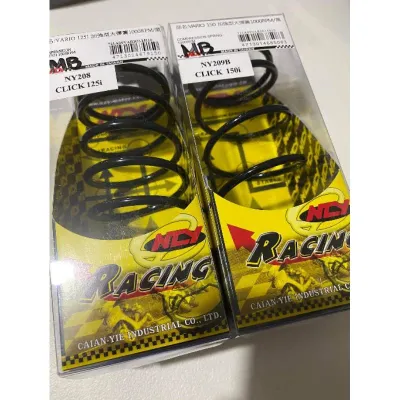
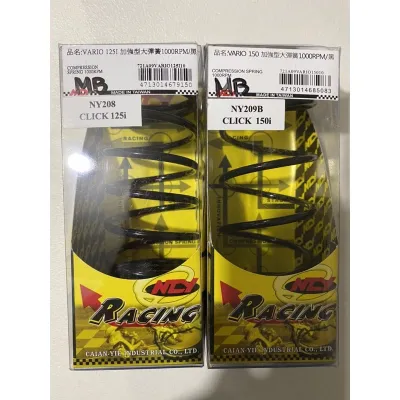
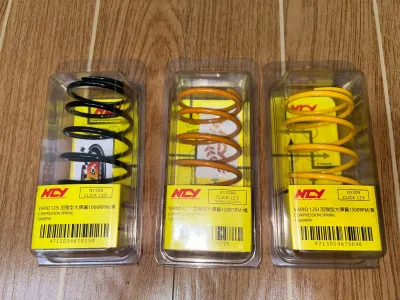
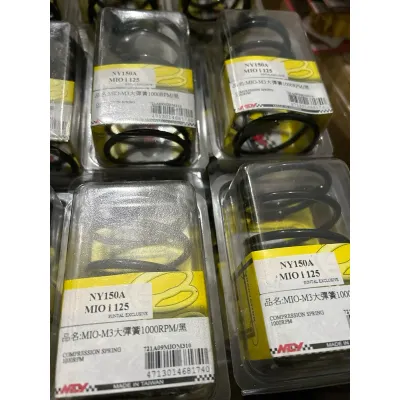
Prices are valid at publication and may change. Please refer to the product page for the latest price.
When browsing online marketplaces or local motorcycle shops, you will often see color-coded springs. While brands like NCY use specific colors to denote different stiffness levels, these color codes are not standardized across the industry. Always verify the actual RPM rating and physical compatibility listed on the product packaging rather than relying solely on the paint color.
Matching Spring Stiffness to Your Riding Needs
Choosing the correct spring stiffness is a balancing act between acceleration and overall efficiency. A stiffer spring, such as a 1500 RPM model, keeps the belt tightly clamped and prevents slipping, which is highly beneficial for stop-and-go city commuting or climbing steep flyovers. This extra clamping force ensures immediate power delivery when overtaking. However, the trade-off is that your engine must work harder to compress the spring, which can slightly lower your top-end speed and increase fuel consumption during long highway cruises.

For daily solo commuting on flat city roads, a milder upgrade like a 1000 RPM spring or even a fresh standard-spec spring is often sufficient. This setup maintains comfortable fuel efficiency while offering a subtle improvement over a worn-out stock component. If you regularly carry a pillion rider or haul heavy cargo through hilly terrain, a stiffer 1500 RPM spring helps keep the engine in its optimal powerband, preventing the transmission from shifting up too early and bogging down.
It is crucial to remember that the center spring does not operate in isolation. It works in direct opposition to the roller weights in your front pulley. If you install a stiffer center spring without adjusting your roller weights, your engine may rev excessively high without a corresponding increase in speed. A balanced CVT tuning approach requires matching the spring stiffness with the correct roller weight configuration and ensuring your drive belt is in excellent condition.
Pre-Purchase Checks and Installation Boundaries
Before purchasing any aftermarket transmission component, you must verify the exact model year and engine displacement of your Honda Click. Parts designed for older generations or different scooter models may have slight dimensional variances that prevent proper seating inside the rear clutch assembly. Always cross-reference the manufacturer’s part numbers with your vehicle’s documentation to ensure a precise fit.
Modifying or servicing a scooter’s CVT system involves high-tension components and specific torque requirements. The center spring is held under significant compression by the clutch nut; releasing this nut without the proper clutch spring compressor tool can cause the assembly to fly apart, risking severe personal injury or damage to the parts. You must consult your scooter’s official service manual for the correct disassembly procedures, safety precautions, and torque specifications for reassembly.
If you observe signs of severe transmission wear, such as deep grooves on the pulley faces, a cracked or frayed drive belt, or unusual grinding noises from the rear casing, a simple spring replacement will not solve the underlying issue. In these situations, stop riding and have the entire CVT system inspected by a qualified motorcycle mechanic. Professional installation is highly recommended if you do not possess the specialized tools or mechanical experience required to handle compressed clutch springs safely.
Frequently Asked Questions (FAQ)
Will a stiffer NCY center spring increase my Honda Click's top speed?
No, a stiffer center spring will not increase your scooter’s maximum top speed. Its primary function is to control how quickly the transmission shifts and to provide adequate clamping force on the drive belt to prevent slipping. While it improves low-end acceleration and throttle responsiveness, an excessively stiff spring can actually prevent the rear pulley from opening fully, which may reduce your top-end speed and increase fuel consumption.
How do I know if my current center spring needs replacement?
You can identify a worn center spring through both physical inspection and riding performance. Physically, you should measure the spring’s free length using a vernier caliper and compare it to the service limit specified in your Honda Click’s manual; a sagged or deformed spring must be replaced. On the road, a fatigued spring often manifests as sluggish acceleration, a noticeable delay when trying to speed up after slowing down, or belt slippage under heavy loads.
Community discussion
Share your experience or ask a question. Comments are reviewed before publication.