
Selecting the right Sanwa multimeter requires matching the instrument’s specific measurement capabilities, safety ratings, and resolution to your actual testing environment. Whether you are diagnosing a stubborn charging system in a humid garage, troubleshooting a home appliance after a sudden power fluctuation, or soldering delicate micro-components on a workbench, your choice of test tool directly impacts both your safety and diagnostic accuracy. A multimeter that is perfect for low-voltage electronics might lack the safety ruggedness required for household mains, while a heavy-duty industrial meter might be too bulky and lack the fine resolution needed for circuit board diagnostics. By understanding your primary testing needs, you can select a model that provides reliable readings without paying for unnecessary industrial-grade features.
Identifying Your Electrical Testing Requirements
Before browsing through different models, you must define the primary environment where your multimeter will operate. Electrical testing generally falls into three distinct categories: automotive diagnostics, household electrical maintenance, and electronics repair. Each of these environments presents unique challenges, voltage levels, and safety hazards that dictate the type of test equipment required. For instance, working on a vehicle involves low-voltage direct current (DC) systems but requires a tool that can withstand high-current starter circuits, transient voltage spikes, and harsh physical conditions. Conversely, household electrical work in the Philippines deals with 220V alternating current (AC) utility power, where the risk of high-energy arc flashes is a constant concern.
Matching your multimeter to your specific environment is not just a matter of convenience; it is a critical safety practice. Using an electronics-grade meter with inadequate input protection on a high-energy household distribution panel can result in catastrophic equipment failure, leading to severe burns or electrical shock. On the other hand, using a basic electrical tester on sensitive automotive electronic control units (ECUs) can draw excessive current from the circuit, potentially damaging expensive onboard computers. A proper match ensures that the meter’s internal circuitry can handle the electrical energy of the system under test while providing the precision necessary to make correct diagnostic decisions.
Products mentioned in this guide
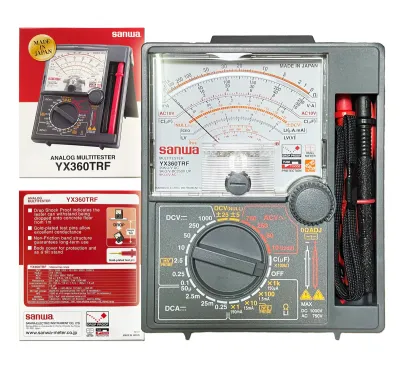
14 Lazada user ratings
🛠️Durability:hope so 👌Ease of Use:just open it and presto 🔨Durability:ok legit and fast seller fast delivery well packed ORIGINAL!!
Compact and reliable tool, Protective body cover for safety, Durable shockproof design, Null center meter for accurate readings,
Quality:super solid Appearance:super solid Performance:super solid
original. . .14 years bago nasira yung last na ganito ko. . eheheh
-made quality, Best-selling analog tester,
![[Fast Delivery] Sanwa YX360TRF Analog Multi-Tester Multi-Meter Made in JAPAN Analogue Multitester Multimeter DN](https://img.lazcdn.com/g/p/66f9ab4f884c715e99ee36d59c6e8d58.jpg_400x400q80.jpg_.webp)
69 Lazada user ratings
Ideal for weak current circuits, Compact and portable, Precise analog meter, Compact and portable, Drop-proof design, Low voltage high resis…Read full reviewShow less
Ideal for weak current circuits, Compact and portable, Precise analog meter, Compact and portable, Drop-proof design, Low voltage high resistance,
📏Accuracy: Precise voltage readings, Easy to use design,
SANWA DAW...salamat sanwai😀
Easy to use design,
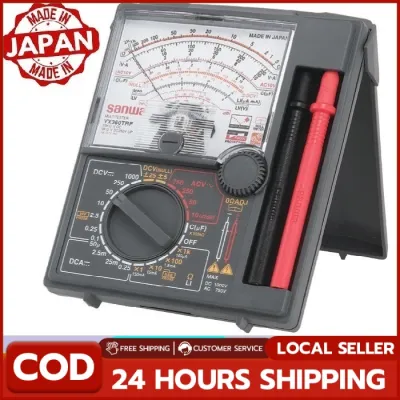
51 Lazada user ratings
🛠️Durability:ok material use. 👌Ease of Use:verry easy to use. 🔨Durability:ok material use but not fixed at the right side.
Great value for the price, looks good and durable considering the cheap price..hope will last.
🛠️Durability:looks durable 👌Ease of Use:quiet handy 📏Accuracy:its accurate though
need ko po replacement ng same na item dont need a refund please thank you
My order is a SANWA multi tester but you me a Sanwai? What is that?
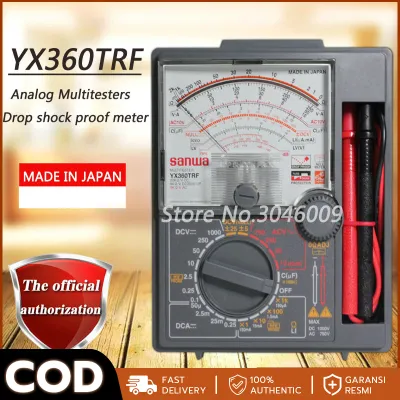
3 Lazada user ratings
Nagsayang kng nang pera ang makabili kung hindi sira ang unit di ma calibrate sa ohms settings mula x1 to x1k nasa gitna lang pag e calibrat…Read full reviewShow less
Nagsayang kng nang pera ang makabili kung hindi sira ang unit di ma calibrate sa ohms settings mula x1 to x1k nasa gitna lang pag e calibrate, pati voltage readings ang layu. Oo what you pay for less is what you get in short INFERIOR product. Sana naman ying pinadala tiniest nyu muna kahit 300 plus lng ang presyo, langhiya mapaaga agad ang tapon ng product nato sa basurahan. hitsura lng okey nilagay pa sanwa yun pala ang sa actual sanwai.
not working.battery installed.
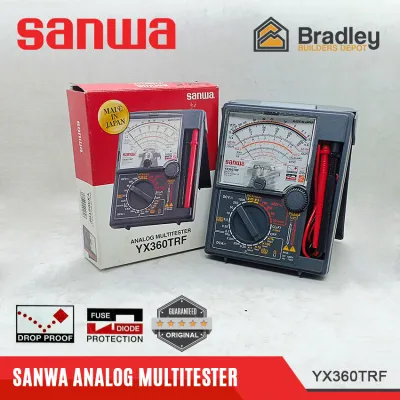
2 Lazada user ratings
legit po sya made in japan
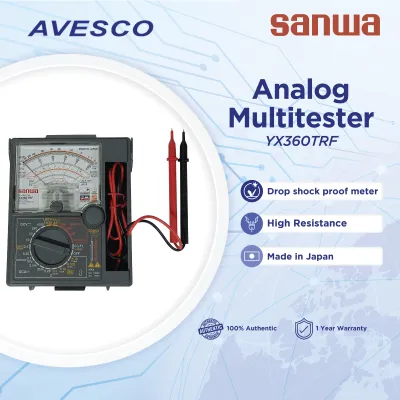
73 Lazada user ratings
Convenient storage for test leads, Easy to use, Durable and reliable, High resistance capability, Great value for money, Clear and precise r…Read full reviewShow less
Convenient storage for test leads, Easy to use, Durable and reliable, High resistance capability, Great value for money, Clear and precise readings,
Clear and precise readings, Convenient storage for test leads, Versatile functionality, original Sanwa.
Accuracy:Clear and precise readings, Versatile functionality, High resistance capability,
Solid body cover for protection, Great value for money
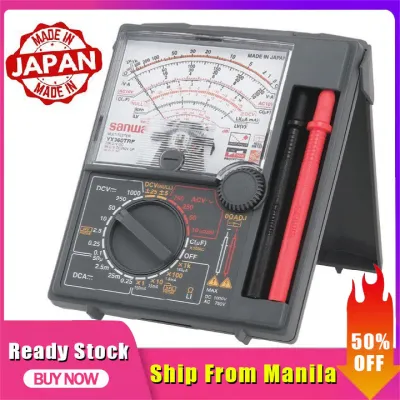
372 Lazada user ratings
Ease of Use: The only way way I would get wo Durability: The only reason why Accuracy: is that the only reason reason why is because of you …Read full reviewShow less
Ease of Use: The only way way I would get wo Durability: The only reason why Accuracy: is that the only reason reason why is because of you and
good packaging very useful to my electrical projects accurate gauge in different value of measuring electronic parts
wrong item..it's sanwai not sanwa model YX 360 TRF IS MY ORDER not YX 360 TRd it's a scam
the quality and apperance you deliver is wrong. i feel this us scam.
ordered brand:SANWA item delivered brand: SANWAI
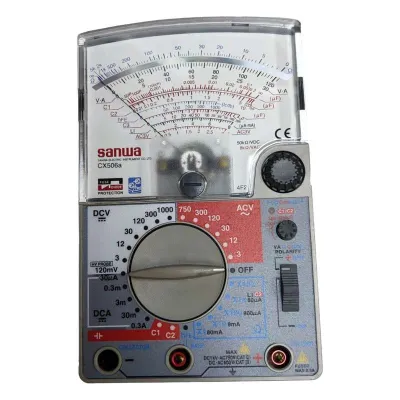
Prices are valid at publication and may change. Please refer to the product page for the latest price.
At a minimum, any multimeter you consider must perform the four baseline measurement functions: AC voltage, DC voltage, resistance, and continuity. AC voltage measurements are essential for verifying wall outlets and household appliances, while DC voltage checks are the standard for testing automotive batteries, sensors, and electronic power supplies. Resistance measurements allow you to check the integrity of coils, heating elements, and switches. Continuity testing, which produces an audible beep when a continuous path is detected, is the most frequently used function for quickly finding broken wires, blown fuses, and open circuits without needing to constantly look at the digital display.
Sanwa Multimeter Categories by Use Case
Sanwa offers a diverse lineup of multimeters structured into distinct tiers, ranging from compact pocket-sized units to highly precise professional and specialized bench meters. Understanding these categories helps you narrow down your options based on your frequency of use, required precision, and budget. Entry-level models are typically designed for light DIY use, offering basic functions in a highly portable form factor. These are excellent for occasional household troubleshooting or keeping in a vehicle glove box for emergency roadside diagnostics.

Professional and specialized tiers are engineered for daily use by technicians, electricians, and engineers who require high accuracy, robust input protection, and advanced measurement features. These mid-to-high-range models feature replaceable test leads, higher count resolutions, and superior physical durability to withstand daily wear and tear. By identifying where your tasks fall on this spectrum, you can avoid the frustration of an underpowered tool or the unnecessary expense of an over-engineered industrial calibrator.
Automotive Diagnostics and Garage Use
Diagnosing modern vehicle electrical systems requires a multimeter that can handle both standard battery testing and complex sensor diagnostics. Automotive electrical systems primarily operate on 12V DC for passenger cars or 24V DC for commercial trucks and heavy machinery. However, the charging system, driven by the alternator, regularly pushes these voltages up to 14.5V or 29V. Furthermore, starting a vehicle or switching off heavy inductive loads like air conditioning clutches can generate high-voltage transient spikes that the multimeter must safely absorb without failing.
While basic voltage checks are sufficient for verifying battery health, advanced automotive troubleshooting requires specialized functions. Features such as duty cycle and frequency measurements are invaluable when diagnosing pulse-width modulated (PWM) solenoids, fuel injectors, and electronic sensors like mass airflow (MAF) or wheel speed sensors. Some specialized automotive meters also include temperature probes, allowing you to monitor engine coolant or air conditioning output temperatures directly from the digital display.
The physical environment of a garage also demands specific design features. Working in tropical climates like the Philippines means dealing with high humidity, dust, and occasional exposure to automotive fluids like oil or coolant. A multimeter used in these conditions must feature a robust build quality, ideally wrapped in a thick, protective rubber holster to absorb shocks from accidental drops onto concrete floors. A bright, backlit display is another essential feature, ensuring you can clearly read measurements when working deep inside a dark engine bay, under a dashboard, or beneath the vehicle chassis.
Safety is paramount when working on vehicle electrical systems. Always consult the original vehicle manufacturer’s service manual for specific wiring diagrams, test points, and safety procedures before performing diagnostics. For critical safety systems such as SRS airbags, anti-lock braking systems (ABS), or high-voltage hybrid and electric vehicle (EV) drivetrains, standard automotive testing procedures do not apply. High-voltage hybrid and EV systems operate at lethal voltages (often exceeding 300V DC) and require specialized high-voltage insulated tools, CAT III or CAT IV rated multimeters, and qualified professional installation and diagnostics. Never attempt to test high-voltage vehicle circuits with a standard automotive multimeter.
Household Electrical Maintenance
For homeowners and DIY enthusiasts, a multimeter is an indispensable tool for maintaining household electrical systems and troubleshooting appliances. In the Philippines, the standard residential electrical supply is 220V AC at 60Hz. Common household tasks include verifying if a wall outlet is properly energized, checking light switches for correct operation, testing appliance heating elements, and diagnosing why a water heater or air conditioning unit is not functioning. These tasks require a meter that prioritizes safety, ease of use, and clear visual feedback.
An auto-ranging multimeter is highly recommended for household maintenance, especially for non-professional users. Auto-ranging automatically selects the correct measurement scale for the voltage or resistance being tested, eliminating the need to manually dial in the expected range. This significantly reduces the learning curve and minimizes reading errors, such as misinterpreting a millivolt reading for a full volt. A clear, high-contrast digital display with large digits further ensures that you can quickly and accurately read the measurement without second-guessing the numbers.
Safety features are a critical consideration for household testing. A multimeter with integrated non-contact voltage (NCV) detection is highly valuable, allowing you to detect the presence of AC voltage through wire insulation or outlet slots without making direct electrical contact. This serves as an excellent preliminary safety check to confirm a circuit is dead before opening a junction box or touching bare wires. Additionally, ensure the meter features high-quality internal ceramic fuses with sufficient interrupting capacity to safely extinguish any high-energy short circuits that may occur during testing.
Electronics Repair and Hobbyist Projects
Electronics repair and hobbyist projects demand a level of precision and sensitivity that standard electrical meters cannot provide. Working on printed circuit boards (PCBs), microcontrollers, and low-voltage DC circuits requires measuring minute changes in voltage, current, and resistance. A minor voltage drop across a diode or a slight deviation in a resistor’s value can mean the difference between a functioning circuit and a dead board. Therefore, electronics hobbyists and repair technicians must look for meters with high accuracy classes and high count resolutions.
Specialized measurement functions are essential for diagnosing electronic components. Capacitance measurement is crucial for testing electrolytic capacitors, which frequently degrade over time and cause power supply failures in consumer electronics. Frequency and duty cycle measurements are necessary for analyzing clock signals and pulse-width modulation circuits. Furthermore, the meter must feature microamp (µA) and milliamp (mA) current ranges, allowing you to measure the low standby currents of battery-powered devices or the output of delicate sensor circuits.
Usability features on the test bench can greatly improve your workflow. A fast-responding continuity beeper is essential for tracing complex PCB traces and finding short circuits quickly. A data hold function allows you to freeze a reading on the screen, which is incredibly helpful when your eyes must remain focused on holding sharp probe tips on tiny surface-mount device (SMD) pads. For advanced diagnostics, some high-end models offer PC connectivity via USB or Bluetooth, enabling real-time data logging to track intermittent thermal faults or battery discharge curves over extended periods.
Key Specifications to Compare Before Buying
When comparing different Sanwa multimeter models, understanding the technical specifications on the product label or user manual is key to making an informed decision. One of the first specifications to look at is the count resolution, often expressed as 2000, 4000, or 6000 counts. This number represents the maximum value the display can show before moving the decimal point. For example, a 2000-count meter can display up to 19.99V with two decimal places, but as soon as the voltage reaches 20V, it must shift to 20.0V, losing one digit of precision. A 4000-count meter, however, can display up to 39.99V with two decimal places, providing double the resolution for common automotive and low-voltage electronics testing.
Another important choice is between auto-ranging and manual-ranging multimeters. Auto-ranging meters are highly convenient because they automatically adjust the internal circuitry to match the incoming signal, making them ideal for beginners and general troubleshooting. However, they can take a second or two to settle on a reading as they scan through the ranges. Manual-ranging meters require you to select the correct range using the rotary dial before taking a measurement. While this has a steeper learning curve, manual-ranging is often preferred by experienced technicians for repetitive measurements of similar values, as it provides instant readings and can extend battery life by reducing processor workload.
Input impedance is a critical specification that is often overlooked but has a massive impact on measurement accuracy. Input impedance refers to the internal resistance of the multimeter when set to measure voltage. A high-quality digital multimeter should have an input impedance of at least 10 Megohms (10 million ohms). This high resistance ensures that the meter draws virtually no current from the circuit under test, preventing a phenomenon known as “circuit loading.” If you use a low-impedance meter on a high-resistance circuit, such as a sensitive automotive sensor line or a microcontroller input, the meter itself will pull down the voltage, resulting in an artificially low and highly inaccurate reading.
Safety Ratings and Proper Usage Boundaries
No matter which multimeter you choose, safety must always be your top priority. Multimeters are rated according to Overvoltage Installation Categories, commonly known as CAT ratings, which define the level of transient voltage spikes the meter can safely withstand. CAT II is rated for single-phase receptacle-connected loads, such as standard household appliances and portable tools. CAT III is designed for the building’s distribution level, including distribution panels, lighting systems, and short branch circuits. CAT IV is the highest rating, engineered for utility-level connections, outdoor overhead lines, and service entrances where massive transient surges can occur.
Before connecting your multimeter to any live circuit, you must verify that its CAT rating matches or exceeds the safety requirements of your testing environment. For example, testing a 220V wall outlet or a main breaker panel in a residential home requires a meter rated for at least CAT III 300V or CAT III 600V. Always check the manufacturer’s label printed on the front of the meter and consult the user manual to verify the maximum voltage and current limits for each input jack. Never attempt to measure voltages that exceed these rated limits, as doing so can cause the meter to explode or cause severe injury.
To ensure safe operation, you must establish clear stop conditions and halt testing immediately if any unsafe indicators arise. First, if the meter displays an “OL” (overload) warning when measuring voltage, immediately disconnect the probes, as the voltage exceeds the selected range or the meter’s maximum capacity. Second, never ignore a low battery warning; low battery voltage can cause the meter’s internal reference voltage to drift, leading to dangerously inaccurate readings—such as displaying a live, lethal 220V line as a safe 12V. Finally, inspect your test probes before every use and stop testing immediately if you detect any physical damage, such as cracked insulation, exposed copper wire, or loose probe tips.
Frequently Asked Questions (FAQ)
Do I need a true RMS multimeter for basic home repairs?
For basic household repairs, a standard average-responding multimeter is usually sufficient and more cost-effective. Average-responding meters are calibrated to measure pure, undistorted AC sine waves, which are typical of simple resistive loads like incandescent light bulbs, standard space heaters, and basic electric stoves. If your troubleshooting is limited to checking if outlets are live or testing simple heating elements, an average-responding meter will provide accurate enough readings for your needs.
However, modern homes in the Philippines increasingly rely on non-linear loads that distort the standard AC waveform. Devices such as inverter air conditioners, variable-speed pool pumps, LED lighting drivers, and computer power supplies draw current in short pulses rather than a smooth sine wave. An average-responding meter will often read these distorted waveforms incorrectly, sometimes underreporting the voltage by up to 10% to 30%. If you regularly troubleshoot modern inverter appliances or complex electronic lighting systems, investing in a True RMS (Root Mean Square) multimeter is highly recommended to ensure accurate voltage and current measurements.
How do I test if my multimeter probes are safe to use?
Testing your multimeter probes is a quick and essential safety routine that should be performed before every measurement session. Start with a thorough visual inspection of the entire length of the lead wires. Look for any signs of cracked, cut, or melted insulation, which can occur if the leads accidentally touch a hot engine component or a soldering iron. Check the strain reliefs at both ends—where the wire meets the probe tip and where it enters the banana plug—to ensure there are no exposed copper strands or loose connections.
After the visual check, perform a functional test using the meter’s internal circuitry. Insert the black lead into the COM jack and the red lead into the voltage/resistance jack, then switch the dial to continuity mode (indicated by the sound wave icon). Touch the two metal probe tips firmly together; the meter should emit a continuous, solid beep, and the display should show a resistance reading very close to zero, typically less than 0.5 ohms. While keeping the probe tips pressed together, gently wiggle the lead wires near the strain reliefs; if the beep stutters or the resistance reading jumps, the internal copper strands are fractured, indicating the probes are unsafe and must be replaced immediately.
If your probes fail either the visual or functional test, do not attempt to repair them with electrical tape or solder. Damaged probes must be replaced immediately with a new set of high-quality leads. When purchasing replacements, ensure that the new probes carry safety and CAT ratings that are equal to or higher than the ratings of your multimeter. Using low-rated probes on a high-rated meter compromises the safety of the entire system, exposing you to potential shock hazards during high-voltage testing.
Community discussion
Share your experience or ask a question. Comments are reviewed before publication.