
Evaluating whether Oser radiator coolant is suitable for your vehicle in the Philippine tropical climate requires looking beyond basic marketing claims and focusing on verified technical specifications. Operating a vehicle in consistently high ambient temperatures, especially during heavy stop-and-go traffic in major metropolitan areas, places immense stress on the engine’s cooling system. To determine if this specific coolant will protect your engine from overheating, you must verify its chemical composition, boiling point, and compatibility with your vehicle manufacturer’s original equipment standards. Choosing the wrong fluid can lead to localized boiling, accelerated corrosion, or catastrophic engine failure, making a systematic verification process essential for every car owner.
Understanding Engine Cooling Demands in Tropical Climates
The tropical climate of the Philippines presents a continuous challenge to automotive cooling systems. Unlike temperate regions where engines experience seasonal temperature swings, local vehicles operate in high ambient heat year-round, often exceeding 35 degrees Celsius. This elevated baseline temperature reduces the temperature differential between the radiator and the surrounding air, making it significantly harder for the radiator to shed heat. When you are stuck in slow-moving traffic with minimal airflow passing through the grille, the cooling system must rely entirely on the radiator fan and the thermal capacity of the coolant to prevent heat buildup.
Under these conditions, the pressure inside the cooling system rises rapidly. If the coolant’s boiling point is too low, the fluid can begin to boil locally around the hottest parts of the engine block, such as the cylinder head. This localized boiling creates vapor pockets, also known as vapor lock, which act as barriers to heat transfer because steam cannot absorb heat as effectively as liquid. Furthermore, these collapsing vapor bubbles cause cavitation, a destructive phenomenon that can erode metal surfaces inside the water pump and engine block over time.
Products mentioned in this guide
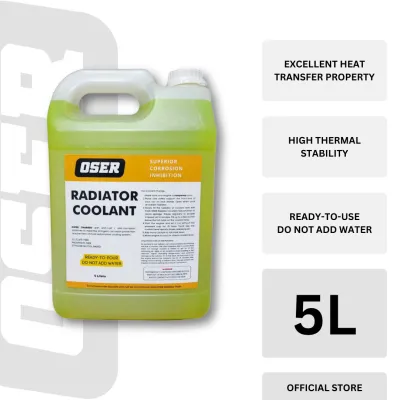
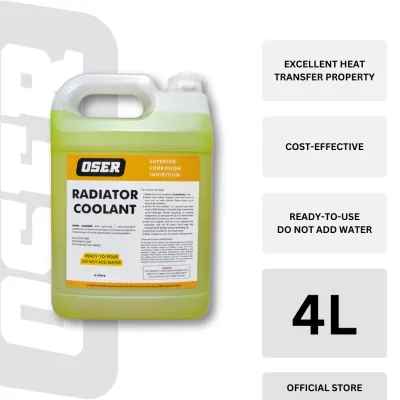
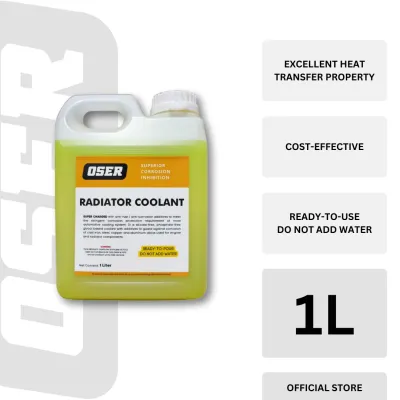
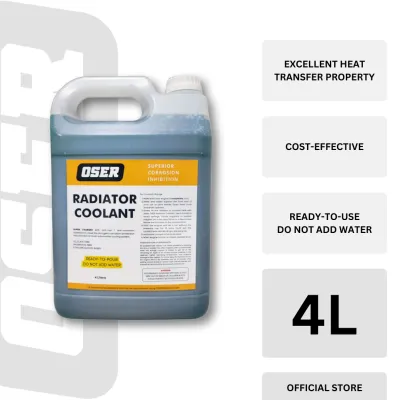
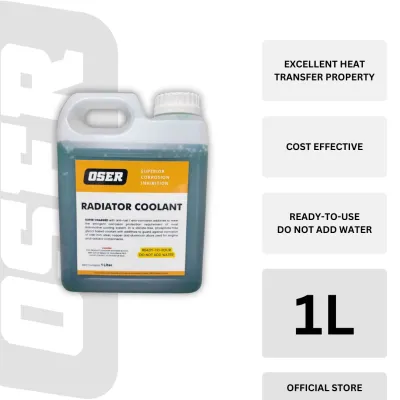
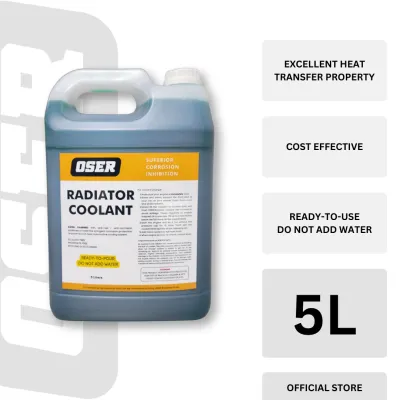
Prices are valid at publication and may change. Please refer to the product page for the latest price.
To combat this, modern cooling systems rely on a precise balance of water and glycol. While pure water has an excellent capacity for transferring heat, it boils at 100 degrees Celsius at sea level and lacks corrosion inhibitors. Adding glycol raises the boiling point of the mixture, providing a critical safety margin when engine temperatures spike. However, because glycol is less efficient at transferring heat than water, maintaining the correct concentration ratio is vital to ensure the system can both resist boiling and actively dissipate heat away from critical engine components.
How to Verify Oser Coolant Specifications on the Label
When inspecting a bottle of Oser radiator coolant, the product label is your primary source of technical truth. You must first determine whether the product is sold as a pre-mixed solution or as a concentrate. Pre-mixed coolants are typically formulated at a 50/50 ratio with demineralized water, which is ready to pour directly into your expansion tank. If you purchase a concentrated formula, you must mix it yourself using distilled water, as tap water contains minerals that will form scale deposits inside your radiator passages.

Next, look closely at the stated boiling and freezing points on the packaging. Even in a tropical climate where freezing is not a concern, the freezing point serves as a reliable indicator of the glycol concentration. For instance, a freezing point of approximately -37 degrees Celsius generally indicates a 50/50 glycol-to-water ratio, which typically elevates the boiling point to around 129 degrees Celsius when using a standard 15 psi radiator cap. Ensure that the label explicitly states a boiling point that meets or exceeds your vehicle’s operating requirements under pressure.
You must also identify the specific chemical technology used in the Oser formulation. Coolants generally fall into three categories: Inorganic Additive Technology (IAT), Organic Acid Technology (OAT), or Hybrid Organic Acid Technology (HOAT). IAT formulations, often green in color, rely on silicates and phosphates to provide rapid corrosion protection but have a shorter service life. OAT formulations use organic acids for long-lasting protection, while HOAT formulas combine elements of both. Check the Oser label to see which technology is utilized, as this dictates how often you must flush the system and whether the fluid is compatible with your radiator’s metal alloys.
Matching the Coolant to Your Vehicle's OEM Standards
Before pouring Oser radiator coolant into your system, you must verify that it matches the Original Equipment Manufacturer (OEM) standards specified for your vehicle. Every car manufacturer designs its cooling system with specific materials, including aluminum, copper, brass, cast iron, and various rubber or silicone seals. Using a coolant with the wrong chemical additives can trigger rapid chemical degradation of these components, leading to repairs that can easily exceed ₱50,000.
To find your vehicle’s requirements, consult the maintenance section of your owner’s manual. Look for specific industry standards or proprietary manufacturer codes, such as Toyota Super Long Life Coolant (SLLC), Honda Type 2, or specific ASTM standards like ASTM D3306. Once you have located this code, compare it directly to the compatibility list printed on the back of the Oser coolant bottle. Never rely solely on the color of the fluid, as coolant dye is not standardized across the automotive industry and can lead to dangerous mismatches.
Choosing a coolant based purely on an advertised high boiling point is a common mistake. If the chemistry of that coolant is incompatible with your engine’s gaskets or water pump seals, the fluid will eventually cause internal leaks, gasket failure, or water pump degradation. A minor increase in boiling protection is never worth the risk of a compromised cooling system seal, which could result in a sudden loss of pressure and a catastrophic overheat on the highway.
Recognizing Early Signs of Coolant Failure and Overheating
Operating a vehicle in tropical conditions means you must remain vigilant for any signs that your coolant is degrading or failing to manage engine heat. The most immediate indicator is your dashboard temperature gauge. While modern cars often use buffered gauges that stay in the middle during normal operation, any upward fluctuation toward the red zone—especially when idling in traffic or climbing steep inclines—indicates that the cooling system is struggling to dissipate heat.
Regular physical inspections of the coolant expansion tank can reveal hidden issues before they lead to a breakdown. With the engine completely cold, check the color and clarity of the fluid. If the coolant appears muddy, brown, or contains floating rust particles, the corrosion inhibitors have broken down, and the fluid must be flushed immediately. A milky or oily film on top of the coolant is an even more severe warning sign, suggesting that engine oil is leaking into the cooling system, likely due to a failing head gasket.
Additionally, keep an eye out for physical leaks and pressure loss. Unexplained drops in the coolant level over time indicate a slow leak, which may be escaping as vapor through a worn radiator cap or a hairline crack in a hose. Look for crusty, white, or colored deposits around the radiator cap, hose connections, and the water pump housing, as these are the telltale signs of dried coolant residue. If you notice a sweet, syrupy smell inside the cabin or coming from the exhaust pipe, it is highly likely that coolant is leaking internally or externally, requiring immediate professional diagnosis.
Safe Cooling System Maintenance in High Temperatures
Performing maintenance on an automotive cooling system carries inherent physical risks, particularly in hot climates where engines retain heat for hours. The absolute safety rule of cooling system maintenance is to never, under any circumstances, open the radiator cap or expansion tank cap while the engine is hot or warm. The system operates under high pressure, and opening it prematurely will cause boiling coolant and pressurized steam to spray out violently, resulting in severe, life-altering burns. Always allow the vehicle to sit turned off for several hours until the hood and radiator hoses are completely cool to the touch.
Once the system is safe to handle, perform a visual inspection of the rubber hoses and metal clamps. The intense heat of tropical driving accelerates the aging of rubber, causing it to become brittle, cracked, or excessively soft and swollen. Squeeze the upper and lower radiator hoses gently; if they feel crunchy or mushy, they are at risk of bursting under pressure and must be replaced. Ensure all hose clamps are tight and free of heavy corrosion that could compromise their holding strength.
While basic level checks and top-ups are straightforward DIY tasks, complex cooling system issues require professional intervention. If you experience persistent overheating, notice signs of oil contamination, or suspect a failing thermostat, do not attempt to diagnose these issues without the proper equipment. A qualified mechanic can perform a cooling system pressure test to pinpoint elusive leaks, test the operation of your radiator fans, and execute a complete chemical flush to remove scale buildup, ensuring your vehicle remains reliable on hot local roads.
Frequently Asked Questions (FAQ)
Can I mix Oser coolant with other brands?
Mixing Oser coolant with other brands is highly discouraged unless you can verify that both products share the exact same chemical technology. Combining incompatible formulations, such as an older silicate-based IAT with a modern organic-acid OAT, can trigger a chemical reaction that causes the additives to fall out of solution. This results in the formation of a thick, gel-like sludge that can clog the narrow passages of your radiator and heater core, leading to rapid engine overheating. If you need to top up your coolant level in an emergency and do not have the matching fluid, it is much safer to use distilled water to maintain system volume until you can perform a proper flush and refill.
Does a higher boiling point always mean better cooling?
No, a higher boiling point does not automatically translate to more efficient engine cooling. The boiling point of a coolant is raised by increasing the concentration of glycol, but glycol has a significantly lower specific heat capacity than pure water, meaning it is less effective at absorbing and carrying heat away from the engine. If you use a mixture with too much glycol, the coolant will run hotter because it cannot transfer heat to the radiator as quickly as a standard 50/50 mix. For tropical climates like the Philippines, adhering strictly to the vehicle manufacturer’s recommended dilution ratio—typically 50/50—provides the optimal balance of elevated boiling protection and efficient heat dissipation.

Community discussion
Share your experience or ask a question. Comments are reviewed before publication.