
Yes, yellow coolant can be highly suitable for the hot tropical climate of the Philippines, but its suitability depends entirely on its chemical formulation and compatibility with your vehicle, not the yellow color itself. In the automotive industry, coolant color is not a standardized performance rating. A yellow-colored fluid might be an Organic Acid Technology (OAT) formula, a Hybrid Organic Acid Technology (HOAT) formula, or another composition entirely. To protect your engine from the extreme thermal stress of local driving, you must look past the dye and verify that the fluid’s chemical specifications match your vehicle manufacturer’s precise requirements.
Operating a vehicle in the Philippines means dealing with intense ambient heat, high humidity, and prolonged idling in heavy traffic. These conditions place immense demands on your cooling system. Choosing a coolant solely based on its yellow color without verifying its chemical properties can lead to severe engine damage, internal corrosion, or cooling system failure. To make an informed decision, you must understand how coolant chemistry works, how the local climate affects your engine, and how to verify the technical specifications on the product label.
Understanding Yellow Coolant: Color vs. Chemical Formulation
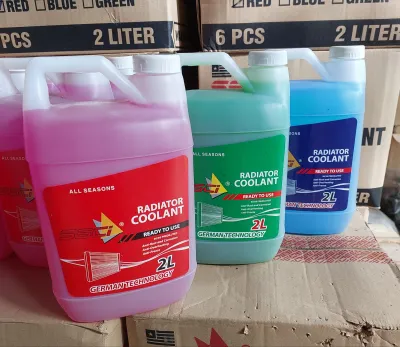
It is a common misconception that the color of an engine coolant indicates its boiling point, performance level, or compatibility. In reality, coolant manufacturers add colored dyes—ranging from yellow and green to red, pink, and blue—primarily for branding, product differentiation, and to help vehicle owners and mechanics identify leaks. The yellow hue itself does not provide any cooling or anti-corrosion benefits; it is simply a visual marker.
Products mentioned in this guide
![[Yellow] Ford 4L Anti-Freeze Coolant - Genuine Motorcraft Auto Parts](https://img.lazcdn.com/g/p/5e000eea0d6f55e1cdece9a2b7c41c5e.jpg_400x400q80.jpg_.webp)
Prices are valid at publication and may change. Please refer to the product page for the latest price.
To determine if a yellow coolant is right for your vehicle, you must identify its underlying chemical technology. Modern coolants generally fall into three main categories, each utilizing different additive packages to prevent rust, scaling, and corrosion inside your engine:
- Inorganic Additive Technology (IAT): This is the traditional formulation typically found in older vehicles. It relies on fast-acting silicates and phosphates to protect metal surfaces, but these additives deplete quickly, requiring frequent changes.
- Organic Acid Technology (OAT): Often dyed orange, red, or sometimes yellow, OAT coolants use organic acids to provide long-lasting corrosion protection. They are designed for extended service intervals but do not contain silicates or phosphates.
- Hybrid Organic Acid Technology (HOAT): This formulation combines organic acids with a small amount of inorganic inhibitors (like silicates or phosphates) to provide rapid yet long-lasting protection. HOAT fluids are frequently dyed yellow, orange, or blue.
Because a yellow coolant could be a pure OAT, a silicate-based HOAT, or a phosphate-based HOAT, you cannot assume any yellow fluid is universally compatible with your car. Vehicle manufacturers design their cooling systems around specific metallurgy, using combinations of aluminum, cast iron, copper, brass, and steel. Using an incompatible chemical formulation can lead to rapid corrosion of these internal components, clogging the radiator and causing localized hot spots. Always prioritize the chemical specifications listed on the product label over the color of the liquid.
How the Philippine Climate Stresses Your Cooling System
The environmental and driving conditions in the Philippines present a unique set of challenges for any automotive cooling system. The country’s tropical climate features consistently high ambient temperatures, often exceeding 30°C to 35°C, coupled with high relative humidity. This high ambient temperature reduces the temperature differential between the hot coolant inside your radiator and the outside air, making it much harder for the radiator to dissipate heat effectively.

Furthermore, urban driving in major Philippine cities like Metro Manila, Cebu, and Davao involves severe stop-and-go traffic. When your vehicle is idling or moving at very low speeds, there is minimal natural airflow passing through the radiator grille. Without the benefit of ram-air cooling, your vehicle’s electronic cooling fans and the coolant itself must work significantly harder to keep engine temperatures within a safe operating range.
This constant high-heat environment accelerates the thermal degradation of the coolant and its protective additives. If a fluid is not formulated to withstand high thermal stress, its corrosion inhibitors can break down prematurely. This degradation leaves your engine block, cylinder head, and radiator vulnerable to rust, scale buildup, and cavitation—a phenomenon where vapor bubbles collapse violently against metal surfaces, causing physical erosion over time.
Essential Specifications to Check for Tropical Driving
When selecting a yellow coolant for use in the Philippines, you must verify specific technical parameters on the product packaging rather than relying on visual inspection. These specifications ensure the fluid can handle the thermal loads of tropical driving while protecting your engine’s internal components.
Boiling Point and Pressure Protection
A critical specification to verify is the fluid’s boiling point under pressure. In hot tropical climates, you need a coolant that remains in a liquid state at elevated temperatures to transfer heat away from the engine block effectively. Most modern coolants are sold as a 50/50 premix or as a concentrate that must be diluted with distilled water according to the manufacturer’s instructions. A standard 50/50 mixture typically provides boiling protection up to approximately 108°C to 110°C at atmospheric pressure, which increases significantly when pressurized by a fully sealed radiator cap. Ensure the product label confirms this level of high-temperature protection.
Industry Standards and OEM Approvals
Look for recognized industry certifications printed on the bottle. A high-quality coolant should meet or exceed standards such as ASTM D3306 for light-duty automotive applications. Additionally, check for specific OEM (Original Equipment Manufacturer) approvals or specifications that match your vehicle’s make, model, and year. Many manufacturers have unique requirements—such as forbidding the use of silicates in Asian vehicles or requiring them for European models—which must be strictly followed to preserve your warranty and prevent internal damage.
Corrosion Inhibitors and Material Compatibility
Ensure the additive package is explicitly rated for the materials used in your vehicle’s cooling system. Modern engines rely heavily on aluminum components, which require robust anti-cavitation and anti-corrosion protection. The product label should detail compatibility with aluminum, cast iron, steel, copper, and brass.
Before purchasing or adding any fluid, cross-reference the product label specifications with your vehicle owner’s manual. If the product instructions conflict with your vehicle manufacturer’s guidelines, or if your vehicle’s required specifications are unidentified, stop and consult the vehicle manufacturer or a qualified professional. Never infer compatibility simply because a product is labeled as a “yellow coolant” or marketed for general automotive use.
Cooling System Maintenance for Heavy Traffic and High Heat
Operating a vehicle in high ambient temperatures and heavy traffic requires a rigorous maintenance and inspection routine. Proactive care helps detect potential cooling system failures before they lead to catastrophic engine overheating on the road.
Perform regular visual inspections of your cooling system when the engine is completely cold:
- Check the Reservoir Level: Ensure the coolant level in the plastic expansion tank is between the "Low" and "Full" (or "Min" and "Max") markings. A consistently dropping level indicates a leak that must be diagnosed immediately.
- Inspect the Fluid Condition: Look closely at the color and clarity of the coolant. Healthy yellow coolant should be clear and translucent. If the fluid appears muddy, brown, rusty, or contains suspended particles, it indicates that the corrosion inhibitors have failed or that contamination has occurred, requiring a complete system flush.
- Assess Hose Integrity: Inspect the upper and lower radiator hoses, heater hoses, and bypass lines. Squeeze them gently to check for soft spots, swelling, or extreme hardening. Look for cracks near the hose clamps or signs of crusty white or colored residue, which indicate slow coolant leaks.
- Inspect the Radiator Cap: The radiator cap plays a vital role in maintaining system pressure, which raises the coolant's boiling point. Inspect the rubber gaskets on the underside of the cap for cracking, tearing, or deformation. A failing cap cannot hold pressure, leading to localized boiling and overheating in heavy traffic.
- Verify Cooling Fan Operation: Ensure that the electronic cooling fans engage correctly when the engine reaches operating temperature or when the air conditioning is turned on.
A strict rule of cooling system maintenance is never to mix different coolant chemistries or colors. If you add a yellow coolant to a system currently filled with a different formulation (such as a green IAT or blue HOAT), the different additive packages can react chemically. This reaction often causes the corrosion inhibitors to drop out of solution, forming a thick, gelatinous sludge. This sludge can quickly clog the narrow tubes of your radiator and heater core, blocking coolant flow, disabling heat transfer, and causing severe engine overheating.
Safe Flushing and Replacement Guidelines
To maintain optimal cooling efficiency and corrosion protection, you must replace your coolant at the intervals specified by your vehicle manufacturer. These intervals are based on mileage or time, whichever comes first. Because stop-and-go driving in hot climates is classified as a “severe driving condition” by most manufacturers, you may need to flush and replace the fluid more frequently than the standard service interval.
When performing any maintenance on your cooling system, safety must be your primary concern. Safety Warning: Never attempt to open the radiator cap or the coolant reservoir cap when the engine is hot or warm. The cooling system operates under high pressure, and opening a hot system will cause boiling-hot liquid and steam to spray out violently, posing a severe risk of life-altering burns. Always allow the engine to cool completely—typically for several hours—before opening any part of the cooling system.
When replacing the fluid, always refer to the applied product’s label and the treated vehicle’s manufacturer instructions for the correct procedures. If you are dealing with a heavily contaminated system, if the previous coolant type is unknown, or if your vehicle requires specialized bleeding procedures to purge trapped air pockets, seek professional flushing services. Trapped air in a cooling system can create localized hot spots, leading to cylinder head warping or engine block failure even if the reservoir appears full.
Frequently Asked Questions (FAQ)
Can I mix yellow coolant with green or red coolant?
No, you should not mix yellow coolant with green, red, or any other color of coolant unless you have verified that they share the exact same chemical formulation and that both manufacturers permit mixing. Coolant colors are not standardized across the industry. Mixing different chemical technologies—such as Organic Acid Technology (OAT) and Inorganic Additive Technology (IAT)—can trigger a chemical reaction that causes the protective additives to precipitate out of the fluid. This forms a thick, gel-like sludge that clogs your radiator, water pump, and internal engine passages, leading to severe overheating and mechanical damage. If you need to switch coolant types or are unsure of what is currently in your vehicle, perform a complete system flush first.
Will yellow coolant stop my car from overheating in heavy traffic?
While using a high-quality yellow coolant that meets your vehicle’s specifications is essential for heat management, the fluid itself cannot prevent overheating if there is an underlying mechanical failure in your cooling system. Your vehicle’s cooling system relies on several components working in unison, including a functional water pump to circulate the fluid, an intact thermostat to regulate flow, clean radiator fins to dissipate heat, and operational electric fans to draw air through the radiator when idling. If any of these mechanical parts are worn, damaged, or clogged, your engine will overheat regardless of the quality or color of the coolant you use. Regular mechanical inspections and timely component replacement are just as critical as using the correct fluid.
Community discussion
Share your experience or ask a question. Comments are reviewed before publication.