
Choosing between a JVT aftermarket pulley set and the original stock Yamaha pulley set for your Mio Sporty depends entirely on your riding priorities, budget, and willingness to perform routine maintenance. While the stock Yamaha pulley is engineered for balanced daily commuting, fuel efficiency, and long-term durability, the JVT aftermarket set is designed to alter the acceleration profile for a more responsive feel in stop-and-go city traffic. Because CVT (Continuously Variable Transmission) behavior is highly sensitive to component specifications, selecting the right setup requires verifying part compatibility, understanding design differences, and applying condition-based decision rules rather than relying on unverified performance claims.
In the Philippines, where tropical heat, high humidity, and heavy urban traffic put significant stress on small-displacement scooters, maintaining your transmission is vital. The front pulley set, or variator, is the core component responsible for shifting gears automatically. Making an informed choice between original equipment manufacturer (OEM) parts and aftermarket upgrades ensures your Mio Sporty remains reliable, efficient, and safe to ride on daily commutes.
Understanding the Role of the Pulley Set in Your Mio Sporty
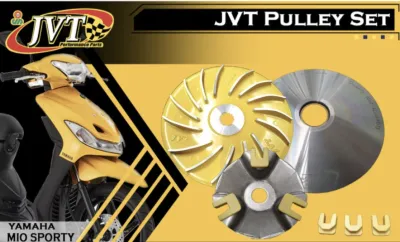
The front pulley set, commonly known as the variator, plays a critical role in how your Mio Sporty manages its power delivery. Unlike a manual motorcycle with fixed gear ratios, a scooter relies on a CVT system to constantly adjust the gear ratio based on engine speed and load. The front pulley set consists of the pulley face, the movable drive face, slide pieces, and roller weights. As the engine spins faster, centrifugal force pushes the roller weights outward along the ramp guides inside the pulley. This movement forces the movable drive face closer to the fixed face, squeezing the drive belt and forcing it to ride higher on the pulley, which effectively shifts the transmission into a higher gear ratio.
Products mentioned in this guide
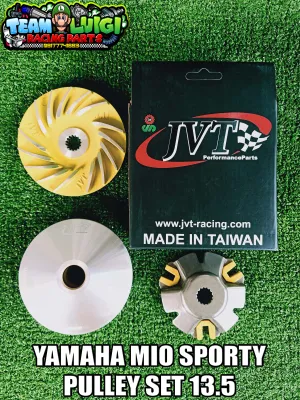
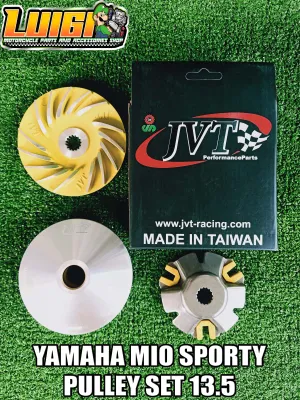
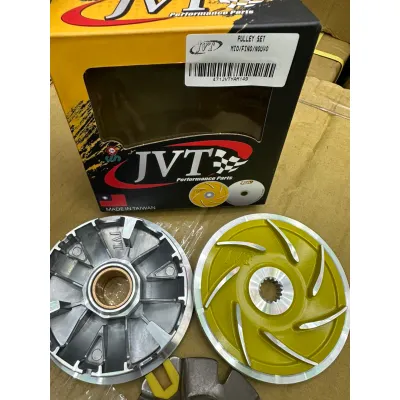
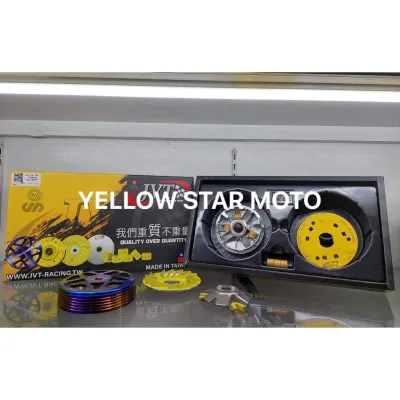
Prices are valid at publication and may change. Please refer to the product page for the latest price.
Physical variables such as the angle of the pulley face, the curvature of the roller ramps, and the mass of the roller weights dictate the delicate balance between low-end acceleration and top-end speed. Steeper ramp angles can cause the roller weights to sweep outward more rapidly or slowly, directly altering how quickly the transmission shifts. If the roller weights are too light, the engine will rev higher before the pulley shifts, offering brisk initial acceleration but potentially sacrificing top-end speed and fuel economy. Conversely, heavier rollers force the pulley to shift earlier, keeping engine revolutions lower for smoother cruising but slowing down initial throttle response. Understanding these mechanical interactions is essential before modifying any component, as any change to the front pulley directly impacts the drive belt, rear clutch, and overall engine load.
Comparing JVT and Stock Yamaha Pulley Sets
When evaluating the stock Yamaha pulley set against the aftermarket JVT alternative, the primary difference lies in their design intentions. Original Equipment Manufacturer (OEM) Yamaha components are engineered with a focus on balanced daily commuting, long-term durability, fuel efficiency, and compliance with factory noise and emission standards. The stock pulley features conservative ramp profiles designed to deliver smooth, predictable power across a wide range of operating conditions. This design minimizes stress on the drive belt and crankshaft, ensuring that the scooter remains reliable even under the high heat and humidity typical of tropical climates.

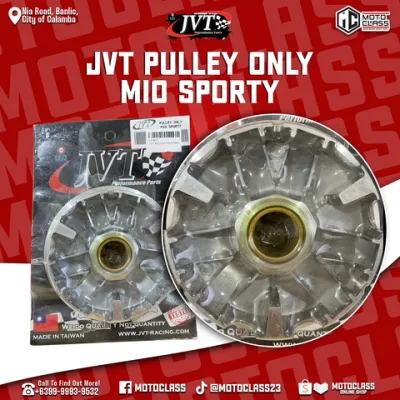
In contrast, aftermarket options like the JVT pulley set are designed to alter the acceleration profile to suit specific riding preferences, such as quicker throttle response in stop-and-go city traffic. To achieve this, aftermarket pulleys often feature modified ramp angles and lighter weight configurations that keep the engine operating within its peak powerband during acceleration. When considering an aftermarket set, it is crucial to physically inspect and compare the ramp profiles, the surface finish of the pulley faces, and the included roller weights against the specifications outlined in your OEM service manual. Look closely at the machining quality; a smoother surface finish reduces friction on the drive belt, which can help manage heat buildup.
Durability observations are another key factor when comparing these two options. During routine CVT inspections, you should monitor the wear patterns on both the pulley faces and the drive belt. Because aftermarket pulleys often alter the belt’s path and operate at higher average engine speeds, they can introduce different wear characteristics. Inspect the pulley faces for grooving or uneven wear, which can cause the belt to slip or hesitate during acceleration. Additionally, check the alignment of the drive belt; any misalignment between the front and rear pulleys can accelerate belt wear and increase the risk of premature failure, making regular inspection of the slide pieces and pulley boss essential.
Cost and Value Considerations
Evaluating the financial investment of a pulley replacement requires looking beyond the initial purchase price of the pulley set itself. To make an informed decision, you should verify current retail prices in ₱ through authorized Yamaha dealerships for genuine parts, or reputable local motorcycle accessory shops and online marketplaces for aftermarket alternatives. While a stock Yamaha pulley set may carry a premium due to OEM quality control and manufacturing standards, it often delivers a lower total cost of ownership over time due to its extended service life and minimal impact on surrounding components.
When replacing a pulley set, you must also factor in the cost of complementary wear items that should ideally be replaced at the same time. Installing a new pulley with a worn drive belt, degraded slide pieces, or flat-spotted roller weights can severely compromise the performance of the new parts and lead to rapid wear. A complete CVT overhaul typically includes a new drive belt, fresh roller weights, and new slide pieces to ensure the entire system operates smoothly.
Furthermore, consider the differences in warranty coverage and return policies. Genuine OEM parts purchased and installed through authorized Yamaha service centers often come with limited warranties and the assurance of exact factory compatibility. Aftermarket components, including JVT sets, may have more restrictive warranty terms or no warranty once installed, placing the responsibility for compatibility and potential secondary damage entirely on the vehicle owner.
Installation, Compatibility, and Safety Checks
Before purchasing any transmission component, you must verify the exact part number compatibility for your specific Mio Sporty model year and engine variant. Even within the Mio model family, subtle differences in crankshaft diameter, spline count, or pulley boss dimensions can exist between model years. Attempting to force an incompatible pulley onto the crankshaft can strip the splines, damage the engine casing, or cause the pulley to wobble during operation, leading to catastrophic transmission failure.
Working on a motorcycle’s CVT system carries significant safety and mechanical responsibilities. The front pulley nut must be tightened to the exact torque specification defined in the manufacturer’s service manual. To achieve this safely, you must use proper CVT holding tools, such as a flywheel holder or a specialized variator holding tool, rather than relying on improvised methods like wedging screwdrivers into the pulley teeth, which can easily chip the aluminum faces. Before assembly, thoroughly clean the crankshaft snout and pulley boss with an approved brake or parts cleaner to remove any oil, grease, or debris that could cause the pulley to slip or bind.
If you do not possess a calibrated torque wrench, the correct holding tools, or if you feel unsure about any step of the process, stop the installation immediately and consult a qualified motorcycle mechanic. A poorly installed pulley can loosen while riding, causing the drive belt to snap, locking up the rear wheel, or permanently damaging the engine’s crankshaft. Professional installation ensures that all components are aligned, torqued to specification, and tested in a controlled environment, preserving both your safety and your motorcycle’s reliability.
Decision Framework: Which Pulley Set Fits Your Ride?
To finalize your choice, evaluate your daily riding conditions and maintenance habits against the following condition-based framework:
- Choose Stock Yamaha if: Your primary goals are factory reliability, standard fuel economy, predictable power delivery, and maintaining original warranty compliance. The OEM setup is ideal for riders who want a "set-and-forget" solution that performs consistently during long daily commutes in tropical heat without requiring frequent CVT cover removal for inspections.
- Choose JVT if: You are actively seeking a noticeable change in initial acceleration feel to help navigate heavy, stop-and-go city traffic, and you are fully prepared to monitor drive belt wear, roller flat spots, and slide piece degradation more frequently. This option suits enthusiasts who enjoy fine-tuning their transmission and do not mind the shorter service intervals associated with aftermarket performance parts.
- Verify First if: You are experiencing performance issues like sluggish acceleration, vibration, or unusual noises from the transmission casing. Before purchasing any new pulley set, perform a comprehensive inspection of your existing CVT components. A worn-out drive belt, dry pulley boss, or damaged clutch springs can mimic the symptoms of a failing pulley; replacing the variator without addressing these underlying issues will not resolve the root problem.
Frequently Asked Questions (FAQ)
Do I need to change the drive belt when installing a new pulley set?
While it is not strictly mandatory to replace the drive belt if it is well within its service limits, doing so is highly recommended. A worn drive belt will have a narrower width than a new one, which prevents it from riding to the very edge of the new pulley faces, limiting the performance benefits of your upgrade. Inspect your current belt for side-wall cracks, fraying cords, or glazing caused by excessive heat. If the belt shows any signs of physical degradation or is close to the manufacturer’s recommended replacement interval, installing a fresh OEM-specification belt alongside your new pulley set ensures optimal grip, correct alignment, and long-term reliability.
Will an aftermarket pulley set void my motorcycle's warranty?
Installing an aftermarket pulley set can affect your motorcycle’s warranty, particularly concerning the drivetrain and engine components. Most manufacturers state that modifications to the transmission, engine, or electrical systems using non-OEM parts will void the warranty for those specific systems and any related components that fail as a result of the modification. If your Mio Sporty is still covered under the manufacturer’s original warranty, it is highly advisable to consult with your authorized dealer before installing any aftermarket parts. For older, out-of-warranty scooters, this is less of a concern, but riders should still weigh the trade-off between aftermarket customization and the proven reliability of genuine parts.
Community discussion
Share your experience or ask a question. Comments are reviewed before publication.