
Choosing an aftermarket RS8 pulley set for your scooter’s continuously variable transmission (CVT) requires a precise understanding of mechanical specifications. Simply matching the brand name or scooter model is not enough to guarantee a successful upgrade. To achieve the ideal balance of acceleration, top speed, and long-term reliability, you must verify physical fitment dimensions and understand how component weights and angles alter your drivetrain’s behavior. In the humid, tropical climate of the Philippines, where stop-and-go city commuting and steep mountain climbs put immense thermal stress on your transmission, selecting the wrong specifications can lead to rapid belt wear, poor fuel efficiency, or even severe engine damage.
Verifying Shaft Fitment and Basic Compatibility
Before purchasing any aftermarket CVT components, your primary task is to ensure the pulley set physically mounts to your crankshaft and transmission shaft without requiring irreversible modifications. Start by checking the crankshaft bore diameter and the exact spline count of your scooter’s shaft. Even within the same model family, manufacturers often update internal engine dimensions across different production years or regional variants. A single mismatched spline will prevent the drive face from seating correctly, leading to stripped threads or a loose assembly. Always verify your specific engine code and model year against the pulley manufacturer’s compatibility list.
Additionally, take the time to inspect the condition of your original crankshaft, variator boss, and keyway before installation. Any existing wear, rust, or play will accelerate wear on your new components. Because transmission disassembly directly impacts your vehicle’s drive system and safety, always consult your original vehicle workshop manual for correct torque specifications and seek qualified professional installation to ensure the components are safely secured. Professional installation at a local motorcycle shop typically costs around ₱300 to ₱800, which is a worthwhile investment to ensure your transmission is safely and correctly assembled.
Products mentioned in this guide
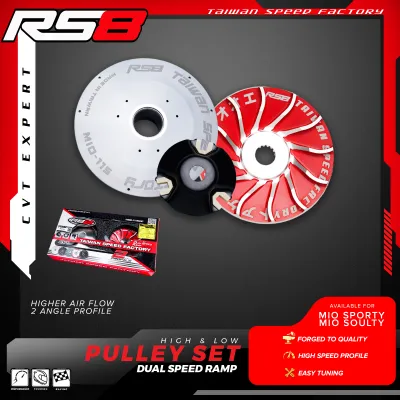
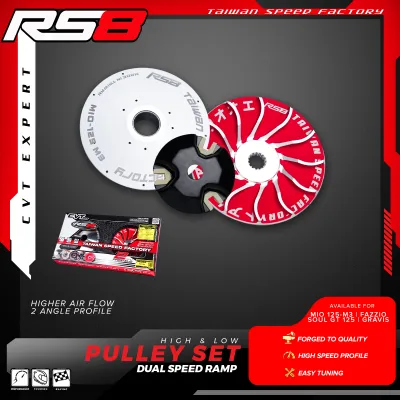
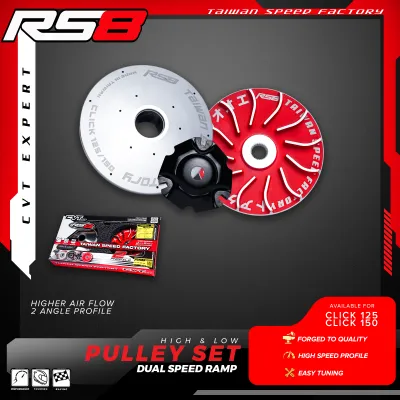
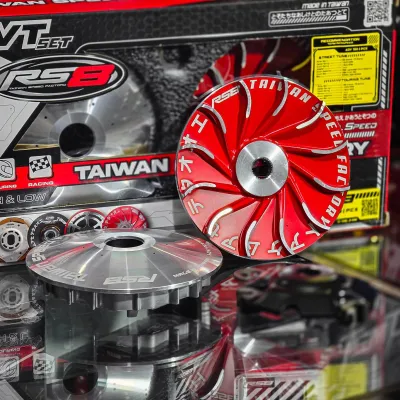
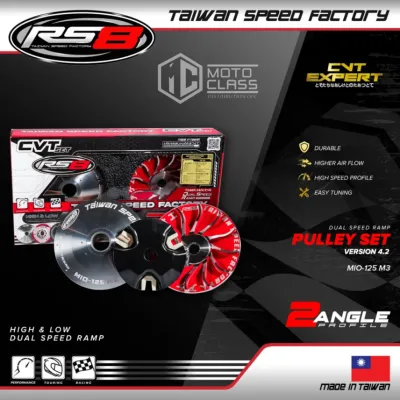
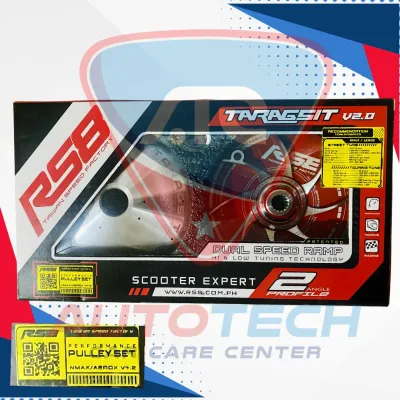
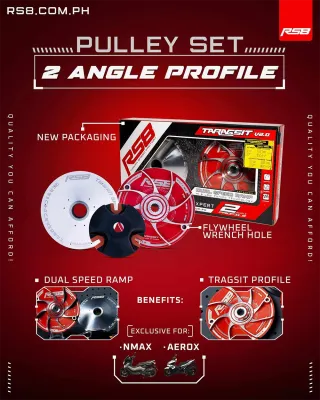
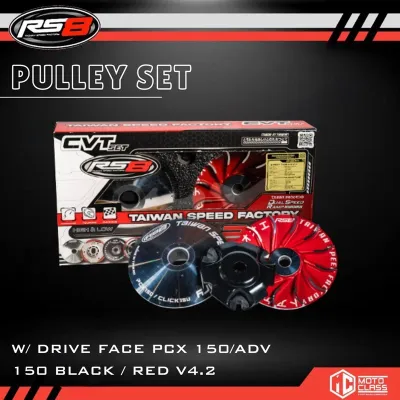
Prices are valid at publication and may change. Please refer to the product page for the latest price.
Decoding Front Pulley Diameter and Ramp Angles
The front pulley, consisting of the drive face and the movable variator, dictates how the drive belt transitions through its gear ratios. When evaluating an RS8 pulley set, compare the outer diameter of the new drive face to your stock unit. A larger outer diameter allows the drive belt to ride higher at maximum shift, which can translate to a higher top-end speed on open roads, provided your engine has the power to pull the taller ratio. However, a larger pulley also requires sufficient clearance inside the transmission casing to prevent the belt from rubbing against the metal housing.

Beyond diameter, analyze the ramp angle profile of the variator. The angle of these internal tracks determines how quickly and smoothly the roller weights push the movable drive face outward. Steeper ramp angles can provide a more aggressive shift, improving initial acceleration and throttle response, while gentler angles offer a smoother, more linear transition. Keep in mind that modifying these angles and diameters alters the belt’s travel path, which may require you to check and verify if a differently specified drive belt is necessary to maintain proper tension and alignment.
Tuning Acceleration and Speed With Roller Weights
Roller weights are the tuning heart of your CVT system, directly controlling the engine RPM at which your transmission shifts. Before selecting new weights, measure the outer diameter and width of your stock rollers to ensure the replacement rollers fit perfectly within the new variator ramps without binding or flipping. Once fitment is confirmed, you can select the gram weight to match your riding environment.
Lighter roller weights require higher engine RPM to fling outward via centrifugal force. This keeps the engine in its powerband longer, prioritizing low-end torque and rapid acceleration—ideal for navigating congested city streets, overtaking slow-moving vehicles, or climbing steep inclines. Conversely, heavier roller weights fling outward at lower engine RPM, forcing the transmission to shift earlier. This lowers your cruising RPM, which reduces engine noise, minimizes vibration, and improves fuel efficiency during long-distance highway riding. Many riders find that a balanced setup, slightly lighter than stock, offers the best compromise for daily commuting in tropical conditions.
Balancing the Setup With the Rear Pulley and Spring
An upgraded front pulley set cannot perform optimally if the rear pulley system is neglected. The rear driven pulley and contra spring work in direct opposition to the front variator, maintaining the necessary clamping force on the drive belt. When installing a new front pulley, check the rear driven pulley’s inner diameter and belt riding depth to ensure the belt remains perfectly aligned throughout the entire shift cycle. If the belt is misaligned, it will experience rapid edge wear and increased friction.
The contra spring rate must be carefully selected to match your front pulley changes; a spring that is too soft will allow the belt to slip under heavy load, while a spring that is too stiff creates excessive parasitic drag, accelerating belt wear and reducing overall efficiency. If you observe consistent belt slippage or uneven wear after upgrading the front pulley, it may be necessary to inspect the rear torque drive guide slots. Upgrading to a full rear torque drive assembly, rather than just swapping the contra spring, provides a more stable path for the belt and ensures your entire CVT system operates in harmony.
Frequently Asked Questions (FAQ)
Do I need to change the drive belt when upgrading the pulley set?
Whether you need a new drive belt depends on the physical dimensions of your new pulley set and the condition of your current belt. If the new front pulley has a significantly larger outer diameter or a modified face angle, the stock belt may no longer sit at the correct riding height, necessitating a belt with a matching specification. Even if the dimensions allow for a stock-length belt, pairing a worn, stretched, or glazed belt with brand-new, precisely machined pulley faces is highly discouraged. A worn belt will slip on the new surfaces, causing rapid heat buildup and premature wear on both the belt and the new pulley set.
Can I mix different brands of front and rear pulleys?
While it is physically possible to mix different brands of front and rear pulleys, doing so introduces significant tuning challenges. CVT systems rely on a delicate balance of belt profiles, ramp geometries, and spring clamping forces. Mixing brands can result in mismatched belt angles, leading to uneven wear, belt slippage, or erratic shifting behavior. For the most predictable performance and easiest tuning, it is highly recommended to use matching components from a single manufacturer or consult official tuning guides and a professional mechanic to verify compatibility before mixing brands.
Community discussion
Share your experience or ask a question. Comments are reviewed before publication.