
A Magnaflow muffler can legally run on Philippine roads and pass Land Transportation Office (LTO) noise inspections, but compliance is not guaranteed for every model or setup. Because Magnaflow designs are engineered for high-performance exhaust flow, their sound profiles are naturally deeper and louder than restrictive factory exhausts. Passing an LTO checkpoint depends on choosing a street-compliant model, keeping the baffle or dB killer firmly installed, and maintaining the system to prevent mechanical leaks.
Understanding Magnaflow Muffler Sound Profiles
Magnaflow is widely recognized for its straight-through perforated core design. Unlike stock mufflers that use complex internal baffles and chambers to force exhaust gases through multiple turns, a straight-through core allows gases to pass directly through a central perforated tube. This tube is wrapped in acoustic packing material, typically high-temperature stainless steel mesh and acoustic fiber. This design absorbs high-frequency harshness, leaving a deep, low-frequency rumble. However, this high-flow architecture naturally increases the overall volume compared to original equipment manufacturer (OEM) setups.
When selecting a Magnaflow muffler, you must distinguish between the brand’s “Street” and “Race” series. Street-oriented models feature larger muffler bodies packed with dense sound-dampening materials designed to control volume and meet public road standards. Conversely, track or race-oriented series prioritize maximum exhaust velocity and weight reduction, using minimal packing and shorter canisters. These race models are significantly louder and are not intended for public street use.
Products mentioned in this guide
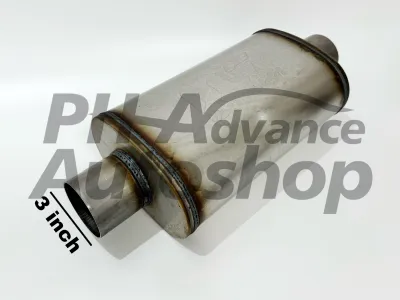
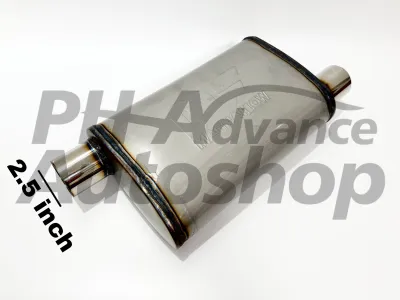
Prices are valid at publication and may change. Please refer to the product page for the latest price.
The physical dimensions of the muffler play a critical role in its acoustic output. A longer and wider muffler body provides a larger volume of acoustic packing material, which dampens more sound waves and lowers the decibel (dB) output. Conversely, a short, narrow canister has less surface area to absorb sound, resulting in a louder, sharper exhaust note. The overall length of your motorcycle’s exhaust pipe also influences the sound; shorter pipes offer less natural dampening before the exhaust gas exits the system.
Before purchasing any aftermarket exhaust, you should consult the manufacturer’s official specification sheet for the specific part number. These documents outline the tested decibel ratings under specific testing conditions, such as a designated distance and engine RPM. Relying on subjective online forum reviews or video clips can be misleading, as microphone quality and environmental acoustics rarely reflect real-world roadside testing conditions.
Navigating LTO Noise Regulations for Modified Motorcycles
Operating a modified motorcycle in the Philippines requires strict adherence to local traffic laws and environmental regulations. The Land Transportation Office (LTO) enforces noise limits primarily guided by the Philippine Clean Air Act (Republic Act No. 8749) and corresponding administrative orders. These regulations aim to curb noise pollution in dense urban areas and residential zones, making aftermarket exhaust systems a frequent target for roadside inspections.

While historically the standard limit for motorcycle exhaust noise has been set at 99 decibels when measured at a specific distance (typically 0.5 meters) and at a designated engine RPM (usually half of the engine’s rated maximum speed), these thresholds can be updated. The LTO periodically issues new memorandums or updates its testing protocols to align with modern environmental standards. To avoid penalties, riders must verify the current legal decibel limits through official LTO announcements or by visiting an authorized private motor vehicle inspection center (PMVIC) for an official reading.
During physical inspections or roadside checkpoints, enforcers do not rely solely on decibel meters; they also look for physical indicators of compliance. Visible markers, such as manufacturer-stamped decibel ratings, safety certifications, or compliance plates (such as JASMA approval markings on compatible Japanese-market imports), provide immediate proof of engineering standards. An exhaust system that lacks any identifying marks or appears highly modified is far more likely to draw scrutiny.
The LTO distinguishes clearly between a professionally engineered, legally modified aftermarket exhaust and an illegal “boga” or open-pipe modification. Open pipes or homemade straight pipes lack any internal baffling or acoustic packing, producing an unrestricted, high-pitched scream that violates environmental laws. In contrast, a brand-name muffler like Magnaflow is generally viewed more favorably by inspectors, provided it retains its structural integrity, compliance labels, and internal sound-dampening components.
Steps to Ensure Your Magnaflow Exhaust Remains Street-Legal
Before performing any installation, modification, or maintenance on your motorcycle’s exhaust system, always consult your vehicle’s manufacturer manual and the specific Magnaflow installation guide. Because exhaust systems operate under extreme heat and pressure, improper installation can affect engine performance, road safety, and void your vehicle warranty. If you are unfamiliar with exhaust mounting or lack the necessary torque tools, have the system installed by a qualified professional mechanic.
Verifying Labels and Documentation
To streamline roadside inspections, keep all physical documentation associated with your Magnaflow muffler. Store the original purchase receipt, warranty card, and product manual inside a waterproof pouch in your motorcycle’s utility box. Additionally, inspect the physical compliance plate or stamped dB rating on the muffler body regularly. Ensure this label remains clean, free of road grime, and is never painted over or covered by mounting brackets, as enforcers will look for this mark first to verify the exhaust is not a generic open pipe.
Managing dB Killers and Baffles
The most effective tool for keeping your Magnaflow muffler within legal limits is the manufacturer-provided dB killer, also known as an exhaust baffle. This removable insert fits into the exit tip of the muffler, slightly restricting the exhaust gas path to break up sound waves and lower the decibel output to street-legal levels. Never permanently remove, drill, or modify this baffle to make the exhaust louder. Operating your motorcycle on public roads without the dB killer installed bypasses the muffler’s sound-dampening design, pushing the noise output into track-only territory and virtually guaranteeing an LTO citation.
Preventing Exhaust Leaks and Rattles
Over time, the high-vibration environment of a motorcycle can degrade exhaust components, leading to mechanical noise that artificially inflates your decibel levels. Periodically inspect the exhaust gaskets, header flanges, and mounting brackets for any signs of looseness, soot blowby, or physical wear. A minor leak at the cylinder head flange or a loose bracket can create high-pitched ticking, popping, or rattling sounds. These mechanical noises can trigger an LTO violation during a roadside test, regardless of how quiet the Magnaflow muffler’s internal core is designed to be.
Handling LTO Apprehensions and Noise Checkpoints
Encountering a joint LTO and local government unit (LGU) checkpoint can be stressful, but your behavior and preparation dictate the outcome. If flagged down for a noise inspection, pull over safely, turn off your engine immediately, and maintain a polite, cooperative attitude. Avoid revving the engine or arguing with the enforcers, as aggressive behavior often escalates the situation and can lead to additional charges.
Proactively present your driver’s license, motorcycle registration (OR/CR), and the physical documentation for your Magnaflow exhaust. Point out the legible manufacturer stamp or compliance label on the muffler body to demonstrate that the component is a certified aftermarket part rather than an illegal, unbranded straight pipe. Clear documentation and a respectful demeanor show that you have made a good-faith effort to comply with national road standards.
If the enforcer conducts a decibel test and issues a violation ticket—such as a Temporary Operator’s Permit (TOP)—do not attempt to resolve the issue on the spot. Accept the ticket and follow the official resolution process, which typically involves paying the prescribed fine at an authorized LTO office or payment center. You will also be required to present the motorcycle for a re-test. To clear the violation and secure your registration renewal, you must reinstall the stock exhaust or configure your Magnaflow muffler with a fully compliant, non-modified dB killer to prove the vehicle meets the legal noise threshold.
Frequently Asked Questions (FAQ)
Does removing the dB killer make my Magnaflow muffler illegal?
Yes, removing the factory-installed dB killer or baffle almost always pushes the exhaust volume past the legal decibel limits enforced by the LTO. Even if your Magnaflow muffler features a street-legal compliance stamp, operating the motorcycle without the baffle invalidates that rating, converting the system into a non-compliant exhaust that will fail roadside inspections.
Are all Magnaflow motorcycle mufflers LTO-compliant out of the box?
No, Magnaflow designs exhausts for various applications, including closed-course racing and off-road use. Compliance depends on the specific model series, your motorcycle’s engine displacement, and the presence of an approved baffle. Always verify the legal classification of the specific part number and match it to your motorcycle’s specifications before purchasing.
Community discussion
Share your experience or ask a question. Comments are reviewed before publication.