
To find the exact manual transmission oil for your vehicle, you must match the manufacturer’s specified Society of Automotive Engineers (SAE) viscosity grade (such as 75W-90 or 80W-90) and the American Petroleum Institute (API) service category (typically GL-4). Using the wrong fluid can lead to accelerated wear, stiff gear changes, or catastrophic synchronizer failure. Always prioritize the specifications detailed in your vehicle’s owner’s manual over general recommendations.
How to Find Your Exact Manual Transmission Oil Specifications
To identify the precise fluid your gearbox requires, your first and most reliable source is the vehicle owner’s manual. Look specifically under the “Capacities and Specifications,” “Lubricants,” or “Maintenance” sections. Car manufacturers design manual transmissions with precise clearances and metallurgy, making their designated specifications the absolute authority for fluid selection.
If the physical manual is missing, you can often locate these specifications on an under-hood decal, an emission control label, or stamped directly onto the transmission’s physical filler plug. Some manufacturers place a metal tag or a colored sticker on the gearbox housing indicating the specific original equipment manufacturer (OEM) part number or fluid type.
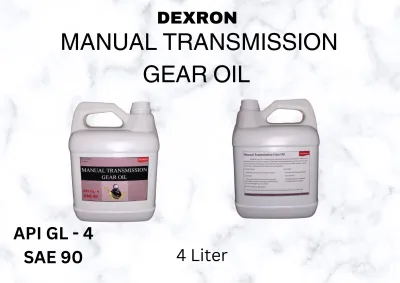
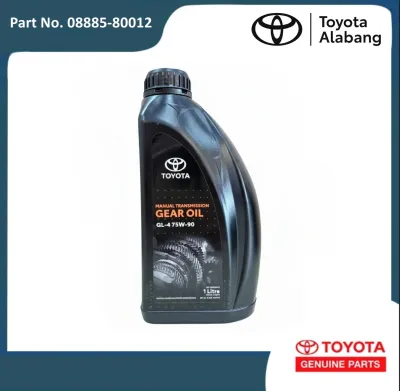
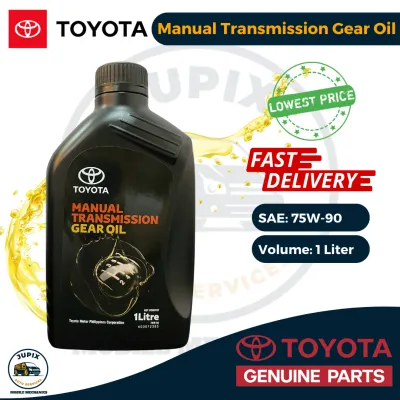
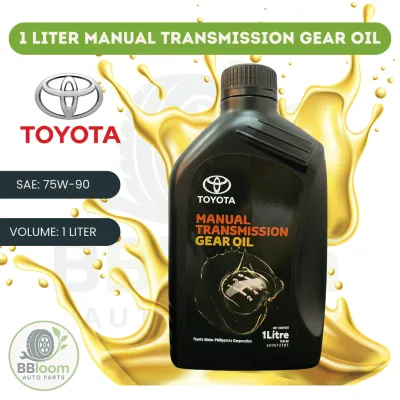
Products mentioned in this guide
![[1 LITER] Toyota Gear Oil (Manual Transmission - 75W90) - Toyota Auto Parts](https://img.lazcdn.com/g/p/fb45266524c4a9f2518f4ebcd3e08f0f.jpg_400x400q80.jpg_.webp)
Prices are valid at publication and may change. Please refer to the product page for the latest price.
Avoid relying solely on auto parts store databases, online forums, or the assumption that a fluid used in a similar model or model year will work. Minor design changes within the same vehicle generation can dictate entirely different fluid requirements. Furthermore, generic retail search engines can occasionally list compatible alternatives that do not actually meet your gearbox’s specific engineering demands.
Before purchasing or operating, understand the safety boundaries of transmission service. Changing transmission fluid requires working underneath the vehicle; always ensure the car is parked on a level surface, securely supported by rated jack stands, and that you follow original-vehicle instructions. If you lack the proper tools, experience, or clear documentation, seek qualified professional installation.
Finally, verify that the fluid bottle’s label explicitly states it is authorized for your specific vehicle make, model, and year. The manufacturer’s manual overrides any general mechanic advice, marketing claims on fluid packaging, or catalog recommendations. If you find a conflict between the product label and your vehicle owner’s manual, stop and consult an authorized service center or a qualified automotive professional.
Decoding Viscosity Grades: What Numbers Like 75W-90 Mean for Your Gearbox
The SAE viscosity grade defines how a manual transmission oil flows at different temperatures. In a grade like 75W-90, the number preceding the “W” (which stands for Winter) represents the fluid’s low-temperature flow characteristics. The second number, 90, represents the fluid’s kinematic viscosity at standard operating temperature (100°C), indicating its thickness and protective film strength under heavy load.

In tropical climates like the Philippines, sub-zero cold starts are not a concern. However, the winter rating still plays a role in daily driving. On early mornings in high-altitude areas like Baguio, or when starting a vehicle that has been parked in an air-conditioned basement garage, a lower winter rating like 75W ensures the fluid flows quickly to protect gears and bearings during the initial startup phase.
The operating temperature number (the “90” in 75W-90) is critical for preventing metal-on-metal contact once the gearbox warms up. However, choosing a higher number than recommended does not translate to superior protection. A thicker oil increases internal drag, which raises operating temperatures, causes stiff or noisy shifting, and reduces fuel economy.
Always stick strictly to the viscosity grade recommended by your vehicle manufacturer. Substituting an 80W-90 fluid where a 75W-90 is specified can alter the shift feel and wear characteristics of your gearbox, even if both fluids share the same API rating.
API Ratings Explained: The Critical Difference Between GL-4 and GL-5
The API service rating indicates the type and concentration of extreme-pressure (EP) additives blended into the manual transmission oil. These additives, typically containing sulfur and phosphorus, form a sacrificial protective layer on gear teeth to prevent scuffing and welding under heavy loads. The two most common ratings for manual gearboxes and transaxles are API GL-4 and API GL-5.
The most critical distinction between these two ratings involves “yellow metal” compatibility. API GL-5 fluids contain roughly double the concentration of sulfur-phosphorus extreme-pressure additives compared to GL-4 fluids. While this high concentration is excellent for protecting hypoid gears in differentials, the active sulfur in GL-5 can chemically attack and corrode the brass or bronze synchronizer rings used in many manual transmissions. Over time, this chemical wear strips away the soft yellow metal, leading to grinding gear changes, difficult engagement, and eventual transmission failure.
As a general rule, API GL-4 fluids are formulated specifically for manual transmissions containing synchronizers, whereas API GL-5 fluids are intended for rear differentials, transfer cases, and non-synchronized gearboxes.
Be cautious of “multi-purpose” or “universal” fluids that claim to meet both GL-4 and GL-5 specifications. Unless the vehicle manufacturer explicitly approves a dual-rated fluid for your specific gearbox model, you should default to a dedicated, single-rated API GL-4 fluid to protect your synchronizers.
Synthetic vs. Conventional Fluid: Which Base Oil Do You Need?
Choosing between conventional and synthetic manual transmission oil depends on your driving environment, vehicle requirements, and budget. Conventional gear oils are refined from crude oil and provide adequate protection under standard operating conditions. Synthetic fluids are chemically engineered to offer superior thermal stability, better resistance to oxidation, and more consistent viscosity across a wide temperature range.
For drivers navigating the demanding, high-heat conditions of stop-and-go traffic in metro Manila or towing heavy loads over steep terrain, synthetic fluids offer distinct advantages. They resist breaking down under extreme heat, reduce friction to lower operating temperatures, and maintain smooth shifting characteristics far better than conventional oils over their lifespan.
When selecting a base oil, follow this strict rule: if your vehicle manufacturer specifies a synthetic fluid, you must not downgrade to a conventional oil, as doing so can compromise protection and void your warranty. If the manual specifies conventional oil, upgrading to a high-quality synthetic of the exact same viscosity and API rating is generally safe and beneficial.
Keep in mind that using synthetic fluid does not extend the manufacturer’s recommended service interval. You must still change the fluid according to the maintenance schedule outlined in your owner’s manual, regardless of the base oil type.
Frequently Asked Questions (FAQ)
Can I use Automatic Transmission Fluid (ATF) in a manual transmission?
Yes, but only if your vehicle manufacturer explicitly specifies it. While it may seem counterintuitive, several manual transmissions—particularly in certain Honda, Ford, and older utility vehicles—are engineered with tight internal clearances that require the thin viscosity and specific additive package of ATF rather than traditional, thick gear oil.
Using heavy manual transmission oil in a gearbox designed for ATF will prevent proper lubrication, cause extremely stiff shifting, and ultimately destroy internal bearings. Conversely, putting ATF in a gearbox designed for heavy gear oil will lead to rapid gear wear due to insufficient film strength. Always consult your owner’s manual to verify the correct fluid type.
Is it safe to mix different viscosity grades or fluid brands?
Mixing different viscosity grades or brands of manual transmission oil is strongly discouraged. Combining different grades alters the final viscosity unpredictably, which can leave your gears with insufficient wear protection or cause shifting difficulties.
Furthermore, different oil brands utilize distinct chemical additive packages. Mixing them, or blending synthetic and conventional fluids, can cause these additives to clash, potentially leading to fluid foaming, accelerated oxidation, or the formation of harmful deposits. For optimal performance and safety, perform a complete drain and refill with a single, approved fluid rather than topping off with a mismatched product.
Community discussion
Share your experience or ask a question. Comments are reviewed before publication.