
Choosing between a Mutarru CVT set and other aftermarket transmission kits depends entirely on your specific scooter model, daily riding conditions, and mechanical expertise. There is no universal “best” option; a pre-configured branded set offers convenience and matched components, while mixing other aftermarket parts allows for highly customized, budget-specific builds. Before making a purchase, you must verify exact dimensional compatibility with your scooter’s original equipment manufacturer (OEM) specifications. Use this guide to understand what to look for, how to compare technical specifications, and how to match a CVT setup to your actual riding needs.
In tropical climates like the Philippines, where scooters endure intense heat, high humidity, and heavy stop-and-go traffic, the transmission system undergoes significant thermal stress. Upgrading or replacing your Continuously Variable Transmission (CVT) components is a common way to restore lost performance or tailor your ride to specific environments. Whether you are looking to spend your hard-earned ₱ on a complete, ready-to-install kit or prefer to source individual components piece by piece, understanding the mechanics of these systems is essential for a safe and reliable upgrade.
Understanding What is Inside a Complete CVT Set
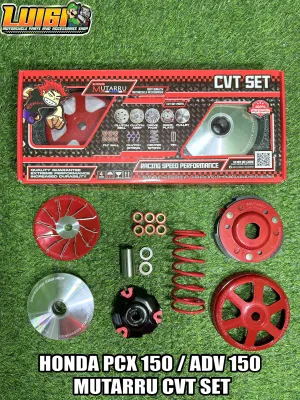
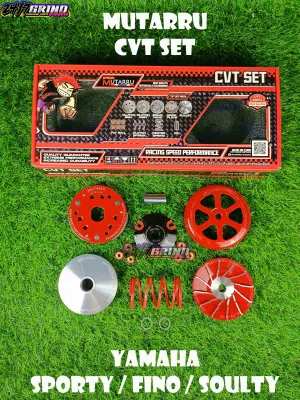
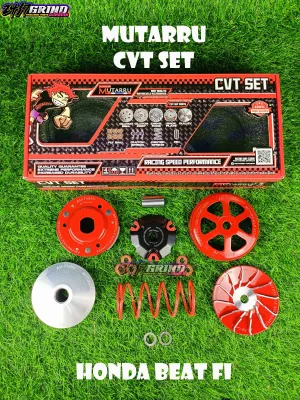
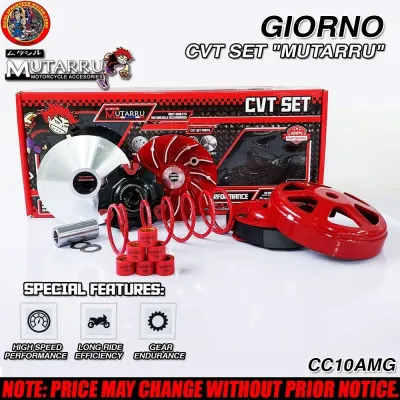
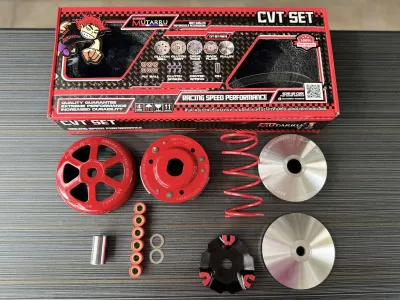
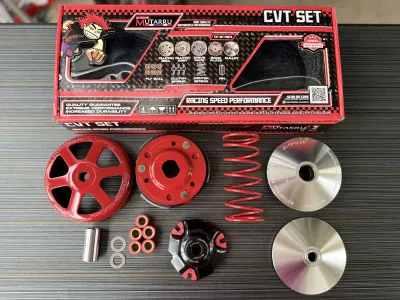
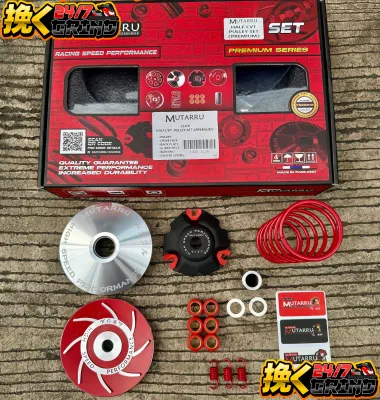
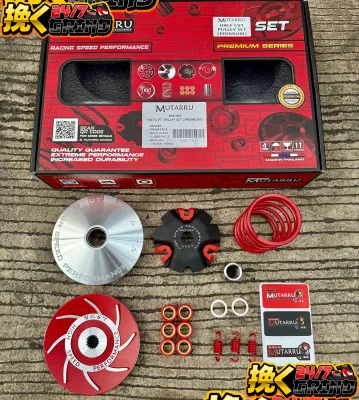
A complete CVT set typically contains several critical components designed to work in harmony to transfer power from the engine to the rear wheel. At the front of the system, the variator assembly includes the variator pulley, a ramp plate, slide pieces, and a set of roller weights. These parts control the initial gear ratio changes as engine speed increases. The drive face sits opposite the variator, sandwiching the drive belt to facilitate smooth transitions up and down the pulley faces.
Products mentioned in this guide
Prices are valid at publication and may change. Please refer to the product page for the latest price.
At the rear of the transmission, you will find the clutch assembly, which consists of the clutch bell, clutch shoes, clutch springs, and the large contra spring (also known as the compression spring). The clutch shoes engage the clutch bell to transfer rotational force to the gearbox, while the contra spring exerts pressure on the rear pulley to regulate how quickly the belt shifts back down during deceleration or under load.
The practical difference between a full transmission overhaul kit and partial upgrade packages is the scope of replacement. A partial kit might only replace wear items like the roller weights or the drive belt, leaving older, worn pulleys or springs in place. A complete CVT set, on the other hand, replaces the entire front and rear pulley systems simultaneously. When purchasing any kit, always check the manufacturer’s official parts list to ensure no critical components are missing, as mismatched or omitted parts can lead to an unbalanced system and premature wear.
Key Specifications to Check Before You Buy
When independent performance testing data is unavailable, comparing technical specifications is the most reliable way to evaluate aftermarket CVT options. One of the primary specifications to analyze is the roller weight range. Roller weights are measured in grams, and their mass directly influences when the variator shifts. Lighter rollers require higher engine RPM to fling outward via centrifugal force, which generally improves initial acceleration but may reduce top-end speed. Conversely, heavier rollers shift the variator earlier at lower RPM, which can benefit fuel economy and cruising comfort but might make acceleration feel sluggish.

Next, examine the clutch shoe materials and spring tension ratings. Clutch shoes are often lined with organic compounds, carbon fibers, or copper-infused materials. Carbon and copper linings generally offer better heat resistance and grip under high-temperature conditions, which is crucial for preventing clutch slippage during long commutes in tropical weather. The tension ratings of the clutch springs and contra spring—often labeled as 1000 RPM, 1500 RPM, or 2000 RPM—indicate the relative stiffness compared to stock components. Higher ratings delay clutch engagement to a higher engine speed, providing a punchier launch but requiring more throttle input for low-speed maneuvering.
Before finalizing any purchase, you must verify exact dimensional compatibility. This includes checking the variator bore size, the spline count on the crankshaft, the pulley diameters, and the recommended belt width and length. Cross-reference these measurements with your scooter’s OEM service manual to ensure a precise fit. Rather than relying on vague marketing claims of “improved performance,” look for explicit material grades, such as CNC-machined aluminum alloy for the pulleys or high-carbon steel for the clutch bell, which are indicators of durability and manufacturing precision.
Mutarru Kits vs. Other Aftermarket Options
Choosing a pre-configured branded kit, such as a Mutarru CVT set, offers a distinct advantage in terms of convenience and compatibility. Branded kits are typically engineered with pre-matched, factory-tuned components. The manufacturer has already selected a roller weight and spring tension combination designed to work cohesively on specific scooter models. This significantly reduces the trial-and-error process often associated with transmission tuning, making it an appealing option for riders who want a straightforward, reliable upgrade without spending hours testing different configurations.
In contrast, sourcing individual generic or alternative aftermarket parts provides maximum flexibility. This approach allows experienced tuners to customize every aspect of the transmission, such as pairing a specific brand’s variator with another brand’s clutch assembly to achieve highly specific performance characteristics. However, this method requires a deep understanding of CVT mechanics and often involves multiple disassembly and reassembly cycles to find the right balance. It also carries a higher risk of component mismatch, which can accelerate belt wear or cause uneven pulley engagement.
Regardless of whether you choose a complete branded kit or a custom mix of parts, verifying the authenticity of the components is critical. Counterfeit parts are common in online marketplaces, and using substandard components in a high-speed transmission can lead to catastrophic failure. Check the manufacturer’s official packaging, look for security holograms, and purchase only from authorized dealers. Additionally, review the manufacturer’s support channels, warranty terms, and the availability of official tuning guides, as reputable brands generally provide clearer documentation to assist with proper setup.
How to Match the CVT Setup to Your Riding Style
To get the most out of your CVT upgrade, you must align the component specifications with your daily riding habits and environmental demands. For stop-and-go city commuting, where you constantly navigate heavy traffic and traffic lights, your setup should prioritize smooth clutch engagement and responsive low-end torque. A configuration with moderate roller weights and standard or slightly stiffer clutch springs will allow you to accelerate smoothly from a standstill without excessive engine revving, keeping your daily commute comfortable and fuel-efficient.
If your daily routes involve carrying heavy loads, riding with a pillion passenger, or navigating steep inclines, your transmission needs to handle increased load without slipping. In these scenarios, prioritize a stronger contra spring and high-grip clutch shoes. The stiffer contra spring keeps the belt clamped tightly in the rear pulley, preventing slippage and ensuring that the engine stays in its optimal powerband while climbing hills. Durable clutch linings will also help dissipate the extra heat generated by the constant load.
For riders who spend a significant amount of time on open highways or bypass roads, the focus shifts toward maintaining higher cruising speeds at lower engine RPM. A setup featuring slightly heavier roller weights and a variator with an optimized ramp angle will allow the belt to travel fully to the outer edge of the pulley. This lowers the engine speed at velocity, reducing vibration, minimizing engine wear, and improving fuel economy during long-distance rides.
Installation, Tuning, and Safety Guidelines
Modifying or replacing your scooter’s CVT components directly impacts the vehicle’s drivetrain and overall safety. Therefore, it is critically important to consult your scooter’s official service manual for the exact torque specifications and assembly sequences. Over-tightening or under-tightening the variator nut or clutch bell nut can lead to severe damage; a loose nut can cause the pulleys to spin off the shaft at high speeds, destroying the crankshaft splines and potentially locking the rear wheel.
Because of the safety risks involved and the specialized tools required—such as a holding tool, a torque wrench, and a spring compressor—professional installation by a qualified mechanic is highly recommended. If you choose to perform the installation yourself, ensure you have the correct tools and follow the original-vehicle instructions meticulously. Never use an impact wrench to tighten transmission nuts without verifying the final torque with a calibrated torque wrench.
Once the installation is complete, do not immediately take the scooter onto busy public roads. Conduct a safe, low-speed test ride in a controlled, traffic-free area. Listen closely for any abnormal noises, such as squealing, rattling, or grinding, and feel for belt slippage or unusual vibrations. Allow the new components a brief break-in period to let the belt and clutch shoes seat properly against their mating surfaces. If you experience any operational conflicts, warning lights, or unexpected handling behaviors, stop riding immediately and consult a professional mechanic to diagnose the issue.
Frequently Asked Questions (FAQ)
Will an aftermarket CVT set void my scooter's warranty?
Modifying core drivetrain components, such as installing an aftermarket CVT set, typically affects your scooter’s powertrain warranty coverage. Most manufacturers will not cover repairs for failures directly or indirectly caused by non-OEM parts. Before installing any aftermarket transmission components, it is highly advisable to read your specific warranty terms or consult an authorized dealer to understand how modifications might impact your coverage.
How often should I inspect or replace CVT components?
You should always refer to your scooter’s official maintenance schedule for the recommended inspection and replacement intervals. However, because aftermarket components can alter wear rates, more frequent visual inspections are wise. Standard inspection points include checking the drive belt for cracking, fraying, or narrowing; inspecting the roller weights for flat spots; measuring the thickness of the clutch shoes; and cleaning out accumulated clutch dust from the housing to maintain optimal grip.
Community discussion
Share your experience or ask a question. Comments are reviewed before publication.