
Choosing the right Continuously Variable Transmission (CVT) set is one of the most critical decisions you will make for your Honda Click 125i. As one of the most popular automatic scooters on Philippine roads, this machine relies heavily on its CVT system to deliver its signature balance of fuel economy and nimble city performance. Deciding between an Original Equipment Manufacturer (OEM) setup and an aftermarket replacement kit depends entirely on your daily riding conditions, performance expectations, and maintenance budget.
For the vast majority of riders who use their Honda Click 125i for daily commuting, long-distance touring, or ride-hailing services, a genuine OEM CVT set is the superior choice. Genuine Honda parts are engineered specifically to maximize the service life of the engine, preserve factory fuel efficiency, and maintain a smooth, vibration-free ride. OEM components also ensure that your scooter remains fully compliant with its manufacturer warranty guidelines.
On the other hand, aftermarket CVT sets are highly appealing if you want to customize how your scooter delivers its power. These third-party kits are ideal for enthusiasts seeking quicker throttle response, faster acceleration for overtaking, or optimized gear ratios for carrying heavy loads up steep inclines. Additionally, reputable aftermarket brands can serve as high-quality, budget-friendly alternatives when genuine parts are temporarily unavailable at local dealerships.
Products mentioned in this guide
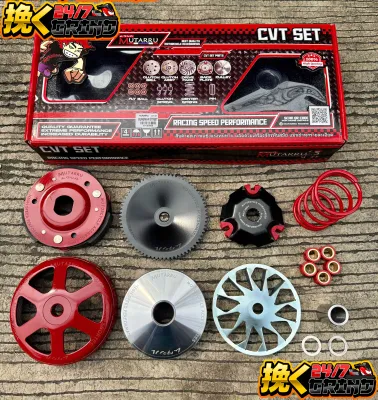
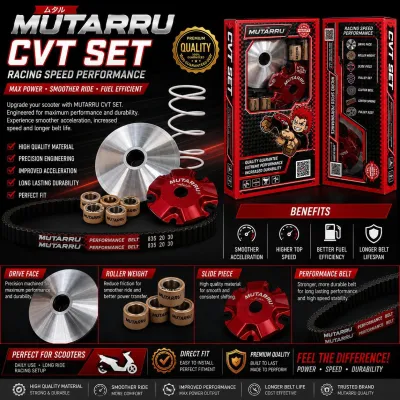
Prices are valid at publication and may change. Please refer to the product page for the latest price.
Ultimately, the best choice is not about finding a universally superior part, but rather matching the transmission’s characteristics to your specific riding style. If you value predictable longevity, quiet operation, and maximum fuel savings, stick with OEM. If you are willing to trade a bit of fuel economy and part lifespan for a more spirited, aggressive acceleration profile, an aftermarket upgrade is worth considering.
Understanding the Click 125i CVT System and Components
To make an informed decision, you must first understand what a complete CVT set actually contains and how these parts interact. Unlike a traditional geared motorcycle that uses chains and sprockets, your Honda Click 125i relies on a system of pulleys, weights, and a high-tensile belt to continuously vary the gear ratio. This seamless transition keeps the engine operating within its optimal power band regardless of your road speed.
A comprehensive CVT set typically includes several critical wear-and-tear and structural components. The primary clutch side consists of the drive face and the variator pulley, which house the movable roller weights. On the secondary side, you will find the clutch assembly—comprising the clutch lining, clutch bell, and torque spring—which manages power engagement to the rear wheel. Connecting these two assemblies is the drive belt, which acts as the primary medium of power transfer.
These components work in perfect harmony to translate engine RPM into forward momentum. As the engine spins faster, centrifugal force pushes the roller weights outward, forcing the front pulley halves closer together and pushing the drive belt to a larger diameter. Simultaneously, the rear pulley halves are forced apart against the tension of the torque spring, allowing the belt to slip deeper into the rear assembly and effectively shifting the scooter into a higher gear.
When buying a “CVT set” for your Click 125i, it is important to distinguish between a full system overhaul and a basic maintenance kit. A standard maintenance replacement usually focus on high-wear items like the drive belt, roller weights, and slide pieces. A full performance or restoration kit, however, will replace the entire variator pulley, drive face, clutch bell, and torque spring to completely refresh or alter the transmission’s behavior.
OEM CVT Sets: Factory Reliability and Daily Comfort
Genuine Honda OEM CVT parts are designed with a primary focus on balanced engineering. Honda’s development teams spend thousands of hours testing these components under extreme environmental conditions to ensure they meet strict standards for noise, vibration, and harshness (NVH). For the average commuter navigating the dense, stop-and-go traffic of metropolitan areas, this engineering translates into a quiet, predictable, and highly comfortable riding experience.

One of the greatest advantages of choosing an OEM CVT set is the guarantee of perfect compatibility and material quality. The rubber compounds in genuine Honda drive belts are formulated to withstand high operating temperatures without stretching prematurely or cracking. Similarly, the factory-specified roller weights—typically weighing 15 grams for the stock Click 125i—are calibrated to keep the engine running at an RPM range that maximizes fuel efficiency, often allowing riders to achieve over 50 kilometers per liter.
Furthermore, installing genuine parts eliminates the guesswork often associated with transmission tuning. Every OEM component is manufactured to exact dimensional tolerances, ensuring that the drive belt aligns perfectly with the pulleys and the clutch shoes engage smoothly against the clutch bell. This precise fitment minimizes internal friction, reduces heat buildup within the CVT casing, and prevents premature wear on adjacent components like the crankshaft and gearbox bearings.
However, the uncompromising focus on daily reliability does come with a few drawbacks. Genuine Honda parts generally carry a price premium at authorized 3S shops compared to entry-level aftermarket alternatives. Additionally, the conservative factory tuning may feel somewhat sluggish or unresponsive to riders who frequently travel with a heavy pillion passenger or those who want immediate throttle response when filtering through tight city traffic.
Aftermarket CVT Sets: Performance Upgrades and Budget Alternatives
The aftermarket segment for the Honda Click 125i is incredibly diverse, offering solutions that cater to two distinct types of riders. Some manufacturers focus entirely on extracting more performance from the 125cc engine, while others aim to provide affordable, direct-replacement parts for cost-conscious owners. Understanding these two sub-categories is essential to avoid purchasing a kit that does not align with your daily needs.
Performance-Oriented Aftermarket Sets
Performance-focused aftermarket CVT kits are engineered to alter the transmission’s shift points to keep the engine in its peak horsepower and torque curves. These kits typically feature redesigned variator ramps with steeper angles, lighter roller weights (often ranging from 11 to 13 grams), and stiffer torque springs. By delaying the upshift, these components allow the engine to rev higher and more quickly, resulting in a dramatic improvement in off-the-line acceleration.
This aggressive setup is highly beneficial for riders who frequently tackle steep mountain roads, such as the scenic routes in Rizal or Benguet, where stock tuning might cause the engine to bog down. The sharper throttle response also makes overtaking slow-moving vehicles on national highways much safer and more predictable. Many performance kits also utilize specialized coatings on the pulley faces to reduce belt slippage and improve heat dissipation during spirited rides.
Nevertheless, these performance gains require clear trade-offs that you must be prepared to accept. Because the engine operates at higher average RPMs, your fuel consumption will inevitably increase, reducing the scooter’s overall efficiency. The constant high-RPM operation also subjects the engine, drive belt, and roller weights to higher levels of stress and thermal load, which generally shortens the service intervals for these parts and can lead to a noisier ride.
Budget Replacement Aftermarket Sets
Budget-focused aftermarket CVT sets serve as direct, low-cost alternatives to OEM parts. These kits are designed to mimic the factory specifications of the Honda Click 125i without introducing any performance modifications. They are highly popular among high-mileage riders, delivery partners, and budget-conscious commuters who need to keep their scooters running reliably without spending a fortune on genuine dealer parts.
While these budget kits offer excellent upfront savings, they require careful consumer scrutiny before purchase. The lower price point is often achieved by using standard rubber compounds in the drive belt and less durable alloys in the pulleys and clutch bells. Consequently, these parts may wear out faster under heavy daily use, potentially leading to issues like belt stretching, clutch slipping, or a noticeable drop in acceleration over time.
To ensure your safety on the road, it is critical to avoid unbranded, generic, or counterfeit CVT components. A low-quality drive belt that snaps at high speed can instantly lock up the rear wheel, presenting a severe safety hazard, or whip inside the transmission case, causing catastrophic damage to the expensive aluminum engine casings. Always source budget parts from recognized, certified third-party manufacturers who provide clear warranty terms.
Key Comparison Dimensions: Durability, Performance, and Value
To help you weigh your options effectively, we can compare OEM and aftermarket CVT sets across four practical dimensions: durability, performance, long-term value, and market availability. Evaluating these factors through the lens of your typical riding environment will point you toward the most logical choice.
Durability and Lifespan
When it comes to pure longevity, genuine Honda OEM CVT components are exceptionally difficult to beat. Under normal commuting conditions and regular maintenance, a factory-installed drive belt and roller weight set can easily last up to 20,000 kilometers before requiring replacement. The metal pulleys and clutch assemblies are similarly robust, often lasting for tens of thousands of kilometers without showing significant grooving or wear.
Aftermarket performance kits, by contrast, sacrifice some durability in exchange for power. The lighter roller weights experience rapid flat-spotting due to the higher friction and speed of their movement within the variator ramps. Additionally, stiffer torque springs put constant, intense tension on the drive belt, which can accelerate belt wear and require you to inspect and replace the belt much sooner than the standard factory interval.
Performance Characteristics
The performance differences between these two options represent a fundamental trade-off between smoothness and aggression. The OEM CVT set is tuned for a linear, predictable power delivery. When you twist the throttle, the scooter accelerates smoothly and quietly, which minimizes rider fatigue during long daily commutes and ensures a stable, controlled ride on slippery, wet roads during the monsoon season.
An aftermarket performance kit transforms the character of the Click 125i, delivering an instant burst of acceleration that is highly satisfying for urban riding. However, this aggressive engagement can make low-speed maneuvering in heavy traffic feel jerky or twitchy. It can also introduce more vibration through the floorboards and handlebars, which may detract from the overall comfort of your daily commute.
Cost and Value
While OEM parts have a higher initial purchase price, they often deliver superior long-term value. A single genuine Honda drive belt that lasts for 20,000 kilometers is ultimately more economical and convenient than a cheap budget belt that costs half as much but must be replaced every 8,000 kilometers. Minimizing the frequency of repairs also saves you significant money on mechanic labor fees over the lifespan of your scooter.
For performance enthusiasts, the value of an aftermarket kit is measured in riding satisfaction and utility rather than pure cost-per-kilometer. If a performance CVT set prevents your scooter from losing speed while climbing steep hills with a passenger, the improved safety and capability may easily justify the higher maintenance costs and increased fuel consumption.
Availability and Sourcing
Sourcing genuine Honda parts in the Philippines is generally straightforward, thanks to an extensive network of authorized Honda 3S shops and flagship service centers. However, rural areas may occasionally experience temporary stock shortages for specific CVT components. In these situations, reputable aftermarket brands are highly valuable, as they are widely stocked by independent motorcycle parts shops across almost every municipality.
When sourcing any CVT components, especially via online marketplaces, you must remain highly vigilant against counterfeit products. Counterfeit “genuine” Honda belts and rollers are common in the market and are often made from substandard materials that fail rapidly. Always purchase your parts from authorized physical dealerships or official, verified online brand stores to guarantee you are getting authentic components.
Safety, Compatibility, and Professional Installation Rules
Modifying or replacing any part of your scooter’s drivetrain carries inherent safety risks that must not be overlooked. The CVT system on your Honda Click 125i is directly responsible for transferring power to the rear wheel and managing engine braking when decelerating. Any failure within this system at high speeds can lead to a sudden loss of control, engine damage, or a severe road accident.
Before purchasing any aftermarket CVT parts, you must consult your Click 125i owner’s manual to verify the exact factory specifications for your specific model year. Pay close attention to the recommended drive belt dimensions and the stock weight of the roller flyballs. Altering these specifications too drastically without a comprehensive understanding of transmission physics can lead to severe belt slippage, excessive heat buildup, or engine over-revving.
We strongly recommend having your new CVT set installed by a qualified, professional motorcycle mechanic rather than attempting a DIY installation without the proper tools. Correctly assembling a CVT requires specialized equipment, such as a pulley holder and a calibrated torque wrench, to tighten the variator and clutch bell nuts to the exact torque values specified by Honda. Over-tightening these nuts with an impact wrench can strip the crankshaft threads, while under-tightening can cause the pulleys to spin loose during operation, resulting in catastrophic mechanical failure.
Furthermore, you must consider the legal and warranty implications of your choice. Installing non-OEM performance parts on a brand-new Honda Click 125i will typically void the manufacturer’s warranty on the engine and drivetrain components. Additionally, ensure that any aftermarket modifications you make do not violate local land transportation regulations regarding vehicle noise limits and road safety standards in your area.
How to Decide: The Final Verdict for Your Scooter
To make the final decision as simple as possible, you can use this structured framework to match your specific riding profile to the correct CVT setup:
- Choose a Genuine OEM CVT Set if:
- You use your Honda Click 125i primarily for daily commuting, school runs, or professional delivery work.
- You want to maintain the maximum possible fuel efficiency (km/L) to keep your daily operating costs low.
- You prefer a quiet, smooth, and highly predictable ride with minimal engine vibration.
- Your scooter is still covered under the manufacturer's factory warranty.
- Choose an Aftermarket Performance CVT Set if:
- You are an enthusiast who wants sharper throttle response and faster acceleration for overtaking.
- You frequently ride on steep, hilly terrain or regularly carry heavy pillion passengers and cargo.
- You are willing to accept higher fuel consumption and more frequent maintenance intervals in exchange for power.
- You enjoy customizing your scooter's mechanical characteristics to match your personal riding style.
- Choose a Reputable Aftermarket Budget CVT Set if:
- You are on a strict repair budget but need to replace worn-out transmission components immediately.
- Genuine OEM parts are currently out of stock or unavailable at your local authorized dealerships.
- You ensure that the parts are sourced from a well-known, certified third-party brand rather than unbranded generics.
Before you purchase a complete CVT set, it is highly recommended to have a professional mechanic perform a physical inspection of your current transmission. In many cases, a loss of performance or a strange vibration is caused by a single worn component, such as flat-spotted roller weights or a dirty clutch bell, rather than a failure of the entire system. Replacing only the specific worn parts can save you a significant amount of money while restoring your scooter’s factory performance.
Frequently Asked Questions (FAQ)
How often should I replace the CVT belt on my Click 125i?
According to the official Honda maintenance schedule, the CVT drive belt on the Honda Click 125i should be inspected every 8,000 to 12,000 kilometers and typically replaced every 20,000 to 24,000 kilometers. However, if you frequently ride in heavy, stop-and-go traffic, carry heavy loads, or operate in dusty and humid tropical environments, the belt may wear out faster. Regular visual inspections for signs of cracking, fraying, or side-wear are essential during routine oil changes.
Can I mix OEM and aftermarket CVT parts?
Yes, mixing OEM and aftermarket components is a very common practice among scooter tuners. For example, many riders choose to keep the highly durable genuine Honda drive belt and clutch assembly while installing lighter aftermarket roller weights to improve acceleration. While this hybrid setup can offer the best of both worlds, you must ensure that all components are fully compatible and that the modified parts do not place excessive stress or heat on the remaining OEM parts.
Will changing my roller weights affect my fuel consumption?
Yes, changing the weight of your roller flyballs will directly impact your fuel efficiency. Installing lighter roller weights allows the engine to rev higher before the transmission shifts, which provides quicker acceleration but causes the engine to burn more fuel at any given road speed. Conversely, installing heavier roller weights can lower your cruising RPM and slightly improve fuel economy on flat highways, but it will make your initial acceleration feel sluggish and slow.
Community discussion
Share your experience or ask a question. Comments are reviewed before publication.