
Deciding between an Original Equipment Manufacturer (OEM) drive face and an aftermarket alternative for your Honda Click comes down to balancing long-term reliability against immediate cost and customization goals. OEM components offer guaranteed fitment, predictable wear, and factory-standard performance, making them a highly reliable choice for daily commuters. On the other hand, aftermarket drive faces provide budget-friendly options and potential performance adjustments, though they require careful physical verification to avoid compatibility issues.
The drive face is a critical component of your scooter’s Continuously Variable Transmission (CVT) system, and choosing an incompatible or low-quality part can lead to premature belt wear, vibration, or even crankshaft damage. To make an informed decision, you must understand how this component operates, how to evaluate material quality, and how to verify physical specifications before installation.
Understanding the Drive Face Role in Your Honda Click
The drive face, often referred to as the primary fixed sheave, is mounted directly onto the engine’s crankshaft. Together with the movable drive pulley (which houses the roller weights), it forms the front pulley system of your Honda Click’s CVT. As the engine spins, the drive belt rides between these two angled faces, moving up and down to continuously vary the gear ratio based on engine speed and load.
Products mentioned in this guide
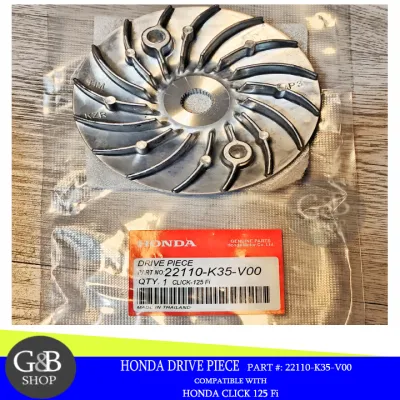
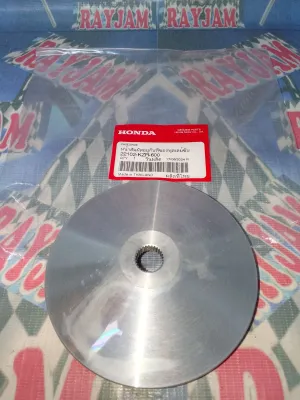
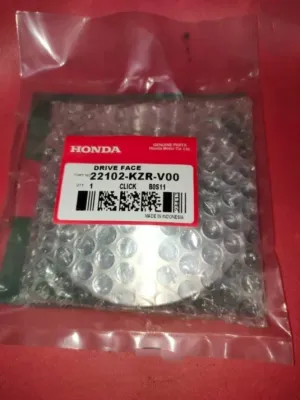
Prices are valid at publication and may change. Please refer to the product page for the latest price.
Because the drive belt is constantly in contact with the drive face, the smoothness and angle of the face’s surface are critical. Over time, the friction from the belt wears down the aluminum surface, creating physical grooves or lips where the belt frequently rides. This wear alters the transition of the belt, leading to noticeable flat spots in acceleration, a reduction in top speed, and increased strain on the engine.
Improper machining or poor material quality on a replacement drive face can accelerate this wear dramatically. If the face angle deviates even slightly from the factory specification, the belt will not sit flat, causing slipping, excessive heat generation, and premature belt failure. Recognizing the early signs of drive face wear—such as sluggish acceleration, unusual CVT vibrations, or a squealing belt—is essential for maintaining your scooter’s efficiency.
Evaluating OEM Honda Drive Faces
Genuine OEM Honda drive faces are engineered specifically for the Honda Click’s engine characteristics and transmission geometry. These parts undergo rigorous factory testing to ensure they meet exact material standards, offering a precise balance of heat dissipation, weight, and surface hardness. When you purchase an OEM part, you are buying guaranteed compatibility that matches the original performance of your scooter out of the showroom.

For riders in the Philippines, where tropical heat, high humidity, and heavy stop-and-go traffic put immense stress on air-cooled and liquid-cooled CVT systems alike, material integrity is paramount. OEM drive faces are cast from high-grade aluminum alloys designed to resist warping and excessive wear under these demanding conditions. This predictable lifespan ensures that your transmission remains reliable over thousands of kilometers of daily commuting.
However, choosing genuine parts does come with certain trade-offs. OEM components generally carry a higher upfront cost when budgeting in Philippine Pesos (₱) compared to budget aftermarket alternatives. Additionally, sourcing genuine parts can sometimes be challenging at local dealerships, especially for older model years of the Honda Click, leading to potential maintenance delays if the part must be backordered.
Navigating Aftermarket Drive Face Options
Aftermarket drive faces present an appealing alternative for riders looking to save money or customize their scooter’s performance. The aftermarket industry offers a wide variety of options, ranging from budget-friendly replacement parts to high-performance CNC-machined pulleys. These parts are widely available through local motorcycle shops and online marketplaces, making them highly accessible when you need a quick replacement.
The primary challenge with aftermarket options is the high variability in manufacturing quality. While some reputable third-party brands produce components that meet or even exceed factory standards, others use lower-grade aluminum alloys or lack precise machining tolerances. A drive face with poor surface finishing can act like sandpaper on your drive belt, wearing it down within a fraction of its normal lifespan.
Furthermore, physical deviations in the center spline or the bore diameter pose a severe risk to your engine. If the splines on the drive face do not engage precisely with the crankshaft splines, the play can strip the crankshaft threads over time. This leads to catastrophic engine damage that requires an expensive and complex engine rebuild, far outweighing any initial savings on the part.
Core Comparison Dimensions for Honda Click Owners
To choose the right drive face, you must compare OEM and aftermarket options across several practical ownership and maintenance dimensions. The first and most critical dimension is fitment and machining tolerance. You must verify that the spline count, bore diameter, and overall outer diameter of the replacement part match your specific Honda Click variant exactly, as these specifications can vary between model generations.
Material durability and surface finish represent the second major dimension. A high-quality drive face must feature a highly smooth, angled surface to minimize belt friction while maintaining enough grip to prevent slipping. The center spline area should ideally be reinforced with a steel insert or high-strength alloy to prevent the splines from stripping under high torque.
Finally, consider the cost-to-value ratio over the long term. While a cheap aftermarket drive face may save you money upfront, its shorter lifespan and the potential for accelerated belt wear can result in higher overall maintenance costs. Conversely, investing in a high-quality component reduces the frequency of CVT teardowns and protects adjacent parts like the drive belt and ramp plate.
| Dimension | OEM Drive Face | Aftermarket Drive Face | Verification Checkpoint |
|---|---|---|---|
| Fitment & Tolerances | Exact factory match | Variable by manufacturer | Verify spline count and bore diameter against the crankshaft |
| Material & Finish | High-grade aluminum alloy | Varies from budget alloy to CNC-machined | Inspect surface smoothness and spline hardness |
| Durability | Predictable, long-term | Highly dependent on brand quality | Check for premature grooving during routine CVT cleaning |
| Cost & Availability | Higher cost, dealer-sourced | Budget-friendly, widely available | Compare local dealer prices in ₱ against reputable shop listings |
Pre-Purchase Verification and Inspection Checklist
Before purchasing or installing any drive face, performing a thorough physical inspection is vital to protect your scooter’s transmission. Start by cross-referencing the part number with your specific Honda Click model year and engine displacement (such as the Click 125i or Click 150i). Never assume that a part labeled for a generic scooter will fit your specific vehicle without verifying the exact dimensions.
Once you have the part in hand, conduct a visual and tactile inspection. Run your finger along the angled face to check for any rough spots, machining ridges, or pitting in the metal. Inspect the center splines closely under a bright light; they should be clean, sharp, and free of metal burrs or deformities that could damage your crankshaft during installation.
Working on a scooter’s CVT system involves high-torque components and carries significant safety implications. Improper disassembly or installation of the drive face can lead to the pulley nut backing off while riding, causing sudden transmission lockup, engine damage, or loss of vehicle control. Always refer to the original vehicle manufacturer’s service manual for the correct torque specifications and assembly procedures.
If you do not possess the specialized tools—such as a flywheel holder or a calibrated torque wrench—or if you lack experience with CVT mechanics, you should have the installation performed by a qualified professional mechanic. Additionally, if your old drive face shows abnormal wear patterns, such as uneven grooving or heat discoloration, stop the installation and consult a professional to diagnose underlying issues like a misaligned belt or worn roller weights.
Decision Framework: Choosing the Right Drive Face
To make your final decision, evaluate your riding habits, budget, and willingness to perform regular maintenance checks. If you use your Honda Click for daily commuting, carry heavy loads, or simply want a reliable, low-maintenance solution, the OEM drive face is the recommended choice. It eliminates the trial-and-error process and guarantees that your scooter operates exactly as the manufacturer intended.
If you are working within a strict budget or are looking to tune your CVT for specific performance characteristics, a high-quality aftermarket drive face is a viable option. However, you must commit to sourcing the part from a highly reputable, verified manufacturer and performing thorough pre-installation checks. Avoid unbranded, ultra-low-cost options that do not provide clear material or manufacturing specifications.
Finally, always assess the overall state of your CVT system before replacing a single component. If your scooter has modified clutch springs, non-standard roller weights, or an aftermarket variator, an aftermarket drive face designed to match those specific modifications may perform better than an OEM part. Conversely, if the rest of your transmission is completely stock, keeping the drive face OEM ensures optimal system harmony.
Frequently Asked Questions (FAQ)
Can I use a drive face from a different Honda scooter model on my Click?
No, you should not assume that drive faces from other Honda scooter models are interchangeable with the Honda Click. Even if they look visually identical, minor differences in spline count, bore diameter, face angle, and outer diameter can prevent proper installation or cause severe damage to your crankshaft. Always verify compatibility using the exact part numbers listed in the official Honda parts catalog for your specific model year.
How often should the drive face be replaced during routine CVT maintenance?
There is no fixed mileage interval for replacing a drive face; instead, replacement should be based on physical condition. You should inspect the drive face during every routine CVT cleaning and belt inspection. If you feel distinct ridges or grooves on the angled surface, notice pitting, or observe wear on the center splines, the drive face must be replaced immediately to maintain proper transmission performance.
Does replacing the drive face require replacing the drive belt at the same time?
While it is not strictly mandatory to replace the drive belt at the same time, it is highly recommended if the old drive face was heavily worn. A grooved or damaged drive face will wear down a new belt prematurely, while an old, unevenly worn belt will not seat correctly on a brand-new drive face. Inspect the belt’s width, check for cracks along the teeth, and replace both components together if either shows signs of significant wear.
Community discussion
Share your experience or ask a question. Comments are reviewed before publication.