
Quick Answer: OEM vs Aftermarket NMAX V2 Sensor Disc
For Yamaha riders in the Philippines, choosing a new nmax v2 sensor disc—whether a Genuine Yamaha OEM brake disc or an aftermarket alternative—is a decision that directly impacts stopping power and safety. Genuine Yamaha OEM brake discs represent the safest, most reliable choice because they guarantee absolute compatibility with the motorcycle’s Anti-lock Braking System (ABS), maintain your official dealer warranty, and offer hassle-free, plug-and-play installation. If you prioritize absolute peace of mind during daily commutes through unpredictable tropical weather and congested city streets, sticking with OEM parts is the most sensible path.
Premium aftermarket brands are highly viable options for riders seeking performance upgrades, such as improved heat dissipation, a stronger initial brake bite, or the aesthetic appeal of a floating rotor. However, these benefits are only realized if the aftermarket disc features an integrated ABS tone ring that has been precision-machined to match factory specifications.
Conversely, unbranded or exceptionally cheap alternatives found on online marketplaces pose severe safety risks. These low-cost options often suffer from poor manufacturing tolerances, which can lead to ABS sensor reading errors, unexpected system failures, or physical warping under heavy load. When it comes to your motorcycle’s primary safety systems, saving a few hundred Pesos on a critical braking component is a compromise that can have catastrophic consequences.
Products mentioned in this guide
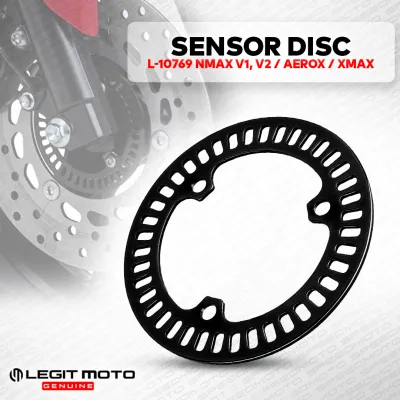
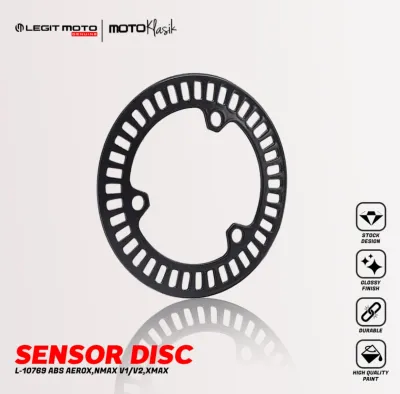
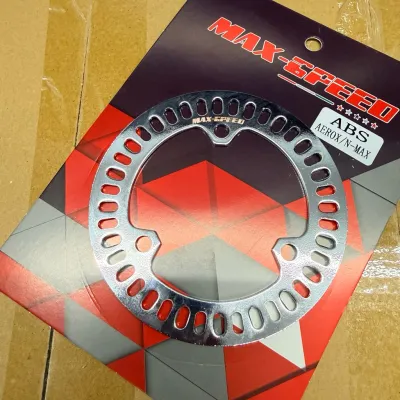
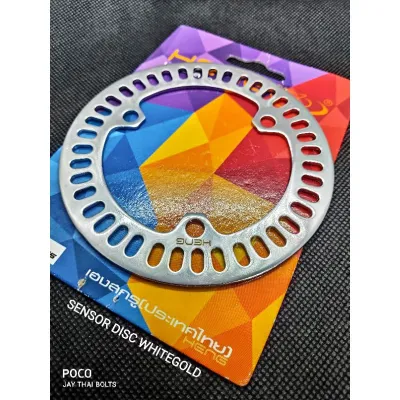
![AEROX / NMAX V1 / NMAX V2 / XMAX ROTOR ABS SENSOR DISC L-10769 FOR YAMAHA 1PC [Local delivery]](https://img.lazcdn.com/g/p/4fac35a43ea30de73f972386e6b04bc2.jpg_400x400q80.jpg_.webp)
Prices are valid at publication and may change. Please refer to the product page for the latest price.
Decoding the "Sensor Disc": Brake Rotors and ABS Tone Rings
In the local motorcycle community, the term “sensor disc” is frequently used to refer to the front or rear brake rotor that incorporates an ABS tone ring, also known as a pulse ring. It is important to understand that the brake rotor and the ABS tone ring are two distinct components working in close coordination. The brake rotor provides the friction surface for your brake pads to clamp against, while the tone ring consists of a series of evenly spaced metal teeth and gaps designed specifically for the ABS sensor to read.

The NMAX V2’s ABS module relies heavily on this tone ring to monitor wheel speed in real time. As the wheel rotates, the magnetic ABS sensor positioned near the wheel hub detects the passing teeth and gaps of the tone ring, sending a continuous stream of electrical pulses to the ABS Electronic Control Unit (ECU). By calculating the frequency of these pulses, the ECU instantly determines if a wheel is about to lock up during sudden braking.
Because this system operates on microsecond calculations, the physical dimensions of the tone ring are incredibly critical. Any slight deformation, improper machining of the teeth, incorrect spacing, or deviation in the air gap between the sensor and the ring can disrupt the signal. When the ABS ECU detects an inconsistent or missing signal, it will immediately illuminate the ABS warning light on your dashboard and disable the anti-lock system, reverting your motorcycle to standard, non-ABS braking. In worst-case scenarios, a faulty sensor ring can cause the ABS to engage unnecessarily, leading to erratic lever feedback and extended stopping distances.
OEM vs Aftermarket: What Actually Matters for NMAX V2 Riders?
When evaluating brake disc options for your NMAX V2, several key dimensions must be analyzed to ensure you choose a component that balances safety, performance, and long-term value.
- ABS Sensor Ring Precision: The defining difference between genuine Yamaha OEM discs and aftermarket alternatives lies in the precision of the ABS tone ring. Genuine OEM discs undergo strict factory calibration to ensure that every tooth is perfectly uniform in height, width, and spacing, guaranteeing that the ABS sensor receives a clean, uninterrupted signal under all riding conditions. In contrast, many budget aftermarket discs utilize stamped sheet metal tone rings rather than precision-cut components. Stamped rings are highly susceptible to minor manufacturing variances and can easily bend or warp during shipping, installation, or heavy thermal stress, leading to immediate sensor reading errors.
- Material and Braking Performance: Standard OEM brake discs are manufactured from durable, high-grade stainless steel designed to offer predictable braking performance and a long service life under normal riding conditions. While highly reliable, they are solid-plate discs that can accumulate significant heat during prolonged downhill braking. Premium aftermarket brands often utilize high-carbon steel alloys, wave patterns, or floating rotor designs. Floating rotors feature an outer friction ring connected to an inner carrier by specialized rivets or bobbins, allowing the outer ring to expand and contract independently as it heats up. This design dramatically reduces the risk of rotor warping and maintains consistent braking feel even under extreme thermal loads.
- Cost and Value: When analyzing the Philippine market, genuine Yamaha OEM parts serve as the baseline for cost-to-reliability value. While they generally cost more than generic aftermarket alternatives, they eliminate the financial risk of diagnostic troubleshooting, premature wear, or system failure. Premium aftermarket discs from globally recognized brands require a substantial financial investment, often costing significantly more than OEM parts, but they justify this price tag through tangible performance upgrades and superior materials. Generic, unbranded discs represent a false economy; the initial savings are quickly offset by the high likelihood of rapid wear, warping, or the need to replace the disc entirely due to ABS compatibility issues.
- Warranty Implications: For owners of relatively new NMAX V2 motorcycles, warranty preservation is a critical factor to consider. Installing non-OEM components on your braking system can have immediate implications for your official dealer warranty. Under standard manufacturer policies in the Philippines, modifications to the braking assembly—particularly those affecting the ABS sensors or electrical system—can void coverage for related high-value components, such as the ABS hydraulic pump, wheel speed sensors, and the main wiring harness. If your motorcycle is still within its warranty period, choosing genuine OEM parts ensures that your coverage remains fully intact.
Which Aftermarket Brands Are Worth Considering?
Premium Performance Brands
For riders who demand the absolute highest level of performance and are willing to invest accordingly, premium global brands such as Brembo, Galfer, and EBC represent the gold standard. These manufacturers employ advanced metallurgy, utilizing high-carbon stainless steel alloys that offer superior friction coefficients and exceptional resistance to thermal fatigue. Their premium floating rotor designs are engineered to handle extreme braking forces without warping. Crucially, these brands apply rigorous quality control standards to their integrated ABS tone rings, ensuring that the spacing and material composition perfectly match the electronic requirements of the NMAX V2’s speed sensors. These options are highly recommended for aggressive riders, those who frequently travel with heavy cargo, or enthusiasts who participate in track days and require fade-free stopping power.
Mid-Range and Reputable Regional Brands
Riders seeking a balance between performance, reliability, and affordability should focus on reputable regional brands and established distributors, such as Racing Boy (RCB) and Bendix. These brands have established a strong presence in the Philippine motorcycle community by offering high-quality, cost-effective alternatives to stock components. Their brake discs often feature upgraded wave designs or improved ventilation slots that enhance heat dissipation compared to standard OEM rotors. When selecting a mid-range disc, it is imperative to verify that the specific model is explicitly labeled as “ABS compatible” for the NMAX V2. Ensure that the integrated tone ring features clean, CNC-machined teeth rather than a simple stamped plate, as this distinction is critical for maintaining stable ABS operation during your daily commute.
Generic and Unbranded Options (What to Avoid)
The local market is flooded with generic, unbranded, or replica brake discs sold at incredibly low prices on various online marketplaces. While these products may look identical to premium options in product photos, they present significant safety hazards. These budget discs are typically manufactured from low-grade steel alloys that lack the necessary thermal treatment, making them highly prone to warping after only a few hundred kilometers of moderate use. Furthermore, their ABS tone rings are frequently misaligned, feature incorrect tooth counts, or suffer from poor spacing. Installing one of these discs almost guarantees that your NMAX V2’s ABS ECU will trigger an error code, disabling your safety systems when you need them most. Saving money on your braking system is never worth compromising your physical safety on the road.
How to Choose: A Decision Framework for NMAX V2 Owners
To make the right choice for your NMAX V2, you must evaluate your specific riding habits, budget, and performance requirements.
- Choose Genuine Yamaha OEM if: You prioritize absolute peace of mind, want to maintain your manufacturer warranty, use your motorcycle primarily for daily city commuting, and require a guaranteed, hassle-free plug-and-play installation without the need to manually adjust sensor clearances.
- Choose Premium Aftermarket if: You are an aggressive rider, frequently tour mountainous routes with steep descents—such as the Marilaque Highway or the roads around Benguet—where heat management is critical, and you want to upgrade to a high-performance floating rotor from a world-renowned manufacturer.
- Choose Mid-Range Aftermarket if: You need a reliable, budget-friendly replacement for a worn-out stock disc, want a slight upgrade in heat dissipation or aesthetics, and are purchasing from an authorized dealer where you can physically inspect the machining quality of the ABS tone ring.
- Verify First if: You are buying any aftermarket disc; confirm the exact NMAX V2 (Connected/Standard) year fitment, as sensor ring tooth counts, wheel hub offsets, or mounting brackets may vary between minor model updates. Checking your owner's manual or consulting with an authorized Yamaha technician prior to purchase will prevent costly compatibility errors.
Installation, Bedding-In, and Critical Safety Checks
Braking systems are the single most critical safety component on your motorcycle; therefore, any work performed on them must adhere to strict safety boundaries. It is highly recommended to have your new brake disc installed by a qualified professional mechanic at an authorized service center. The installer must consult the original vehicle manufacturer’s service manual and utilize a calibrated torque wrench to tighten the disc mounting bolts to Yamaha’s exact torque specifications. Reusing old, stretched bolts or tightening them unevenly can cause the rotor to sit slightly crooked, leading to brake drag, rapid wear, or catastrophic bolt failure while riding.
Once the new disc is mounted, the mechanic must physically verify the air gap between the ABS speed sensor and the tone ring. This clearance must be uniform across the entire 360-degree rotation of the wheel. Use a non-magnetic feeler gauge to confirm that the gap falls within the allowable tolerance specified in the service manual. Any physical contact between the sensor and the rotating ring will instantly destroy the sensor, while an excessive gap will prevent the sensor from reading the wheel speed.
After successful installation, a proper bedding-in (or burnishing) process is mandatory to ensure optimal braking performance. For the first 50 to 100 kilometers, avoid sudden, aggressive braking maneuvers. Instead, perform a series of gentle, controlled stops from moderate speeds (around 50 km/h down to 10 km/h) without coming to a complete stop. This process allows the brake pads to transfer an even, microscopic layer of friction material onto the new rotor surface, preventing brake squeal, uneven wear, and localized hot spots that can warp the metal.
Finally, conduct a thorough post-installation safety check in a secure, low-traffic environment. Turn on the ignition and confirm that the ABS warning light on the dashboard illuminates, indicating that the system is performing its self-diagnostic check. Ride the motorcycle slowly; the ABS light should turn off automatically once you exceed approximately 10 km/h. Gently apply both the front and rear brakes to verify that the levers feel firm, there is no unusual vibration or pulsing under light pressure, and the motorcycle comes to a smooth, controlled stop.
Frequently Asked Questions (FAQ)
Can I transfer the original ABS sensor ring to an aftermarket disc?
On the Yamaha NMAX V2, the ABS tone ring is typically integrated directly into the brake disc assembly or permanently pressed onto the rotor carrier. It is not designed to be removed, serviced, or transferred to another disc. Attempting to pry or press the original ring off will almost certainly bend, warp, or stretch the delicate metal. Even a microscopic deformation will alter the tooth spacing and cause immediate ABS system malfunctions. You must always purchase a complete, model-specific brake disc assembly that comes with a pre-installed, factory-verified sensor ring.
Why did the ABS warning light turn on after replacing the disc?
If your ABS warning light illuminates or flashes after installing a new disc, it indicates that the ABS ECU is detecting an irregular or missing wheel speed signal. The most common causes include a warped or poorly machined aftermarket sensor ring, an incorrect air gap between the sensor and the ring, metallic road debris stuck to the magnetic sensor tip, or physical damage to the delicate sensor wire during installation. You should immediately inspect the sensor for cleanliness and check the air gap clearance. If the light persists, stop riding the motorcycle and have it diagnosed by a professional mechanic.
Must I replace the brake pads when installing a new brake disc?
Yes, it is highly recommended to install a fresh set of brake pads whenever you replace a brake disc. Your old brake pads have developed specific wear patterns, grooves, and uneven surfaces that match your old rotor. Reusing these worn pads on a perfectly flat, new disc reduces the physical contact area between the pad and the rotor, resulting in significantly reduced stopping power, uneven pad transfer, and premature grooving or warping of your brand-new brake disc.
Community discussion
Share your experience or ask a question. Comments are reviewed before publication.