
Quick Answer: Should You Upgrade Your Mio i 125 CVT?
Upgrading to a sun racing cvt set mio i 125 is not a universal necessity for every rider, but rather a situational choice based on your daily riding environment, performance goals, and maintenance tolerance. In the Philippines, the Yamaha Mio i 125 serves as a ubiquitous daily commuter, navigating congested urban streets, handling sudden tropical downpours, and carrying varying payloads. Deciding whether to modify its transmission system requires weighing the benefits of factory-engineered reliability against the appeal of custom performance tuning.
To help you decide, consider this conditional decision framework:
- Choose the Stock Yamaha CVT if: You prioritize ultimate factory reliability, optimal fuel efficiency, minimal maintenance overhead, and keeping your manufacturer's warranty fully intact for daily commuting.
- Choose the Sun Racing CVT Set if: You have specific performance targets, such as quicker overtaking power in heavy traffic or better climbing ability on steep inclines, and you are willing to perform more frequent maintenance and accept faster wear on consumable parts.
- Verify first if: Your current performance issues, such as sluggish acceleration, vibration, or dragging, are actually caused by worn-out stock rollers, a stretched drive belt, or a glazed clutch bell rather than an inherent limitation of the stock CVT system. Replacing these wear items with fresh original equipment manufacturer (OEM) parts might restore your scooter's original performance without needing a full aftermarket upgrade.
Key Differences: Sun Racing vs Stock CVT Components
To understand how these two systems compare, we must first look at the core components that dictate how a Continuously Variable Transmission (CVT) operates. The CVT system consists of several highly interactive parts: the drive face, roller weights, movable drive pulley, clutch housing (bell), clutch assembly, and the contra spring (compression spring). While Yamaha’s original equipment manufacturer (OEM) engineering focuses on a balance of durability, quiet operation, and fuel economy, aftermarket brands like Sun Racing take a performance-first approach. The following sections evaluate how these differing philosophies manifest in the actual riding experience, durability, and long-term costs.
Products mentioned in this guide
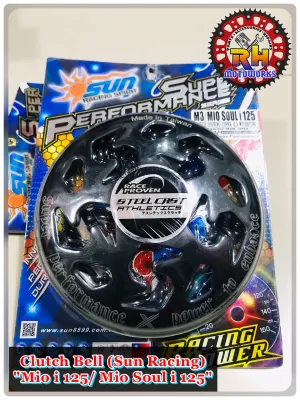
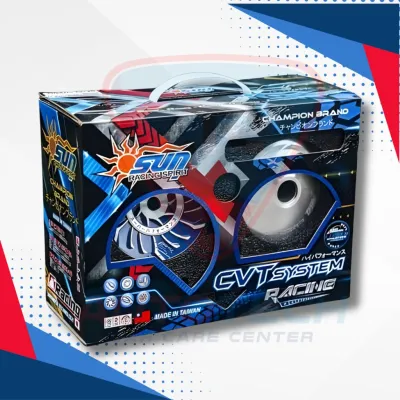
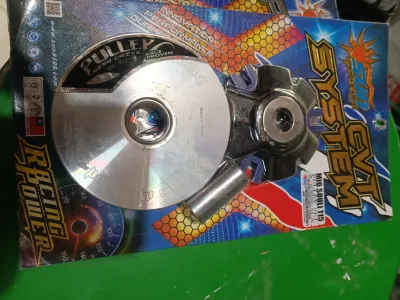
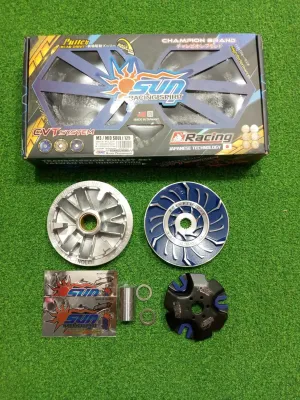
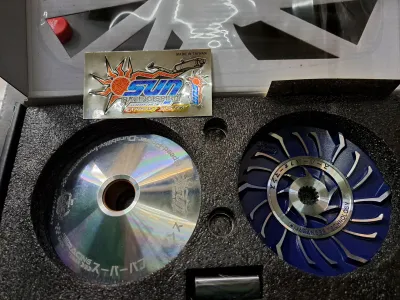
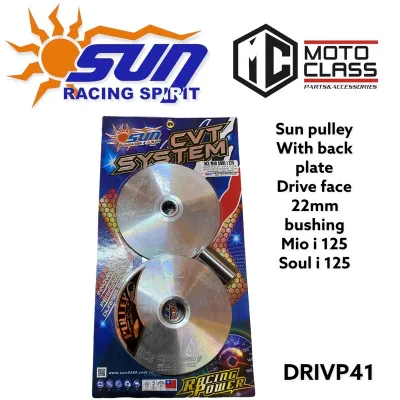
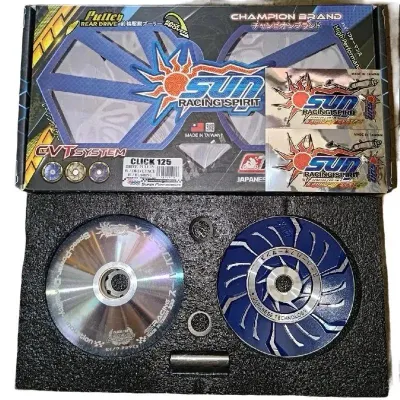
Prices are valid at publication and may change. Please refer to the product page for the latest price.

Performance and Riding Feel
Roller Weight Profiles and Pulley Ramp Angles The stock Yamaha Mio i 125 CVT is designed with a linear, predictable power delivery. The factory roller weights and the gentle ramp angles of the stock pulley are engineered to keep the engine running at a moderate, fuel-efficient RPM during typical city cruising speeds of 40 to 60 km/h. This setup ensures that power delivery is smooth and manageable, making it easy for riders of all skill levels to operate the scooter safely in diverse traffic conditions.
In contrast, the Sun Racing CVT set often utilizes redesigned pulley ramp angles and lighter roller weights. By modifying the ramp profiles, the belt is forced to transition differently across the pulley faces. Lighter rollers require higher engine RPM to sling outward via centrifugal force. This keeps the engine in its peak powerband longer during initial acceleration, giving the scooter a much more responsive, aggressive “bite” when you twist the throttle from a complete stop.
Clutch Spring Stiffness and RPM Bands The clutch springs and the contra spring play a critical role in determining when the transmission engages and how quickly it back-shifts. The stock Mio i 125 uses relatively soft clutch springs, allowing the clutch to engage at lower RPMs for smooth, quiet, and vibration-free takeoffs. The stock contra spring is also softer, designed to minimize tension on the drive belt and reduce friction, which directly contributes to the scooter’s excellent fuel economy.
The Sun Racing kit typically includes stiffer clutch springs and a higher-tension contra spring. Stiffer clutch springs delay clutch engagement until the engine reaches a higher, more powerful RPM, resulting in rapid off-the-line acceleration. The stiffer contra spring keeps tighter pressure on the pulley faces, preventing belt slippage under heavy load and enabling faster back-shifting when decelerating and re-accelerating, which is highly beneficial when weaving through stop-and-go traffic or climbing steep roads in hilly regions.
Real-World Character and Tuning Dependencies It is crucial to understand that actual performance gains are highly conditional. There are no guaranteed horsepower or top-speed increases simply by bolting on an aftermarket CVT set. The final performance character depends heavily on the rider’s weight, cargo load, local terrain, and whether other engine modifications—such as an aftermarket exhaust system, upgraded fuel injectors, or ECU tuning—are installed.
A lighter rider might experience a dramatic increase in initial acceleration with a Sun Racing setup, while a heavier rider or someone frequently carrying a pillion passenger might find that overly light rollers cause the engine to scream at high RPMs without translating to actual forward speed. The stock CVT delivers a smooth, linear, and predictable roll-on that minimizes rider fatigue during long commutes, whereas the Sun Racing set provides a punchier, sportier feel that appeals to performance enthusiasts but can feel jerky in slow-moving traffic.
Durability and Maintenance Requirements
Materials, Design Priorities, and Wear Lifespans Yamaha engineers the stock Mio i 125 CVT components using highly durable, wear-resistant metal alloys and composite plastics designed to withstand tens of thousands of kilometers under typical tropical riding conditions. The priority is longevity and low maintenance. The stock slide pieces, roller weights, and pulley faces wear down slowly and evenly, ensuring consistent performance over a long period.
Aftermarket racing parts, including the Sun Racing CVT set, prioritize lightweight construction and maximum grip. The aluminum alloys used in aftermarket pulleys may be softer or have different thermal properties to dissipate heat during aggressive riding. However, this high-friction, high-performance environment can accelerate wear. The steeper ramp angles and stiffer springs exert greater physical stress on the drive belt, roller weights, and slide pieces, meaning these components will naturally degrade faster than their OEM counterparts.
Maintenance Intervals and Inspection Routines With a stock CVT setup, standard maintenance intervals typically involve a simple cleaning and inspection every 6,000 to 10,000 kilometers, with drive belt replacement recommended around every 20,000 kilometers under normal riding conditions. This makes the stock setup highly cost-effective and convenient for busy commuters who want to minimize garage visits.
If you upgrade to the Sun Racing CVT set, you must adopt a much more rigorous maintenance schedule. Because the system operates at higher average RPMs and temperatures—especially in the hot, humid climate of the Philippines—you should inspect the CVT case every 3,000 to 5,000 kilometers. This involves opening the CVT cover, cleaning out accumulated belt dust, and checking for signs of premature wear on the rollers and sliders.
Observable Wear Indicators Checklist Regardless of which CVT setup you choose, riders should regularly monitor these critical wear indicators to prevent sudden on-road failures:
- Roller Flat Spots: Inspect the roller weights for any flat sides, which prevent them from rolling smoothly up the pulley ramps, leading to sluggish acceleration or a drop in top speed.
- Belt Fraying and Cracks: Examine the drive belt closely for any cracks along the inner teeth or fraying cords along the edges; a snapped belt will leave you stranded.
- Clutch Glazing: Check the clutch lining and the inner surface of the clutch bell for a shiny, glass-like finish or bluish discoloration, which indicates overheating and causes clutch slippage (manifesting as a shuddering sensation during takeoff).
- Slide Piece Play: Ensure the plastic slide pieces fit snugly on the ramp plate; excessive play causes annoying rattling noises and uneven pulley wear.
Cost and Value Analysis: Is the Premium Justified?
Upfront Costs and Labor When evaluating the financial side of this upgrade, you must look beyond the initial purchase price of the parts. A complete Sun Racing CVT set—which typically includes the pulley, drive face, roller weights, clutch springs, and contra spring—represents a significant upfront investment compared to buying individual OEM replacement parts. While a single worn stock roller or slide piece can be replaced for a nominal cost, an aftermarket upgrade requires purchasing the entire matched set to function correctly.
Furthermore, professional installation is highly recommended. Properly tuning a CVT involves matching the roller weights and spring tensions to your specific weight and riding style, which often requires a mechanic to perform multiple test runs and adjustments. Specialized tools, such as a dry clutch holder, a torque wrench, and a pulley holder, are necessary to avoid damaging the crankshaft splines or stripping threads during installation. Labor costs for professional tuning and installation must be factored into your initial budget.
Long-Term Maintenance and Replacement Costs The long-term cost of ownership is where the financial gap between stock and aftermarket setups widens. Because aftermarket CVT systems subject the drivetrain to higher stress, you will find yourself replacing wear items more frequently. Drive belts, which can last up to 20,000 kilometers on a fully stock setup, may need replacement much sooner when paired with aggressive aftermarket pulleys and stiff contra springs.
Roller weights in performance setups also tend to develop flat spots quicker due to the rapid movement along steeper ramp angles. Over a two-year period, a rider using a Sun Racing CVT set may spend significantly more on replacement belts, rollers, and professional maintenance labor than a rider sticking to the factory Yamaha maintenance schedule.
Price Verification and Market Fluctuations Riders should verify current pricing and genuine parts availability through authorized local motorcycle dealers or reputable online marketplaces. Prices of both OEM Yamaha parts and Sun Racing kits can fluctuate due to import costs, shipping fees, and regional supply chain conditions in the Philippines. Be cautious of counterfeit aftermarket parts, as low-cost imitations can fail catastrophically and damage your engine’s crankshaft or transmission housing.
Installation, Safety, and Warranty Considerations
Safety Boundaries and Handling Impacts Modifying your scooter’s transmission is not merely an aesthetic or minor performance upgrade; it directly alters how power is delivered to the rear wheel. A more aggressive CVT setup can make the throttle response highly sensitive. In wet or slippery conditions—common during the Philippine rainy season—a sudden surge of power to the rear wheel can cause loss of traction, especially on painted road markings or asphalt.
Additionally, the increased engine braking or altered deceleration characteristics of a stiff contra spring can affect how you handle corners and manage braking distances. Always take time to familiarize yourself with the altered handling dynamics in a safe, controlled environment before riding in heavy traffic.
Warranty Voiding and Manufacturer Guidelines Before installing any aftermarket transmission parts, consult your original vehicle documentation and warranty terms. Installing a non-OEM CVT kit like the Sun Racing set will almost certainly void the manufacturer’s warranty on the drivetrain, engine, and associated electrical or mechanical components.
If your Mio i 125 is still under its factory warranty period, sticking to original Yamaha parts and having them serviced exclusively at authorized Yamaha 3S shops is the only way to keep your warranty coverage intact. If a major engine failure occurs and an aftermarket pulley or clutch is found inside the transmission case, the manufacturer will likely deny your warranty claim.
Professional Installation and Torque Specifications CVT installation requires precision. Incorrectly torqued bolts can lead to severe mechanical failures. For example, if the primary drive face nut is under-torqued, it can spin loose at high RPM, stripping the crankshaft splines and requiring an expensive engine teardown to replace the crankshaft. Conversely, over-torquing can strip the threads or damage the bearings.
Always consult the official Yamaha Mio i 125 service manual for the exact torque specifications for the primary pulley nut and the rear clutch bell nut. If you do not possess a calibrated torque wrench and the necessary holding tools, do not attempt this installation yourself. Entrust the work to a qualified motorcycle mechanic who has experience tuning automatic scooter transmissions. Additionally, ensure that all modifications comply with local vehicle safety and land transportation regulations in the Philippines.
Final Verdict: How to Choose the Right CVT Setup for Your Ride
Actionable Decision Matrix Ultimately, the decision to upgrade to a Sun Racing CVT set or remain with the stock Yamaha setup depends on your personal priorities, budget, and willingness to perform regular maintenance.
If your primary goal is a hassle-free, highly fuel-efficient daily commute where you can ride from point A to point B without worrying about accelerated part wear, the Stock Yamaha CVT is undeniably the better choice. It is engineered to deliver reliable, predictable performance over thousands of kilometers with minimal intervention.
If you are a performance enthusiast who finds the stock acceleration lacking during highway overtaking, or if you frequently climb steep mountain roads with heavy loads and are fully prepared for the increased maintenance costs and shorter component lifespans, the Sun Racing CVT Set offers a noticeable, customizable improvement in throttle response and power delivery.
The Middle-Ground Approach If you are on the fence, you do not have to jump straight into a full aftermarket CVT kit. A highly practical middle-ground approach is to make minor, reversible adjustments to your existing stock setup.
For instance, you can try installing slightly lighter OEM-quality roller weights or upgrading to a slightly stiffer contra spring while keeping the stock pulleys and clutch. This allows you to fine-tune your Mio i 125’s acceleration and climbing ability at a fraction of the cost, without immediately subjecting your entire drivetrain to the extreme wear of a full racing-spec transmission system.
Frequently Asked Questions (FAQ)
The following frequently asked questions address common compatibility and secondary component queries regarding the Yamaha Mio i 125 CVT system.
Will a Sun Racing CVT set fit other Yamaha scooter models?
While many Yamaha scooters share similar engine displacements, you must never assume cross-model compatibility. The CVT components designed specifically for the Mio i 125 may not fit other models like the Mio Soul i 125, Mio Gravis, Mio Gear, or larger scooters like the Aerox or NMAX.
Differences in crankshaft diameters, spline counts, pulley outer diameters, and clutch bell dimensions mean that attempting to install a mismatched CVT set can cause immediate mechanical damage. Always verify the exact model year and engine compatibility using the manufacturer’s official application chart, or consult a professional mechanic before making a purchase.
Do I need to upgrade the drive belt when installing an aftermarket CVT?
When installing a high-performance aftermarket CVT set like Sun Racing, it is highly recommended to inspect your current drive belt’s wear status. If your current belt has more than 10,000 kilometers of use, replacing it during the CVT installation is wise to ensure optimal performance and safety.
Because aftermarket pulleys feature altered ramp angles and stiffer springs that increase belt tension and operating temperatures, a standard or worn belt may experience accelerated wear or premature snapping. Upgrading to a heavy-duty or reinforced drive belt (such as a high-quality Kevlar-reinforced belt designed for performance applications) can provide the necessary strength and thermal resistance to handle the increased friction and higher RPM ranges safely.
Community discussion
Share your experience or ask a question. Comments are reviewed before publication.