
Selecting the right transmission lifter jack is a critical decision that directly impacts both your safety and the success of your drivetrain repairs. To make the correct choice, you must match the jack’s load capacity to your vehicle’s transmission weight plus a generous safety margin, while ensuring the jack’s physical clearance matches your garage setup. Specifically, the jack’s minimum lowered height must roll easily under your vehicle when it is supported on jack stands, and its maximum lift height must comfortably reach the transmission mounting point.
In the Philippines, where high relative humidity can make garage floors slick and popular family vehicles range from compact city hatchbacks to heavy-duty 4×4 pickup trucks, choosing the wrong equipment poses severe risks. A jack that is too tall will not fit under a standard sedan, while an underpowered jack can fail catastrophically under the weight of a heavy utility vehicle transmission. Understanding how to calculate these physical boundaries ensures a smooth, secure, and professional-grade repair process.
How to Determine the Correct Load Capacity for Your Transmission
To identify the correct capacity for your transmission lifter jack, you must first determine the exact dry weight of your vehicle’s transmission. This information can be found in your vehicle’s official factory service manual, from manufacturer specifications, or through verified automotive repair databases. Never rely on generic online estimates, as transmission weights vary wildly depending on the casing material, gear count, and whether the unit is manual or automatic.
Products mentioned in this guide
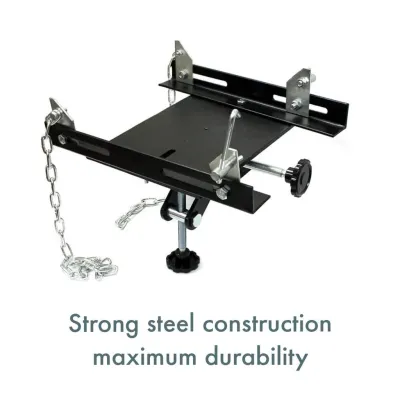
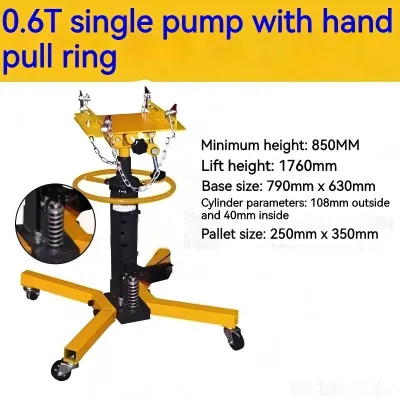
Prices are valid at publication and may change. Please refer to the product page for the latest price.
Once you have the dry weight, you must calculate a safety margin. A transmission is rarely removed completely bare; it often retains residual automatic transmission fluid (ATF), and may still have the heavy torque converter, transfer case, or mounting brackets attached. To account for these variables, select a jack with a rated capacity that exceeds your transmission’s dry weight by at least 30 percent. For instance, if your transmission weighs 80 kilograms, your jack should be rated for at least 104 kilograms.
Market options generally fall into distinct capacity tiers, which serve as helpful reference points:
- Light-Duty Jacks (Up to 500 kg / 1,100 lbs): Typically suitable for front-wheel-drive passenger sedans, compact hatchbacks, and light crossover vehicles.
- Heavy-Duty Jacks (1,000 kg / 2,200 lbs and above): Required for larger rear-wheel-drive vehicles, commercial vans, and 4×4 SUVs or pickup trucks that feature integrated transfer cases.
A strict safety boundary must be maintained: never exceed the manufacturer’s rated capacity under any circumstances. Additionally, a higher capacity rating is not automatically better if the jack’s physical footprint is too large for your workspace. A massive 1.5-ton commercial jack may be physically impossible to maneuver under a compact car, even if it easily handles the weight. Always verify that the physical dimensions of the jack are compatible with your working environment before prioritizing raw lifting power.
Calculating Lift Height and Under-Vehicle Clearance Requirements
To ensure your transmission lifter jack can perform the job, you must translate “maximum lift height” and “lowered height” into physical measurements taken directly from your garage floor. This requires a level concrete surface and a reliable measuring tape.

First, measure your under-vehicle clearance to determine the required lowered height of the jack. This measurement must be taken after the vehicle is safely raised and supported on heavy-duty jack stands at your intended working height. Measure the distance from the garage floor to the lowest point of the vehicle’s subframe or rocker panels. The transmission jack’s minimum lowered height must be less than this measurement so you can roll the jack underneath the vehicle while carrying the transmission.
Next, calculate the maximum lift height. Measure from the garage floor to the transmission bell housing or the center mounting point while the transmission is still installed. Your jack’s maximum extended height must exceed this measurement by several inches. This extra height is necessary to lift the transmission slightly off its mounts, clear any chassis crossmembers, and allow you to lower it smoothly without running out of hydraulic travel.
Vehicle modifications drastically alter these clearance equations. If you drive a modified 4×4 pickup with a suspension lift and larger mud tires—common setups for navigating waterlogged roads during the Philippine rainy season—you will require an extended-height jack or specialized tall adapters to reach the drivetrain safely. Conversely, if you are working on a lowered sports car, a specialized low-profile jack is mandatory to slide under the low chassis clearances. Always consult your vehicle’s specific documentation to verify frame heights before purchasing lifting equipment.
Critical Secondary Specs: Tilt, Safety Chains, and Stability
Beyond raw weight capacity and vertical lift, several secondary specifications dictate how safely and efficiently you can maneuver a heavy, awkward component like a transmission.
Transmissions do not sit perfectly level when installed; they are angled slightly downward to match the tilt of the engine block. Because of this, a quality jack must feature multi-directional saddle tilt adjustments. Fore-and-aft tilt, along with side-to-side swivel controls, allow you to match the angle of the transmission bell housing precisely. This alignment is critical during reinstallation to guide the transmission input shaft smoothly into the clutch disc or torque converter pilot without binding or damaging the delicate splines.
Safety chains or heavy-duty adjustable straps are non-negotiable safety features on any transmission saddle. A transmission is an unbalanced, top-heavy object often coated in slippery road grime or leaked fluid. Without secure chains tightly binding the unit to the saddle, the transmission can easily slide off when the jack is rolled or if the vehicle is accidentally bumped. Ensure the jack you select features robust, integrated anchor points and high-tensile chains.
Finally, pay close attention to the jack’s base width and caster quality. A wider wheelbase distributes the weight over a larger surface area, greatly reducing the risk of the jack tipping over while carrying a top-heavy load. In humid tropical environments, concrete garage floors can collect condensation or “sweat,” making the surface slick. High-quality, ball-bearing swiveling casters made of polyurethane or heavy steel ensure smooth rolling over floor joints and debris, preventing sudden jerks that could destabilize the load.
Your Step-by-Step Transmission Jack Selection Checklist
Use this practical checklist to evaluate any transmission lifter jack before making your purchase or starting your repair:
- Step 1: Verify Drivetrain Weight: Consult your vehicle's factory service manual to find the exact dry weight of the transmission. Add a minimum of 30 percent to this number to account for fluids, torque converters, and transfer cases.
- Step 2: Measure Ground Clearance: Raise your vehicle safely on jack stands. Measure the distance from the floor to the lowest undercarriage clearance point. Ensure the jack's minimum lowered height is lower than this number.
- Step 3: Measure Working Height: Measure the distance from the floor to the transmission mounting points. Confirm that the jack's maximum lift height exceeds this measurement by at least 10 to 15 centimeters.
- Step 4: Inspect Safety Features: Physically verify that the jack features mechanical tilt adjustment knobs, integrated safety chains, and a wide, stable four-legged base with heavy-duty swiveling casters.
- Step 5: Review Manufacturer Instructions: Always cross-reference the jack's operating manual with your vehicle's specific lifting points and safety guidelines before attempting to support any load.
Frequently Asked Questions (FAQ)
Can I use a standard floor jack to remove a transmission?
No, you should never use a standard floor jack to remove or install a transmission. Standard floor jacks feature a small, flat cup saddle designed solely for lifting frame points, lacking the wide support platform, safety chains, and multi-directional tilt adjustments required to balance an awkward, top-heavy transmission. Attempting to use a standard floor jack carries an extremely high risk of the transmission slipping off, which can cause catastrophic physical injury, crush your hands, or cause expensive damage to the vehicle’s underbody and engine components.
Do I need a taller transmission jack for SUVs and pickup trucks?
Yes, high-clearance vehicles like SUVs, crossovers, and pickup trucks generally require transmission jacks with extended maximum lift heights or specialized tall adapters to reach the elevated drivetrain. Because these utility vehicles also feature significantly heavier transmissions and transfer cases compared to compact passenger cars, you must carefully verify both the extended lift height and the maximum load capacity against your specific vehicle model’s service manual before proceeding with any DIY removal.
Community discussion
Share your experience or ask a question. Comments are reviewed before publication.