
Finding the right 45W car charger requires looking beyond the wattage number printed on the box. To get the fastest, safest charge during your daily commute or long road trips, you must evaluate how that power is distributed across ports, which fast-charging protocols the charger supports, and how well the physical unit fits your vehicle’s accessory socket. A mismatched charger can leave your devices charging at a crawl or, worse, cause overheating in a hot cabin.
Understanding the 45W Output and Port Distribution
When shopping for a 45W car charger, verify how the manufacturer defines that wattage. Many chargers advertise “45W” on the packaging, but this often represents the combined maximum output of all ports rather than a single port’s capacity. If a charger has two ports, it might split the power as 30W on one and 15W on the other, or divide it evenly when both are occupied.
To power a demanding device like a compact laptop or tablet, you need a single port that outputs the full 45W independently. Plugging a second device into a multi-port charger triggers power redistribution. This split can instantly drop your primary port’s output to 30W or 20W, which might cause a laptop to stop charging or switch to a slow trickle.
Products mentioned in this guide
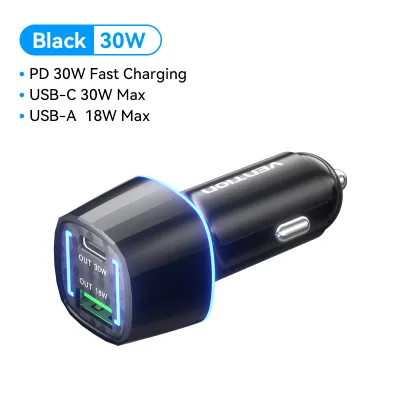
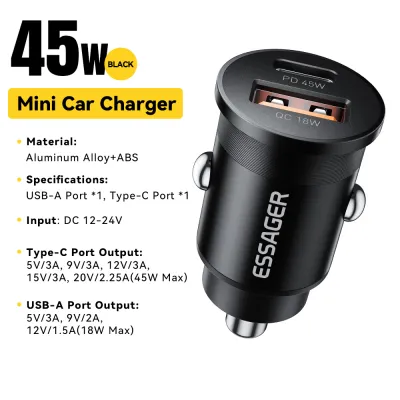
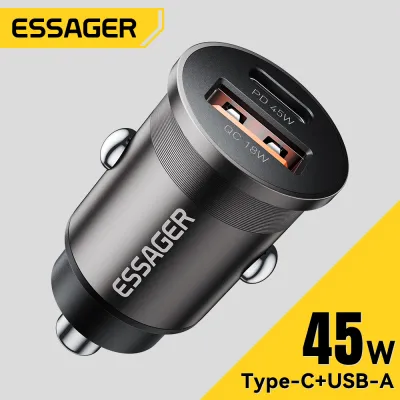
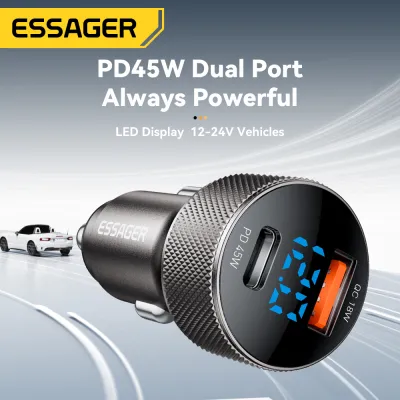
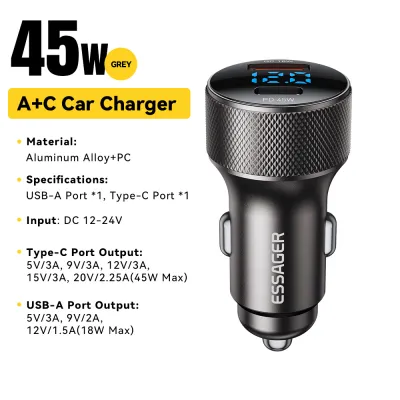
Prices are valid at publication and may change. Please refer to the product page for the latest price.
Check your device’s exact power specifications to avoid overbuying or underbuying. A smartphone that maxes out at 25W will not benefit from a single-port 45W output, though the extra headroom is useful for larger electronics. Conversely, if your laptop requires a minimum of 45W to charge while in use, a multi-port charger that splits its power will fall short. Always read the fine print on the product label to confirm single-port output specifications.
Essential Charging Protocols: USB-C PD vs. Quick Charge
Wattage alone does not guarantee fast charging; the charger and your device must support the same charging protocol. The most critical protocol to look for in a 45W car charger is USB-C Power Delivery (PD). This is the universal standard used by modern laptops, tablets, and Apple devices to negotiate high-speed power transfer safely. Without USB-C PD, a 45W charger may default to a slow 5W charge.

For many Android smartphones and legacy accessories, Qualcomm’s Quick Charge (QC) remains highly relevant. While USB-C PD is the dominant standard, having a charger that supports both protocols ensures maximum compatibility. This is particularly important for mixed-device households where family members carry a variety of phone brands with different fast-charging requirements.
When browsing online marketplaces, look for chargers that explicitly list dual-protocol or multi-protocol support. A charger equipped with both a USB-C PD port and a USB-A Quick Charge port offers the greatest flexibility. This setup allows you to fast-charge a modern tablet via the USB-C port while simultaneously powering an older dashcam or passenger phone via the USB-A port.
Physical Design and Vehicle Compatibility
A car charger must fit securely within your vehicle’s accessory socket to maintain a stable electrical connection. Most passenger cars use a 12V electrical system, while larger commercial vehicles like trucks operate on a 24V system. Verify that the charger is rated for your vehicle’s specific voltage range; fortunately, many modern chargers handle a wide input range from 12V to 24V.
The physical shape of the charger also impacts usability. Flush-fit or low-profile chargers sit nearly flat against the socket, making them ideal for tight spaces where an extended charger might get bumped by your hand or gear shifter. However, if your vehicle’s accessory socket is recessed deep inside a dashboard cubby, a slightly extended charger with a textured grip is much easier to insert and remove.
Take a moment to inspect the clearance around your vehicle’s socket. In tropical climates like the Philippines, where high humidity and dust can accumulate in open cabin areas, a loose-fitting charger can spark or lose connection over bumpy roads. Choosing a charger with robust, spring-loaded side clips ensures it stays firmly anchored in the socket, preventing interrupted charging cycles.
Safety Features and Label Verification
Car electrical systems can be unpredictable, with voltage spikes occurring when you start the engine. A high-quality 45W car charger must include built-in safety mechanisms to protect both your vehicle and your devices. Look for products that explicitly state protection against overcurrent, overvoltage, short circuits, and overheating on their packaging or product descriptions.
Before plugging any accessory into your dashboard, inspect the physical body of the charger for recognized safety certification marks. These symbols indicate that the device has undergone independent testing to meet strict safety standards. Avoid unbranded, generic chargers that lack these markings, as they often skimp on internal cooling components and high-quality circuit boards.
Operating conditions in warm climates demand extra vigilance. In the intense tropical heat of the Philippines, car cabins can reach extreme temperatures when parked under the sun. If a car charger feels excessively hot to the touch during use, or if you notice a faint burning smell, unplug it immediately. A malfunctioning charger can draw excessive current, leading to a blown vehicle fuse or damage to your car’s internal wiring. Spending around ₱500 to ₱1,500 on a certified, brand-name charger is a small price to pay to safeguard your vehicle’s electrical system.
Matching the Cable to the Charger's Capabilities
Even the most advanced 45W car charger cannot deliver its full speed if paired with an inadequate cable. Standard USB-A to USB-C cables, or cheap cables bundled with older devices, are generally limited to lower wattages and cannot support the high-voltage requirements of USB-C Power Delivery. To achieve a true 45W charge, you must use a high-quality USB-C to USB-C cable.
For charging levels above 60W, cables require a specialized internal chip called an E-marker to negotiate power safely. While a 45W charger does not strictly require an E-marker cable, using a cable rated for 60W or 100W ensures that the cable itself will never become a bottleneck. These heavy-duty cables feature thicker internal copper wires that reduce resistance and heat buildup, which is crucial for maintaining charging efficiency in warm environments.
Finally, consider the length and build quality of the cable. A cable that is too long can create clutter around your gear shifter, posing a safety hazard while driving. Conversely, a cable that is too short might strain the ports if a passenger tries to use the phone from the back seat. A durable, braided nylon cable of around one meter is usually the sweet spot for vehicle cabins, offering flexibility without cluttering your console.
Frequently Asked Questions (FAQ)
Can a 45W car charger safely charge a smartphone that only needs 20W?
Yes, it is entirely safe. Modern smartphones and chargers use smart negotiation protocols to communicate before transferring power. When you plug a 20W phone into a 45W charger, the phone will only draw the maximum wattage it is designed to handle. The charger will not force 45W of power into a device that cannot accept it, preventing battery damage or overheating.
Why is my laptop charging slowly even with a 45W car charger?
Slow charging usually happens because of power splitting or cable limitations. If you have other devices plugged into the charger at the same time, the charger may drop the laptop’s port output to 30W or less, which is below its active charging threshold. Additionally, using an older or low-quality cable that does not support Power Delivery will limit the charging speed to standard rates. Ensure you are using a dedicated USB-C to USB-C cable on the primary port with no other devices connected.
Community discussion
Share your experience or ask a question. Comments are reviewed before publication.