
When sourcing a replacement crank pin for your Yamaha Mio Sporty, the most critical specifications to look for are the exact original equipment manufacturer (OEM) part number, precise dimensional measurements (outer diameter and length) matching your specific model year, and verified material standards. Because the Mio Sporty is a staple of daily commuting in the Philippines, its engine frequently endures high operating temperatures and heavy stop-and-go traffic. Ensuring you purchase the exact specification for this internal engine component is vital to prevent premature wear, engine knocking, or catastrophic crankshaft failure. Before purchasing from an online marketplace or a local parts shop, you must verify these technical details against your motorcycle’s official service manual.
Clarifying the Part: Crank Pin vs. Piston Pin
Before diving into technical specifications, you must ensure you are looking for the correct component. In motorcycle engine terminology, the crank pin and the piston pin (often called the gudgeon pin) serve entirely different purposes, yet they are frequently confused in product listings and local repair shops. The crank pin is the heavy-duty steel journal located on the crankshaft assembly itself, serving as the mounting point for the large end of the connecting rod. It experiences immense rotational and combustion forces during every engine cycle.
In contrast, the piston pin is a smaller, hollow pin that secures the small end of the connecting rod to the piston crown. Because local listings on ecommerce platforms and informal mechanic jargon sometimes use these terms interchangeably, relying solely on a product title can lead to ordering the wrong part. To avoid this costly mistake, always consult a factory teardown diagram or physically inspect your disassembled engine to confirm whether you need the lower crankshaft pin or the upper piston pin.
Products mentioned in this guide
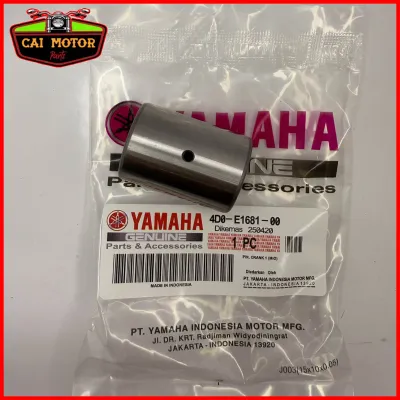
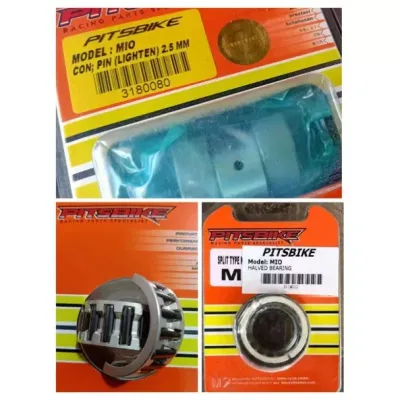
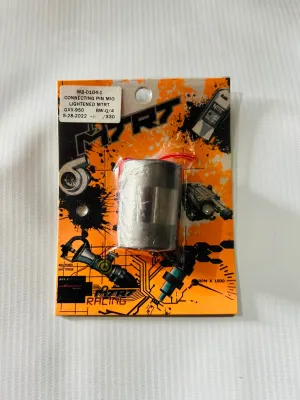
Prices are valid at publication and may change. Please refer to the product page for the latest price.
Key Specifications to Verify for Mio Sporty
To guarantee a precise fit and reliable engine operation, you must verify several key specifications on the product packaging or listing before making a purchase. First and foremost is the Yamaha OEM part number. Yamaha utilizes specific part numbering systems that identify the exact generation and design of the crankshaft assembly; matching this number is the most reliable way to ensure compatibility.

Next, you must perform dimensional checks. Do not rely on generic product descriptions that simply label a part as “standard size” or “Mio Sporty compatible.” Instead, look for listings that explicitly state the outer diameter and overall length in millimeters, and cross-reference these figures with the wear limits and standard dimensions specified in your official Mio Sporty service manual. Even a fraction of a millimeter deviation can prevent the connecting rod bearing from seating correctly or cause the crankshaft webs to bind.
Finally, pay close attention to material and finish labels. High-quality replacement pins undergo specific heat treatment processes, such as induction hardening or carburizing, to withstand constant friction. You should look for clear manufacturer specifications regarding these surface treatments and ignore unverified marketing buzzwords like “racing grade” or “unlimited durability” unless they are backed by official manufacturer documentation or certified material standards.
Checking Compatibility and Engine Variants
The Yamaha Mio Sporty has enjoyed a long and successful production run, but this longevity means the platform has undergone subtle engine updates and revisions over the years. These changes can affect internal clearances, bearing sizes, and crank pin dimensions. Assuming that a part fits all model years can result in purchasing a component that is incompatible with your specific engine block.
To ensure a perfect match, create a checklist of your motorcycle’s details before shopping. Locate the exact model year, engine code, and displacement stamped on your motorcycle’s chassis or engine crankcase. This information allows you to verify if your engine uses the early-generation specifications or the later revised components.
Additionally, never assume universal fitment across different models within the Yamaha Mio family. While the Mio Sporty shares some design philosophies with siblings like the Mio Soul, Mio i 125, or Mio Gravis, their internal engine architectures, stroke lengths, and crankshaft designs differ significantly. Always look for explicit manufacturer cross-compatibility data rather than assuming a part labeled for another Mio variant will fit your Sporty.
Installation and Safety Boundaries
Replacing a crank pin is a highly technical procedure that directly impacts your motorcycle’s safety and performance. Installing internal engine components requires precise clearance measurements, specialized hydraulic press tools to split and reassemble the crankshaft webs, and strict adherence to factory torque specifications. Attempting this repair with basic hand tools or without a dial indicator to check crankshaft runout can result in an imbalanced crankshaft, severe engine vibration, and rapid bearing failure.
If you do not have access to the official Yamaha service manual, lack specialized precision measurement tools like micrometers and dial bores, or find that your engine components show wear beyond visual limits, halt the process immediately. In these situations, you should consult a qualified motorcycle mechanic or a professional engine machining shop to perform the assembly.
Furthermore, never replace a worn crank pin in isolation. You must thoroughly inspect all related components, including the connecting rod, the big-end needle roller bearings, the piston, and the crankshaft webs themselves. If the original pin failed due to oil starvation or normal wear, these adjacent parts are likely damaged as well, and failing to replace them concurrently can lead to catastrophic engine failure on your very first ride.
Frequently Asked Questions (FAQ)
Can I use a standard oversized pin if my connecting rod is worn?
Using an oversized crank pin is not a simple drop-in fix for a worn connecting rod. Installing an oversized pin requires professional machining of the connecting rod journal and the sourcing of specific, manufacturer-approved oversized needle bearings to maintain the correct oil clearance. Forcing an oversized or unverified aftermarket pin into a worn housing without precise machining will cause immediate bearing binding, localized overheating, and eventual engine seizure. If your connecting rod or crankshaft web is severely worn, replacing the entire connecting rod kit or crankshaft assembly is generally the safest and most reliable course of action.
How do I know if the crank pin is the actual cause of my engine noise?
Identifying a failing crank pin typically involves listening for a distinct, deep metallic knocking sound coming from the bottom end of the engine, which often becomes more pronounced under acceleration or when the engine is warm. You may also experience excessive engine vibration through the footboards and handlebars. However, because similar symptoms can be caused by worn piston rings, loose valves, or CVT transmission components, you should never buy replacement parts based on sound alone. The only definitive way to confirm a worn crank pin is to perform a professional engine teardown and use a micrometer to measure the pin’s roundness and clearance against the service manual limits.
Community discussion
Share your experience or ask a question. Comments are reviewed before publication.