
Selecting the correct engine coolant is critical for maintaining the performance and longevity of your Toyota vehicle in the Philippines. With the country’s year-round tropical heat, high humidity, and demanding stop-and-go traffic conditions, your engine’s cooling system operates under constant thermal stress. To protect your engine from overheating, corrosion, and premature component failure, you must match the exact original equipment manufacturer (OEM) coolant specification designated for your vehicle model. Relying on generic “universal” fluids or choosing a product based solely on its color can lead to chemical incompatibility, radiator clogging, and expensive engine repairs. The safest and most reliable approach is to consult your owner’s manual or the under-hood placard to identify whether your vehicle requires Toyota Long Life Coolant (LLC) or Toyota Super Long Life Coolant (SLLC), and to verify that any aftermarket alternative explicitly meets these precise standards.
Understanding Toyota Coolant Specifications
Toyota vehicles utilize highly specialized cooling system designs that require specific chemical formulations to prevent corrosion and cavitation. The manufacturer primarily specifies two types of coolant: Toyota Long Life Coolant (LLC) and Toyota Super Long Life Coolant (SLLC). Understanding the differences between these two formulations is essential for maintaining system integrity and adhering to proper service intervals.
Toyota Long Life Coolant (LLC) is typically red in color and is formulated as a concentrated fluid that requires manual dilution before use. Chemically, it is a non-silicate, non-amine, non-nitrate, and non-borate coolant that relies on organic acid technology combined with phosphates (P-OAT) to protect the metal surfaces inside the engine. This formulation is commonly found in older Toyota models. Because it is a concentrate, it must be mixed with distilled water—ideally in a 50/50 ratio—to achieve the correct balance of freeze protection, boil-over protection, and corrosion inhibition.
Products mentioned in this guide
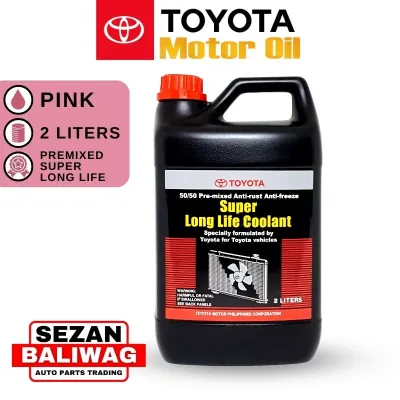
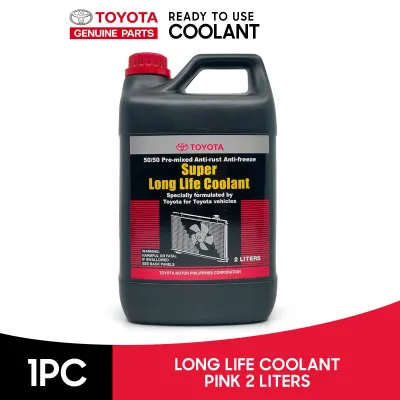
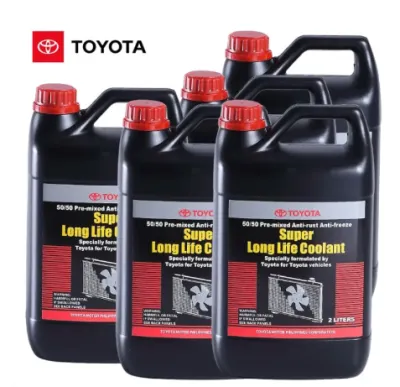
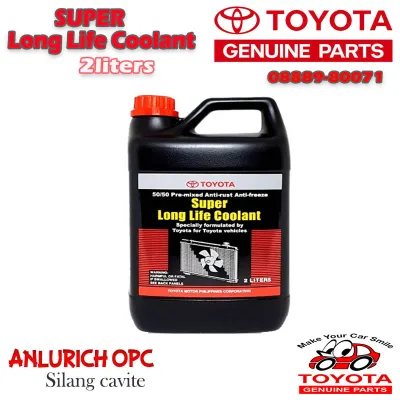
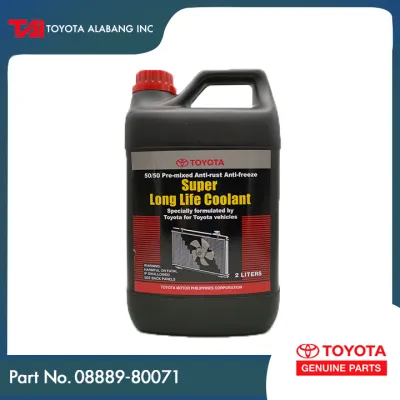
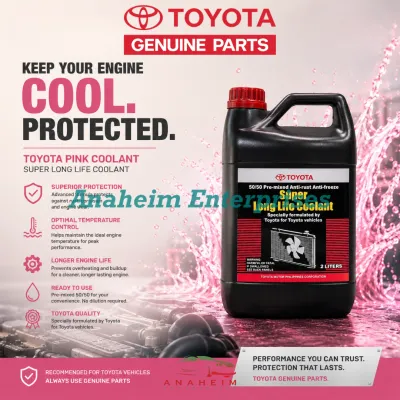
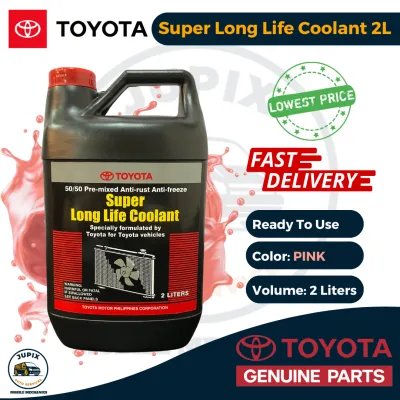
Prices are valid at publication and may change. Please refer to the product page for the latest price.
Toyota Super Long Life Coolant (SLLC) is typically pink in color and comes pre-mixed from the factory at a 50/50 ratio with deionized water. It is formulated with a highly advanced sebacate-based organic acid technology that contains no silicates, borates, nitrites, or amines, but includes specific phosphate inhibitors to protect aluminum components. SLLC is designed for extended service intervals and is standard in modern Toyota vehicles. Because it is pre-mixed, it must never be diluted with additional water, as doing so will weaken the concentration of protective additives and lower the boiling point of the fluid.
While color coding (red for LLC and pink for SLLC) serves as a helpful visual guide for quick identification, you should never rely on color alone when purchasing coolant. Many aftermarket manufacturers dye their fluids red or pink to mimic OEM products, but these fluids may use entirely different chemical bases, such as silicate-based inorganic acid technology (IAT) or hybrid organic acid technology (HOAT). Mixing these incompatible chemistries can cause a chemical reaction that compromises your cooling system. Always verify the exact specification by checking your vehicle’s owner’s manual or looking for the specification label on the coolant reservoir or under-hood placard before adding any fluid to your system.
Key Selection Criteria for Toyota Coolants
When evaluating coolant options in the Philippine market, you must look beyond generic marketing claims. Many products on auto supply shelves are labeled as “universal” or “formulated for all Asian vehicles.” While these products may claim broad compatibility, they often lack the specific balance of phosphates and organic acids required by Toyota’s P-OAT specification. To ensure complete compatibility, look for aftermarket products that explicitly state compliance with Toyota’s OEM standards, such as JIS K2234 (Japanese Industrial Standard) or ASTM D3306, and specifically mention compatibility with Toyota Red or Pink coolant specifications on the product label.

The choice between pre-mixed (50/50) and concentrated coolant is another critical decision point. Pre-mixed coolants offer convenience and eliminate the risk of introducing contaminants into the cooling system. They are blended with highly purified deionized water at the factory, ensuring optimal performance. If you choose a concentrated coolant, you must dilute it yourself using only distilled water. Never use tap water, well water, or mineral water for dilution. The tap water in many parts of the Philippines contains high levels of minerals, including calcium and magnesium. When subjected to the intense heat of an operating engine, these minerals precipitate out of the solution, forming scale deposits on the internal walls of the radiator and engine block. This scale acts as an insulator, severely reducing heat transfer efficiency and eventually leading to localized hot spots, radiator clogging, and engine overheating.
Mixing different coolant chemistries is one of the most common causes of cooling system failure. Toyota’s P-OAT formulation is designed to work in harmony with the specific aluminum, copper, and rubber materials used in Toyota engines. If you mix a phosphate-free organic acid technology (OAT) coolant or a silicate-rich hybrid organic acid technology (HOAT) coolant with Toyota’s formulation, the additives can react chemically. This reaction often results in “gelation,” where the fluid thickens into a jelly-like substance. This gel blocks the narrow passages of the radiator core and heater core, restricts coolant flow, and causes rapid engine overheating. Furthermore, the chemical reaction can deplete the corrosion inhibitors, leaving the metal components of your engine vulnerable to rust, cavitation, and pitting.
Where to Buy Authentic Coolants in the Philippines
Sourcing genuine coolant is critical to protecting your engine, as counterfeit automotive fluids are a persistent issue in the local market. The most reliable source for authentic Toyota coolant is an official Toyota dealership or an authorized service center. Purchasing directly from the dealership guarantees that you are receiving genuine Toyota LLC or SLLC formulated specifically for your vehicle. While dealership prices may be higher than those at independent shops, the assurance of product authenticity and the prevention of catastrophic engine damage justify the cost.
If you choose to purchase from independent auto supply shops or online marketplaces, you must exercise extreme caution. When shopping on ecommerce platforms, look for official brand stores or sellers with high ratings, positive customer reviews, and established track records. Avoid listings that use generic stock photos; instead, look for sellers who provide clear, high-resolution photographs of the actual product labels, batch numbers, and security seals.
To protect yourself from counterfeit products, learn to identify common red flags. Inspect the packaging closely. Genuine Toyota coolant jugs feature high-quality, crisp label printing with clear text, accurate logos, and precise alignment. Counterfeit products often have blurry text, misaligned labels, or spelling errors. Check for a batch number and manufacturing date stamped on the bottle, which should be clearly legible and not easily rubbed off. Ensure the safety seal under the cap is intact and has not been tampered with. Finally, be highly suspicious of unusually low prices. If a 4-liter jug of coolant is being sold at a fraction of the price found at authorized dealerships, it is highly likely to be a counterfeit or diluted product that could severely damage your engine.
Safe Maintenance and Topping-Up Guidelines
Performing cooling system maintenance requires strict adherence to safety protocols to prevent severe personal injury and engine damage. The most critical safety rule is to never open the radiator cap or the coolant reservoir cap when the engine is hot or warm. The cooling system operates under high pressure, and the fluid inside can reach temperatures well above the boiling point of water. Opening the system while hot will cause the pressurized fluid to instantly boil and spray out, leading to severe steam burns to your face, hands, and body. Always allow the vehicle to sit idle for several hours until the engine block and radiator are completely cold to the touch before attempting any maintenance.
When topping up a slightly low coolant reservoir, always use the exact same coolant specification currently in the system. If your vehicle is filled with pink SLLC, top it up only with pink SLLC. Do not add water to a pre-mixed coolant system, as this dilutes the protective additives. If you must top up a system that uses concentrated red LLC, ensure you use a pre-diluted 50/50 mixture of LLC and distilled water. Keep a clean funnel dedicated solely to cooling system fluids to prevent introducing dirt, grease, or engine oil into the reservoir.
While minor fluid loss over extended periods can occur due to natural evaporation, frequent drops in the coolant level indicate an underlying issue. You must establish clear stop conditions where you cease DIY top-ups and consult a qualified professional mechanic. If you find yourself constantly adding coolant, if you notice visible puddles of pink or red fluid under your vehicle, or if the coolant in the reservoir appears severely discolored, cloudy, or has a milky texture (which indicates engine oil contamination), do not continue driving. These symptoms point to leaks, radiator damage, or a blown head gasket, all of which require immediate professional diagnostic assessment and repair to prevent catastrophic engine failure.
Frequently Asked Questions (FAQ)
Can I use distilled water to top up my Toyota coolant in an emergency?
Yes, you can use distilled water to top up your cooling system in an emergency situation to prevent immediate engine overheating. If you notice the temperature gauge rising and find the coolant level dangerously low, adding distilled water is a safe temporary measure to get you to a service station. However, this dilutes the concentration of corrosion inhibitors and lowers the boiling point of the mixture. You should have the cooling system flushed and refilled with the correct pre-mixed Toyota coolant specification as soon as possible to restore full corrosion and boil-over protection. Never use tap water or mineral water, even in an emergency, as the mineral content will quickly form scale deposits inside your radiator.
Is it safe to mix different coolant colors in my Toyota engine?
No, it is not safe to mix different coolant colors, nor is it safe to assume that matching colors guarantees compatibility. Coolant manufacturers use various dye colors to distinguish their products, but there is no universal industry standard linking color to chemical composition. For example, a red coolant from an aftermarket brand might use a silicate-heavy formulation that is chemically incompatible with Toyota’s phosphate-organic acid technology (P-OAT) red coolant. Mixing incompatible formulations can trigger a chemical reaction that forms a thick gel, clogging your radiator tubes, water pump, and engine passages, leading to severe overheating and costly repairs. Always select coolant based on the explicit specification listed in your owner’s manual rather than the color of the fluid.
How often should I flush and replace the coolant in my Toyota?
The interval for flushing and replacing your coolant depends entirely on the specific formulation used in your vehicle and is detailed in your owner’s manual. Generally, Toyota Super Long Life Coolant (SLLC) has a very long service life, often requiring its first replacement at 160,000 kilometers or 10 years, and every 80,000 kilometers or 5 years thereafter. Toyota Long Life Coolant (LLC) typically requires more frequent replacement, often every 40,000 kilometers or 2 years. However, operating your vehicle under severe driving conditions—such as frequent idling in heavy city traffic, towing, or driving in high-temperature tropical environments like the Philippines—can accelerate fluid degradation. You should inspect your coolant condition regularly and perform a professional flush earlier if you observe cloudiness, rust particles, or discoloration.

Community discussion
Share your experience or ask a question. Comments are reviewed before publication.